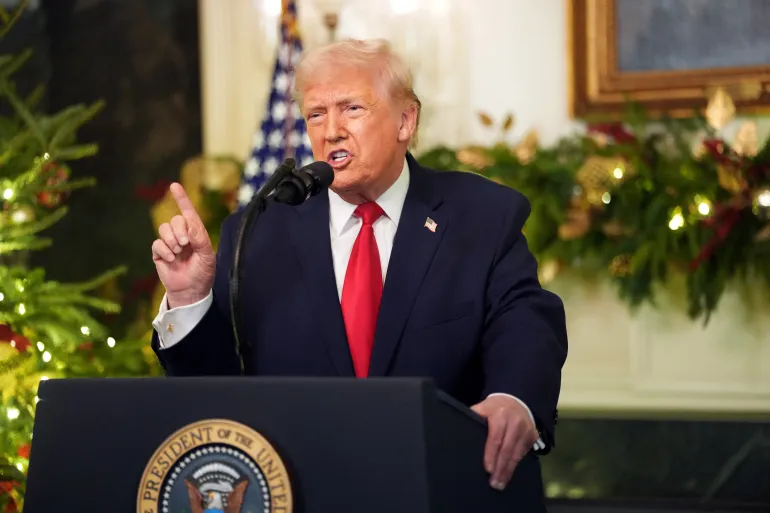
In his first prime-time address from the White House since authorizing military strikes in Iran last June, President Donald Trump attempted to recast himself as the steward of an economic revival. Yet Wednesday night’s 17-minute televised speech—pitched as an update on America’s “economic comeback”—felt less like a fiscal roadmap and more like an early stump speech for 2026. Its rhythm, rhetoric, and rewards were quintessentially Trumpian: boastful, combative, and calibrated for campaign optics rather than policy credibility.
Trump opened his remarks with a sweeping claim that his administration had tamed inflation, secured the border, and restored “American respect” on the world stage. “Our nation is strong… stronger than ever before,” he declared, promising unprecedented growth “the likes of which the world has never seen.” For a White House address ostensibly about the economy, it leaned heavily into political self-congratulation and partisan blame.
A familiar villain: Democrats and “the inherited mess”
The president repeated a refrain that defined both his 2016 and 2020 campaigns: that Democrats are solely responsible for Americans’ economic anxiety. “It’s not the Republicans’ fault. It’s the Democrats’ fault,” Trump said flatly, calling his predecessors hypocrites for using affordability as a “cudgel” while, in his view, creating the very conditions for inflation and rising costs.
This line of attack resonates with his loyal base but sidesteps the complex mix of global supply shocks, post-pandemic labor dynamics, and monetary tightening that economists cite as key drivers of America’s recent inflationary cycle. Blaming Democrats might serve as a political adhesive, uniting an anxious conservative bloc under a simple narrative of externalized fault, but it lacks empirical grounding. According to a December Quinnipiac poll, only one-third of Americans rated the economy as “excellent” or “good,” a figure at odds with Trump’s “A-plus-plus-plus” self-assessment.
Inflation cools, but affordability lingers
Trump’s claim that “inflation has stopped” carries partial truth. Inflation has slowed significantly from post-pandemic highs, and wage growth has outpaced price increases in several quarters. But as the most recent Department of Labor data show, unemployment has crept up to 4.6%—the highest since 2021—and consumers still report persistent strains in basic affordability. A poll conducted in November found nearly half of Americans struggling to afford essentials such as food, housing, and healthcare.
That tension—between macroeconomic stabilization and microeconomic pain—explains why the president’s rosy outlook risks falling flat beyond his rally crowds. Charts flashing across the television feed showed falling prices for gas and groceries, yet Americans aren’t necessarily feeling better off. This gap between statistical recovery and lived experience has haunted administrations of both parties; what’s novel for Trump is how bluntly he disregards that dissonance.
The populist cheque: policy showmanship at work
The president’s headline promise—to send $1,776 checks to active-duty troops financed by tariff revenues—was pure political theater. It wrapped patriotic symbolism (the $1,776 figure alluding to American independence) around dubious fiscal arithmetic. Those same tariff revenues have already been earmarked in Trump’s other populist pledges: a $2,000 “tariff dividend” for all Americans and a new bailout for farmers affected by trade disruptions. The lack of congressional appropriation makes these commitments aspirational at best, misleading at worst.
Yet politically, the gesture matters. Trump’s economic messaging has always leaned on visible, transactional rewards rather than structural policy: checks, grants, or tax refunds that voters can immediately associate with his administration. The “tariff dividend” recalls his 2019 trade war playbook, when he cast tariffs not as taxes on consumers but as redistributive patriotism. Economically it’s dubious; electorally, it’s effective symbolism.
Contrasts within the Republican ticket
Perhaps the most revealing contrast came not between Trump and Democrats, but within his own party. A day before the speech, Vice President JD Vance delivered a markedly different message in Pennsylvania. Vance’s tone was empathetic, recalling what it felt like to choose “between putting food on the table and filling a prescription.” His “kitchen-table conservatism” was designed to humanize Republican economics in struggling Rust Belt communities.
Trump, by comparison, opted for triumphalism over empathy. His brisk delivery from the Diplomatic Room was intended to project vigor and control—but it underscored, once again, his detachment from the everyday anxiety driving voter discontent. Where Vance offers relatability, Trump doubles down on bravado. Within GOP circles, this divergence reflects a strategic debate ahead of the midterms: should the party lead with grievance or empathy?
Housing
One of the few forward-looking elements in Trump’s address was his preview of “aggressive housing reform” to come in early 2026. He vowed to appoint a new Federal Reserve chair who would lower interest rates to ease mortgage burdens. For many Americans, this promise targets the single most visible affordability issue today: housing. But it also places Trump on a collision course with the Fed’s institutional independence.
Any overt political hand in interest-rate policy risks undermining years of efforts to insulate monetary decisions from short-term partisan gain. Even conservative economists have cautioned that strong-arming the Fed toward rate cuts could reignite inflationary pressures—precisely the outcome Trump claims to have already defeated.
Political stakes: the affordability election
This economic address also functioned as a signal to nervous Republicans after a string of lackluster results. Democratic victories in recent New Jersey and Virginia gubernatorial races, both fought on affordability, have rattled the GOP. In Tennessee, a district Trump won by 22 points in 2024 shrank to a nine-point Republican margin in a December special election where cost-of-living dominated voter concerns.
Against this backdrop, Trump’s optimism aims to revive confidence in Republican stewardship. Yet simply declaring that “America is back” risks alienating the very swing voters who feel left out of the rebound. The upcoming midterms could hinge not on whose metrics appear rosier, but on which party articulates the emotional truth of economic insecurity more authentically.
Prosperity as perception
Ultimately, Trump’s address reveals a presidency running on parallel tracks: one narrative projects unstoppable resurgence; the other grapples with a fatigued electorate wary of political hyperbole. His insistence that “the border is secure,” “inflation has stopped,” and “prices are down” builds an image of restoration rather than realism. That framing might energize his base—but absent tangible relief, it risks sounding like victory laps on a half-built track.
For Trump, success has always been performative as much as substantive. Wednesday’s message was no exception: a televised affirmation that optics still matter more than outcomes. As the midterms near, the test will be whether Americans—still calculating grocery bills and rent hikes—are willing to believe that prosperity is just a matter of perception.