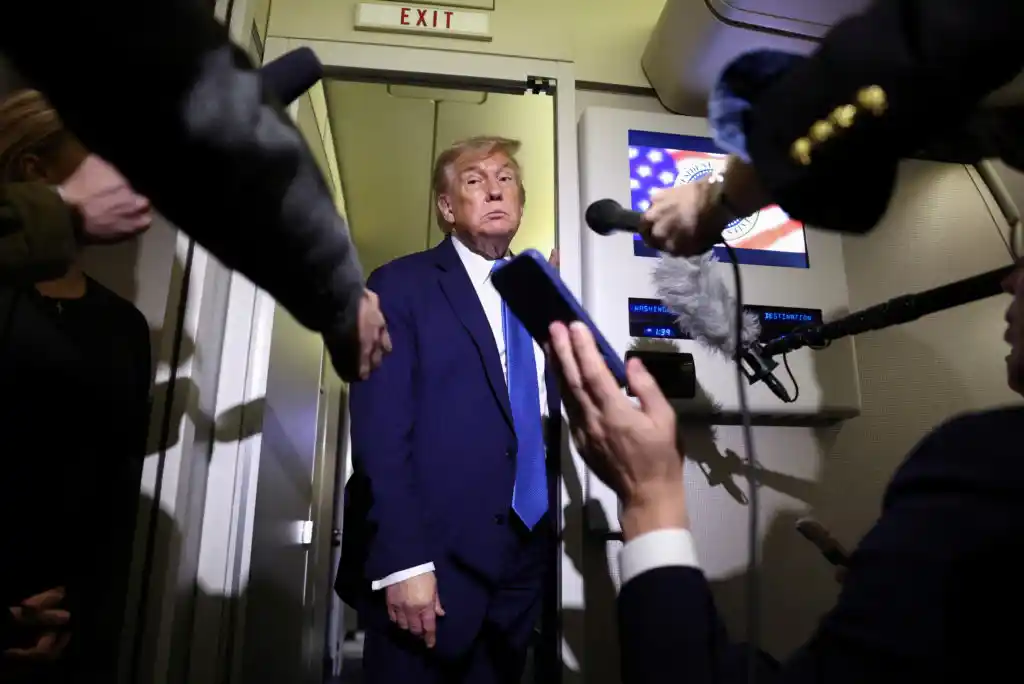
When Donald Trump declared that the United States was “locked and loaded” to defend Iranian protesters against their own government, it was vintage Trump: bombast wrapped in moral outrage, broadcast directly on his social media platform. Yet beyond the hyperbole lies a serious geopolitical question: what happens when American threats of military action intersect with a moment of genuine domestic upheaval in one of the Middle East’s most volatile states?
Six months after his administration’s strike on Iranian nuclear facilities, Trump’s latest warning marks the resurfacing of a deeply-rooted American impulse—to cast itself as liberator in moments of foreign oppression. But in Iran’s case, the rhetoric is as dangerous as it is familiar. The domestic protests unfolding across several Iranian cities are an organic expression of public anger over spiraling inflation, unemployment, and decades of authoritarian rigidity. The specter of American intervention risks transforming these demonstrations from a homegrown demand for accountability into a proxy battlefield for foreign agendas.
Iran’s latest wave of demonstrations began on December 28, sparked by economic frustration but sustained by something deeper—a collective fatigue with clerical rule and its inability to deliver material stability. For many young Iranians, the Islamic Republic’s promises of justice and independence have curdled into slogans of self-preservation for the elite. Reports of six or seven civilian deaths may seem limited in number, but they underscore a dangerous cycle of state repression that has characterized Iran’s response to dissent since 2009.
Economically, the regime stands cornered. U.S. sanctions, internal corruption, and structural mismanagement have hollowed out industries and wiped out savings. Politically, factionalism within the clerical establishment is widening, as evidenced by discreet power struggles around Ayatollah Ali Khamenei’s succession. Against this backdrop, Trump’s declaration arrives not as a lifeline for protesters but as a complication to their cause.
The Return of “America the Rescuer”
For Trump, the logic is simple and politically potent. Casting himself as the global defender of freedom plays well to his base at home, especially amid an election year narrative built around strongman diplomacy. His statement—“If Iran violently kills peaceful protesters, the United States will come to their rescue”—evokes both moral clarity and militaristic bravado. The phrase “locked and loaded,” recycled from earlier moments of confrontation with Iran and North Korea, dramatizes American readiness without necessarily committing to immediate action.
But the history of U.S. intervention in West Asia is littered with cautionary tales. From Iraq to Afghanistan to Libya, the promise of liberation often degenerated into prolonged instability, civilian suffering, and regional chaos. Ali Shamkhani, adviser to Supreme Leader Khamenei, captured this sentiment sharply in his rebuttal: “The people of Iran are well acquainted with the experience of Americans coming to the rescue.” Indeed, the memory of foreign meddling—spanning from the 1953 CIA-backed coup to the 1988 U.S. naval downing of an Iranian passenger plane—remains seared into the Iranian psyche. For many Iranians, even those critical of their government, overt American threats risk delegitimizing the protests they support.
A Calculated Duel of Rhetoric
Both sides understand the stakes of perception. For the Iranian regime, framing the protests as an American-backed conspiracy helps justify repression under the banner of defending national sovereignty. For Trump, amplifying Iran’s turmoil bolsters his narrative of strength abroad and defiance against “weak” globalist diplomacy. Each actor, in effect, relies on the other to reinforce their domestic legitimacy.
Yet this exchange of threats arrives in a different geopolitical context than in years past. Washington’s unilateral dominance in the Middle East has eroded; regional power now pivots through a complex web of Chinese mediation, Gulf pragmatism, and shifting Russian engagement. The Abraham Accords, while still operational, coexist uneasily with Arab caution over another U.S.-Iran crisis. Meanwhile, Tehran has carefully calibrated its survival strategy through asymmetric power projection—arming proxies, building regional deterrence, and exploiting Western fatigue with prolonged conflict.
In this environment, any American hint of direct intervention risks triggering a cascade of miscalculations. Iran’s Revolutionary Guards, already under pressure to show strength, could escalate against U.S. positions in Iraq, Syria, or the Persian Gulf. Israel, emboldened by earlier White House endorsement of its potential strike, might read Trump’s comments as a green light for unilateral action. Even limited confrontations could spiral rapidly beyond control.
Between Moral Posture and Strategic Prudence
There is an undeniable moral dimension to Trump’s statement. Few would dispute that Iran’s protesters—many of them women, students, and workers—deserve global solidarity in their struggle for basic freedoms. But solidarity does not require airstrikes. If Washington truly seeks to stand with the Iranian people, it must do so through sustained diplomacy, humanitarian support, and information access, not through the threat of another war.
The real test of American credibility lies in consistency. Successive U.S. administrations have often conflated democracy promotion with regime change, leaving reformist movements abroad vulnerable to association with foreign agendas. The Biden administration’s cautious tone in the aftermath of the 2022 Mahsa Amini protests offered a contrast, focusing on sanctions against rights violators rather than military rhetoric. Trump’s return to maximalist language signals not just a policy shift, but a reassertion of an old Washington reflex—to conflate empathy with intervention.
Inside Iran, the government’s reaction to Trump’s warning will likely follow a familiar script. State media will condemn Western interference, security forces will tighten control, and officials will seek to rally nationalist sentiment. Yet beneath the surface, such pressure may deepen the regime’s legitimacy crisis. Public disenchantment is already widespread, and even staunch defenders of the revolution quietly acknowledge that economic grievances are eroding the ideological core that once sustained the Islamic Republic.
For ordinary Iranians, however, the calculus is tragically simple. They neither need nor trust another foreign savior. What they seek is agency—a chance to determine their political and economic future without becoming pawns in a geopolitical chessboard. The task of reform or resistance, as many activists have argued, must remain Iranian in character, even if it benefits from global attention.
Ultimately, Trump’s declaration is less a prelude to war than an act of political theater. It reasserts American power in words while offering little policy coherence in deeds. But every rhetorical escalation narrows the space for diplomacy and amplifies the risk of misinterpretation. In a region already strained by proxy conflicts and mistrust, words alone can ignite consequences far beyond their intent.
As protests flicker across Iran’s streets, the world faces a familiar dilemma: how to support a people’s cry for justice without drowning it in the noise of great-power rivalry. The answer lies not in being “locked and loaded,” but in being patient and principled—recognizing that real change, when it comes, rarely arrives on the wings of foreign intervention, but through the costly, courageous persistence of those who fight for it from within.