Minnesota has always presented itself as a quiet exemplar of American civic life: polite, pragmatic, progressive in measured ways, with a reputation for good government and high voter turnout. The state boasts an enviable quality of life, clean lakes, strong schools, a robust social safety net, and its residents have long cultivated an image of Midwestern reasonableness. Yet beneath this placid surface, Minnesota has become something far more consequential: the nation’s most vivid microcosm of its deepening political fracture. In an era when red and blue America seem to inhabit parallel realities, Minnesota is “perfectly purple”, neither safely Democratic nor convincingly Republican, placing it squarely in the bull’s-eye of the country’s frayed and fractured politics.
This purple identity is no accident. It emerges from a geography and demography that mirror the nation’s own divides. The Twin Cities metropolitan area, home to Minneapolis and St. Paul, is a diverse, educated, increasingly cosmopolitan hub. It is the engine of Democratic strength, bolstered by progressive policies on labor, education, and social issues, and by sizable communities of color, including one of the largest Somali-American populations in the country. Beyond the metro, Greater Minnesota, rural counties, the Iron Range, agricultural heartlands, leans conservative, rooted in traditions of hard work, resource extraction, and skepticism toward coastal elites. These areas once supported strong unions and New Deal Democrats; today, many voters respond to Republican appeals on trade protectionism, energy independence, and cultural traditionalism.
Electorally, the pattern has held for decades. Minnesota is the last state never to have voted for Ronald Reagan in 1984 (thanks to native son Walter Mondale), and it has backed every Democratic presidential nominee since. But the margins tell a different story. In 2024, Kamala Harris won the state by just four points, 51 percent to Donald Trump’s 47 percent, despite Tim Walz, the sitting governor, serving as her running mate. That was narrower than Biden’s seven-point victory in 2020, signaling a subtle but persistent rightward drift. At the state level, the legislature has been a near-constant knife-edge contest. After the 2024 elections, the Minnesota House settled into a virtual tie, 67-67 after special elections and legal wrangling, necessitating power-sharing arrangements that are rare in American politics. The Senate remains narrowly Democratic-Farmer-Labor (DFL), but slim majorities force constant negotiation. Gridlock on divisive issues coexists with grudging compromise on others, a reminder that purple governance, while functional, is exhausting.
What has elevated Minnesota from a mere battleground to the symbolic center of American division is the convergence of national fault lines here with unusual ferocity. The state’s long-standing refusal to fully cooperate with federal immigration enforcement, its sanctuary-like policies and limits on local law-enforcement collaboration, made it a prime target when Donald Trump returned to the White House in 2025. In early 2026, the administration launched Operation Metro Surge, described by the Department of Homeland Security as the largest immigration enforcement operation in U.S. history. Thousands of ICE and Border Patrol agents flooded the Twin Cities, conducting door-to-door raids and vehicle stops in residential neighborhoods.
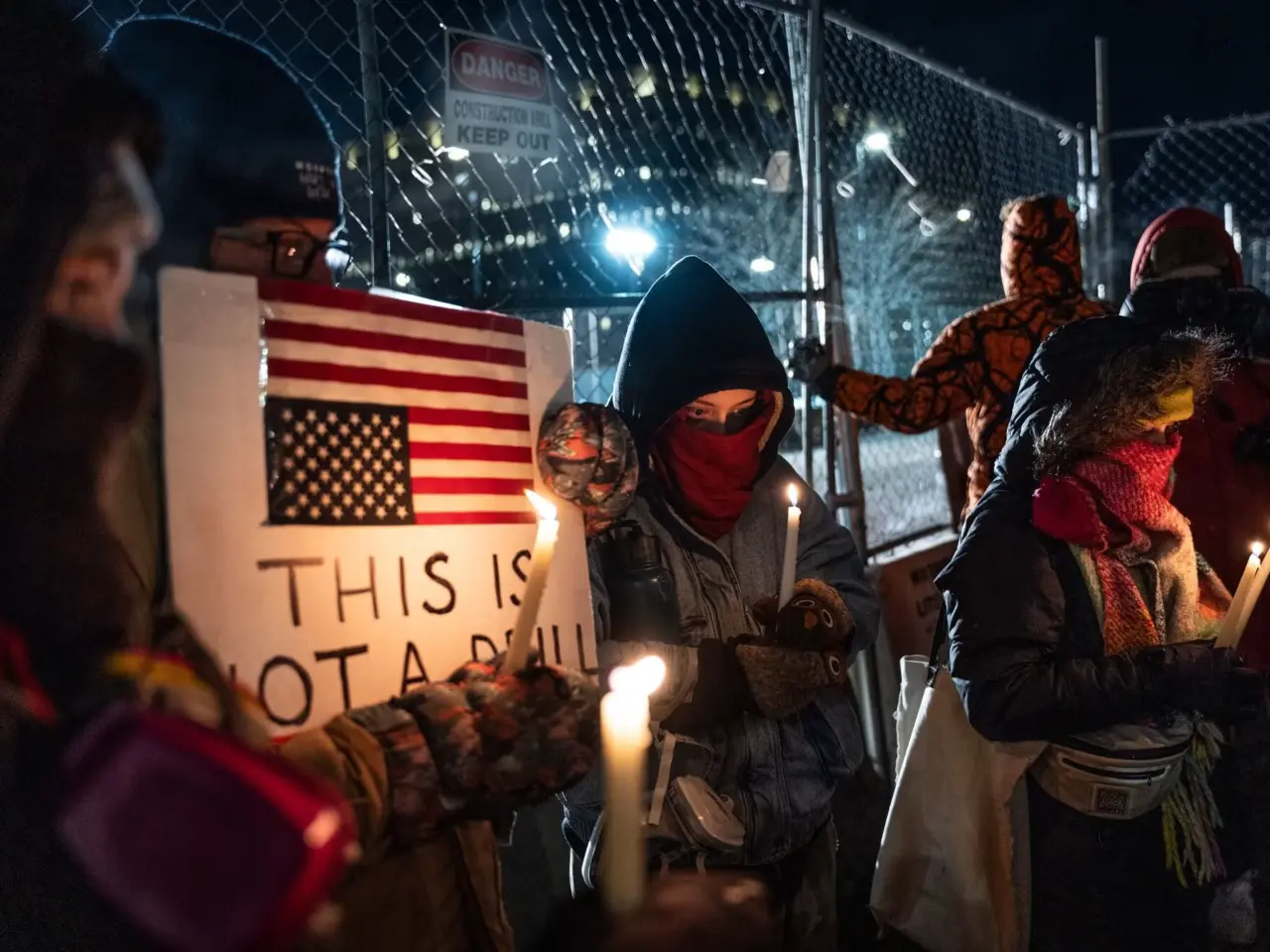
What began as enforcement quickly spiraled into tragedy. On January 7, 2026, ICE agent Jonathan Ross fatally shot Renée Nicole Good, a 37-year-old U.S. citizen, poet, and mother of three, in south Minneapolis. Bystander videos showed Good attempting to drive away from masked agents surrounding her car; federal officials claimed self-defense after she allegedly tried to run over an officer. The footage suggested otherwise, Good’s vehicle appeared to be maneuvering to escape rather than attack, yet the administration labeled the incident an act of “domestic terrorism.” Protests erupted almost immediately, echoing the unrest that followed George Floyd’s murder in the same city just six years earlier.
The violence did not stop there. On January 24, federal agents shot and killed Alex Jeffrey Pretti, another 37-year-old U.S. citizen and VA intensive-care nurse, during an anti-ICE demonstration. At least two agents opened fire, with videos capturing the chaos of tear gas, flashbangs, and confrontations. These were not isolated incidents; reports documented multiple shootings involving immigration agents nationwide since mid-2025, but Minnesota’s cases drew particular outrage because the victims were American citizens not targeted for deportation. Governor Walz condemned the operations as overreach, Mayor Jacob Frey demanded ICE leave the city, and protests spread from Minneapolis to other urban centers. National Guard troops were placed on standby, schools closed, and the state became a flashpoint for debates over federal power, use of force, and the human cost of mass deportation policies.
The political fallout has been profound. Democrats portray the crackdown as punitive retaliation against a state that refused to bend, punishment for remaining purple rather than turning reliably red. Republicans and the Trump administration frame it as necessary enforcement against sanctuary policies that shield criminals. The incidents have deepened mistrust: local officials accuse federal agents of recklessness, while DHS officials criticize Minnesota leaders for inciting resistance. Even as talks between state officials and federal border czar Tom Homan have hinted at possible de-escalation, contingent on greater local cooperation, no resolution has emerged. The episode has exposed how immigration, once a policy debate, has become a visceral symbol of national rupture.
This is not Minnesota’s first brush with national symbolism. The George Floyd protests of 2020 turned the state into a global focal point for racial justice. The 2024 election saw it as a surprisingly competitive holdout in the Midwest. Now, in 2026, it stands as a laboratory for the second Trump era’s most ambitious, and controversial, domestic policy. The state’s divided government mirrors the nation’s: slim majorities, forced bipartisanship, and constant tension between executive ambition and local resistance. Walz, battered by unrelated fraud scandals in state programs and declining to seek reelection, has declared he will never run for office again. Senator Amy Klobuchar has entered the gubernatorial race, positioning herself as a unifier against Trump-era tactics. The 2026 elections, for governor, legislature, and possibly open Senate seats, will test whether purple fatigue leads to realignment or entrenchment.
Minnesota’s predicament is America’s in miniature. In a polarized country, the states that refuse easy categorization become the arenas where conflicts play out most intensely. Purple places force confrontation with uncomfortable truths: that no side can govern without the other, that federal power can feel like occupation when it clashes with local values, and that the human stakes of policy fights are rarely abstract. The shootings in Minneapolis were not inevitable, but they were foreseeable in a nation where immigration enforcement has been weaponized as political theater.
Yet there is something stubbornly resilient about Minnesota. Its civic culture, high trust, volunteerism, a tradition of pragmatic compromise, has not vanished. Even amid protests and recriminations, power-sharing in the legislature continues, and residents still pride themselves on neighborliness. The state may be the bull’s-eye, but it is also a reminder that division is not destiny. If America is to heal its fractures, it might look to places like Minnesota, not for easy answers, but for the difficult, daily work of living together across lines that refuse to disappear.
References and Further Reading
- Minnesota Secretary of State. (2024). 2024 general election results. https://www.sos.mn.gov/elections-voting/election-results/2024/2024-general-election-results
- Wikipedia contributors. (2025). 2024 United States presidential election in Minnesota. Wikipedia. https://en.wikipedia.org/wiki/2024_United_States_presidential_election_in_Minnesota
- Wikipedia contributors. (2026). 2024 Minnesota House of Representatives election. Wikipedia. https://en.wikipedia.org/wiki/2024_Minnesota_House_of_Representatives_election
- FOX 9 Minneapolis-St. Paul. (2026, January 27). Special election keeps MN House tied 67-67 heading into legislative session. https://www.fox9.com/news/special-election-results-house-tied-legislative-session-jan-2026
- Wikipedia contributors. (2026). Operation Metro Surge. Wikipedia. https://en.wikipedia.org/wiki/Operation_Metro_Surge
- Vera Institute of Justice. (2026, January 21). The ICE killing of Renee Nicole Good is a watershed moment for Trump. https://www.vera.org/explainers/the-ice-killing-of-renee-nicole-good-is-a-watershed-moment-for-trump
- CNN. (2026, January 8). Mother of 3 who loved to sing and write poetry shot and killed by ICE in Minneapolis. https://www.cnn.com/2026/01/08/us/renee-nicole-good-minneapolis-ice-shooting-hnk
- Wikipedia contributors. (2026). Killing of Renée Good. Wikipedia. https://en.wikipedia.org/wiki/Killing_of_Ren%C3%A9e_Good
- Wikipedia contributors. (2026). Killing of Alex Pretti. Wikipedia. https://en.wikipedia.org/wiki/Killing_of_Alex_Pretti
- NPR. (2026, January 29). Border czar says he plans to “draw down” ICE and CBP operations in Minnesota. https://www.npr.org/2026/01/29/nx-s1-5693019/border-czar-plans-to-draw-down-ice-and-cbp-minnesota
- PBS NewsHour. (2026). Minneapolis community defies ICE to warn immigrants of approaching agents. https://www.pbs.org/newshour/nation/minneapolis-community-defies-ice-to-warn-immigrants-of-approaching-agents
- City of Minneapolis. (2026, January 12). State of Minnesota, Minneapolis and Saint Paul sue to halt ICE surge into Minnesota. https://www.minneapolismn.gov/news/2026/january/ag-lawsuit
- U.S. Department of Homeland Security. (2026, January 19). ICE continues to remove the worst of the worst from Minneapolis streets as DHS law enforcement marks 3,000 arrests during Operation Metro Surge. https://www.dhs.gov/news/2026/01/19/ice-continues-remove-worst-worst-minneapolis-streets-dhs-law-enforcement-marks-3000