The Munich Security Conference (MSC) 2026 has once again proven its role as the premier venue for confronting the world’s gravest security challenges. This year, amid the ongoing Russian aggression in Ukraine, escalating nuclear saber-rattling from Moscow, and profound uncertainties about the durability of American commitments under a second Trump administration, discussions on nuclear deterrence have surged to the forefront. European leaders, experts, and officials are openly debating options long considered taboo: how—or whether—Europe can reduce its near-total reliance on the U.S. nuclear umbrella and forge a more autonomous or complementary deterrent posture.
The catalyst is clear. Russia’s invasion of Ukraine, now in its fifth year, has featured repeated nuclear threats, including the deployment of systems like the Oreshnik missile to Belarus and tests of advanced nuclear-capable platforms. These actions have shattered post-Cold War complacency, reminding Europeans that nuclear coercion remains a live tool of statecraft. Compounding this is doubt about U.S. extended deterrence. Statements from Washington questioning alliances, burden-sharing, and even ideological divergences with Europe have fueled fears that the transatlantic nuclear guarantee—central to NATO since the 1950s—may not be ironclad indefinitely.
A pivotal contribution to the debate came from the European Nuclear Study Group, whose report “Mind the Deterrence Gap: Assessing Europe’s Nuclear Options”—released just before the MSC and presented there—warns of a looming “dangerous deterrence gap.” The multinational experts evaluate five pathways: (1) continued dependence on U.S. extended deterrence; (2) bolstering the role of British and French nuclear forces in European defense; (3) creating a common European deterrent; (4) pursuing new independent national programs; and (5) emphasizing conventional capabilities alone. The report concludes that strategic complacency is no longer viable; Europeans must confront nuclear realities head-on, investing resources and political will to avoid vulnerability.
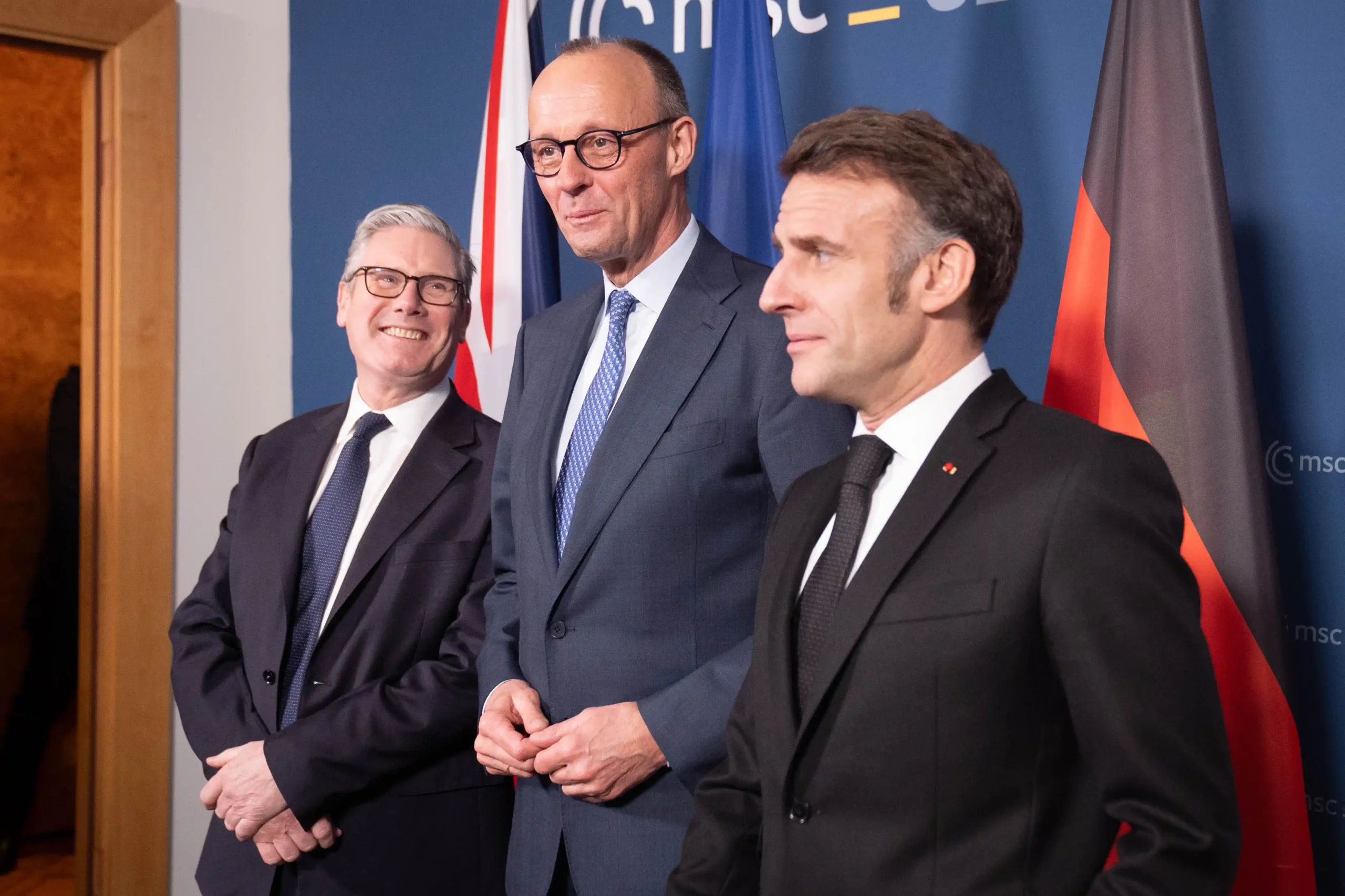
High-level speeches amplified this urgency. German Chancellor Friedrich Merz, opening the conference, declared that U.S. leadership “is being challenged, maybe even already lost,” and revealed confidential talks with French President Emmanuel Macron on “European nuclear deterrence.” Merz framed these as embedded within NATO’s nuclear sharing, adhering to Germany’s non-proliferation obligations, but the admission marked a seismic shift for Berlin—historically reticent on nuclear matters beyond hosting U.S. weapons. Macron, consistent with prior overtures, emphasized Europe’s need to become a “geopolitical power” and spoke of a “holistic” approach to deterrence, including consultations on France’s nuclear role with partners. He reiterated that France’s force de frappe serves vital European interests, though ultimate decisions remain sovereign.
Support for exploring European options extended beyond the Franco-German axis. Officials from Baltic states expressed openness to discussing Europe’s role, while viewing NATO as the cornerstone. Britain’s involvement in trilateral meetings with France and Germany hinted at potential coordination between Europe’s two existing nuclear powers. Yet divisions persist: Spanish Prime Minister Pedro Sánchez warned against nuclear rearmament, advocating “moral rearmament” through values and multilateralism instead.
This “nuke-talk” reflects deeper strategic anxieties. Europe’s conventional buildup—spurred by Ukraine—addresses one dimension of deterrence, but lacks the escalatory ladder that nuclear weapons provide against a nuclear-armed adversary like Russia. Relying solely on U.S. guarantees risks decoupling if American priorities shift toward Asia or domestic retrenchment. Strengthening Franco-British roles (Option B in the report) offers a pragmatic bridge: France’s roughly 290 warheads and Britain’s 225 could, with enhanced consultation and planning (building on recent UK-France coordination pledges), extend credible coverage without new proliferation. A fully common European deterrent (Option C) would demand unprecedented integration—shared command, targeting, and decision-making—posing immense political and technical hurdles. Independent national programs (Option D) invite proliferation risks, NPT violations, and alliance fractures.
Critics argue that amplifying nuclear discourse heightens escalation dangers and undermines arms control. Others contend that ignoring the gap invites coercion or worse. The reality is that deterrence works through credibility; perceived doubts in U.S. resolve could embolden adversaries while fracturing Alliance cohesion.
The MSC debates underscore a maturing Europe. For decades, nuclear strategy was outsourced to Washington. Now, facing a multipolar nuclear landscape—with Russia modernizing, China expanding, and proliferation risks growing—Europe must think independently without discarding transatlantic bonds. NATO Secretary General Mark Rutte clarified that no one seeks to replace the U.S. umbrella, only to reinforce collective deterrence.
The path forward lies in pragmatic steps: deeper Franco-German-British dialogue, joint exercises incorporating nuclear scenarios, and transparent consultations with NATO allies. Investing in dual-capable conventional systems could complement, not substitute, nuclear elements. Above all, Europeans must demonstrate unity and resolve—signaling to both adversaries and allies that the continent will not be caught strategically naked.
The heating nuke-talk in Munich is not alarmism; it is overdue realism. In an era where the old order crumbles, Europe cannot afford to outsource its ultimate security. Confronting nuclear choices now, however uncomfortable, is the price of preserving peace tomorrow.