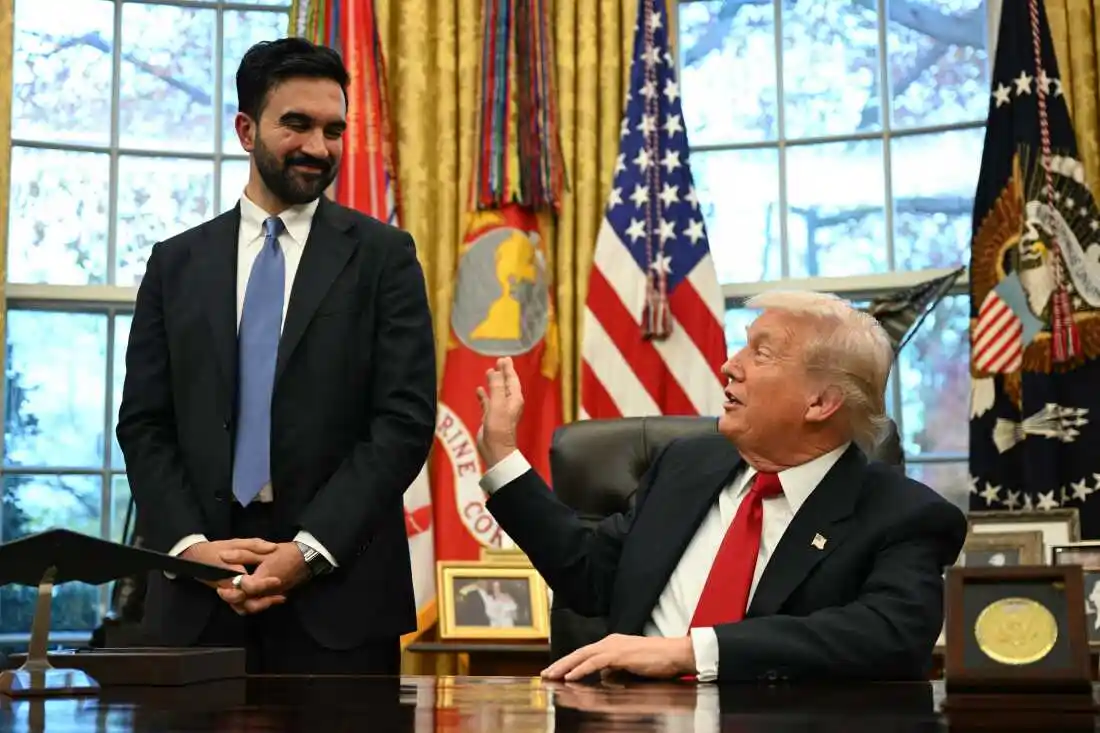
The Oval Office played host to one of the more unexpected theatrical episodes of contemporary American politics: an encounter between President Donald Trump and Zohran Mamdani, the freshly minted mayor-elect of New York City, a youthful figure who seemed, at first glance, a study in contradictions. Their meeting was less a clash of titans than a curious choreography of civility and political performance that left spectators pondering what it reveals about the elastic, and often surreal, state of American governance.
This is amazing. Kudos to Trump & Mamdani on coming together. We need more of this. @ZohranKMamdani @realDonaldTrump pic.twitter.com/NpEBxNJiPL
— Piers Morgan (@piersmorgan) November 21, 2025
The narrative arc leading up to this meeting was suffused with rancor. Mamdani, a Democratic Socialist of immigrant heritage and a former activist turned politician, had emerged as a vibrant symbol of progressive hope in one of the nation’s most complex urban ecosystems. He campaigned on a platform of affordability, equity, and radical reform—values that, from Washington’s conservative vantage point, might appear as ideological threats. Trump, known for his blunt rhetoric and polarizing governance, had not been subtle in his antipathy; he labeled Mamdani a “communist,” and at times, resorted to insinuations questioning his legitimacy as mayor-elect. The mutual hostility was palpable both online and in offline political discourse.
Yet, when the cameras rolled in the White House, the scene was something quite different. Rather than antagonists, the two seemed more akin to reluctant conversationalists caught under the glare of public scrutiny. The language was polite, even warm at times. Trump repeatedly praised Mamdani for his agenda on housing and his decision to retain the existing police commissioner, a nod to continuity that seemed designed both to flatter the incoming mayor and reassure skeptical constituencies. When reporters queried Mamdani about his past comments branding Trump as a “fascist,” the moment shimmered with paradoxical levity. Trump suggested Mamdani simply say “yes” to avoid complications, sharing a laugh that seemed both genuine and performative. Mamdani, to his credit, acquiesced, smiling but hardly softened in his views.
This exchange typified the layered theatrics of modern American power. The dissonance between substance and spectacle was on full display. Behind the mutual smiles lay unresolved tensions—threats from the federal government to withhold essential funds, ongoing debates about policing reform, and the enduring fissures in national dialogue over race, immigration, and governance. The political theatre played out, not to mask these issues, but rather to frame them in a manner palatable to a turbulent electorate.
Mamdani’s approach during the meeting was a careful balancing act. Aware of his progressive base’s scrutiny, he repeatedly emphasized the dire realities facing New Yorkers: skyrocketing rents, a crisis in affordable housing, systemic inequities that demanded immediate address. Yet, he also showcased a pragmatic streak, steering clear of confrontational grandstanding in public dialogue. His refusal to be trapped in what could have become a hostile back-and-forth over his political ideology signaled a maturity that belied his youthful appearance.
Working people have been left behind in New York. In the wealthiest city in the world, one in five can't afford $2.90 for the train or bus. As I told Trump today— it’s time to put those people right back at the heart of our politics. pic.twitter.com/PUVQfuT38s
— Zohran Kwame Mamdani (@ZohranKMamdani) November 21, 2025
Trump, for his part, seemed to relish moments where he could recast himself, however briefly, not as the combative or divisive figure of recent memory, but as a statesman capable of bridging divides. Whether this was a genuine pivot or a tactical move to deflect from a troubled news cycle remains unclear. Nevertheless, his praise of Mamdani and the relatively upbeat tone of the encounter provided a sharp contrast to the acrimony that has marked much of his presidency and post-presidential commentary.
The media response to the meeting revealed the polarized lenses through which American political life is viewed. Some commentators hailed the event as a hopeful sign of bipartisan civility, even if cautious realism tempered optimism. Others saw in Trump’s behavior a calculated effort to neutralize a potentially powerful progressive opponent, suggesting that the charm offensive was less about policy alignment and more about image management. Progressive activists expressed concern that Mamdani’s willingness to engage on such a stage could blur lines of ideological clarity, while Trump’s supporters remained wary or dismissive of Mamdani’s platform altogether.
This episode of political theatre can be situated in a broader historical and cultural context. In an era dominated by identity politics, media spectacle, and a resurgent polarization that fractures traditional party lines, moments like the Trump-Mamdani meeting underscore the performative dimensions of power. Leadership has become as much about managing public perception and symbolic gestures as about advancing coherent policy. The camera-ready handshake and shared laughter, therefore, are as much part of governance today as budget negotiations or legislative battles.
Underneath the spectacle lies a fundamental question: Can substantive dialogue and progress emerge in such an environment? The meeting offered no concrete policy breakthroughs. Yet, it did open a narrow window—however fragile—into the possibility that political adversaries might find common ground, or at least a modus vivendi, for addressing pressing urban challenges like affordable housing and public safety.
UNDERSTAND THE DIFFERENCE…“Trump is constructive populism, Mamdani is destructive populism.” @JackPosobiec
— NanLee Marie Carissimi (@NanLee1124) November 22, 2025
pic.twitter.com/8X3Lrhy38Y
For New Yorkers, the stakes are particularly high. The city’s governance sits at the crossroads of federal priorities and local realities. The threat of federal budget cuts looms large, challenging the very programs Mamdani has vowed to protect and expand. The mayor-elect is tasked with navigating not only the sprawling complexities of municipal administration but also the shifting winds of national politics. His encounter with Trump became a symbolic moment of asserting his legitimacy and agenda on a grand stage—a declaration that New York’s concerns command attention even amid Washington’s cacophony.
Trump’s willingness to engage, however brief or strategic, may signal his recognition of the evolving political terrain. New York remains both a strategic and symbolic prize. How he balances support and opposition, flattery and confrontation, in the months to come will shape not only his political legacy but also the national discourse.
The meeting between Donald Trump and Zohran Mamdani, then, unfolds as a study in contradictions: youthful idealism meets seasoned political theatrics, progressivism meets populism, cacophony meets civility. It does not resolve the profound disputes that define American politics today, nor does it erase the divisions that roar beneath the surface. But it does highlight the ongoing dance of democracy in an age where power is simultaneously fragile and flamboyant, substantive and symbolic.