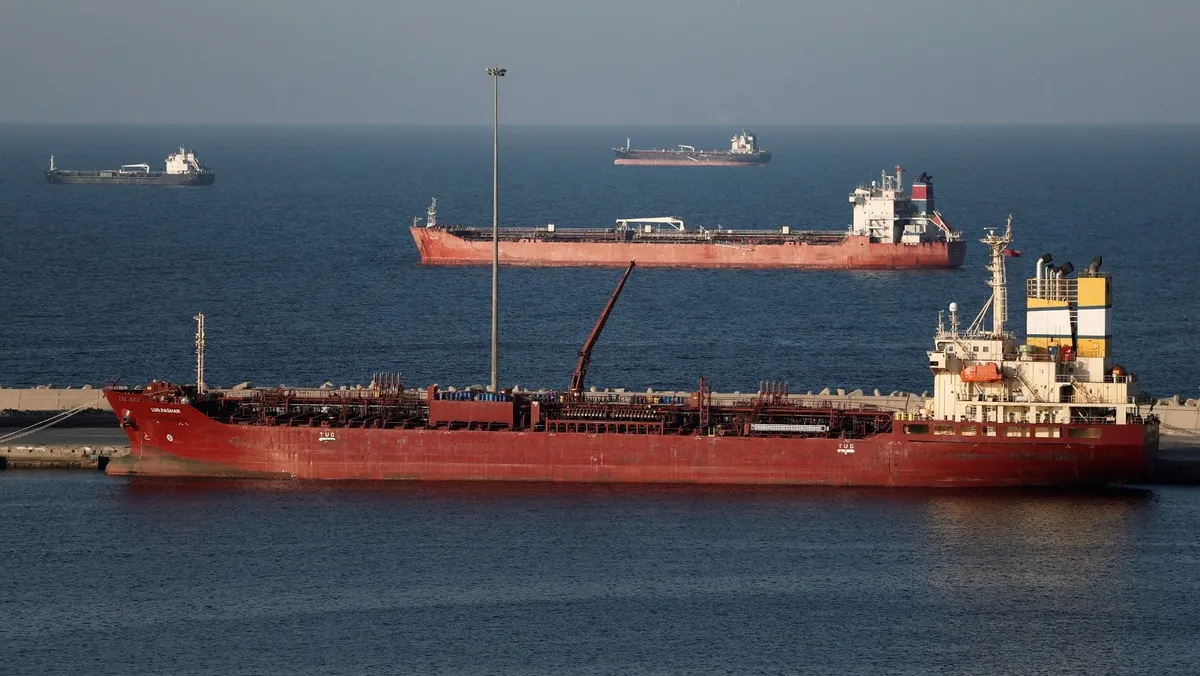
The Strait of Hormuz is the world’s most dangerous energy chokepoint: a 21-mile-wide slit between Iran and Oman through which roughly 20 million barrels of oil and significant volumes of liquefied natural gas pass every day — about one-fifth of global seaborne oil trade. Any sustained closure or serious disruption here would send crude prices surging past $100 a barrel and ripple through supply chains from Tokyo to New Delhi. For China, the planet’s largest crude importer, the question is no longer theoretical. Amid the 2026 Iran conflict and threats to shipping, Beijing confronts what analysts are openly calling its “Hormuz problem.” The answer is yes — but it is a problem Beijing has spent two decades methodically shrinking.
China’s exposure is real and large. In 2025 it imported roughly 11 million barrels per day of crude. About half — 5–5.5 million barrels — originated in the Middle East. Saudi Arabia supplied 14 percent, Iraq 10–11 percent, the UAE and Oman another 13 percent combined. Iran, despite official sanctions, quietly delivered around 11–13 percent (roughly 1.2–1.4 million barrels daily via shadow tankers). When Iranian volumes are included, the Middle East accounted for roughly 50 percent of China’s total crude supplies and one-third of its refining needs. China alone absorbs nearly 38 percent of all oil transiting Hormuz. Add Qatar’s LNG — which supplies 27 percent of China’s imports and one-third of its total LNG — and the picture sharpens: Beijing’s economy still relies on this narrow waterway for a substantial slice of its imported energy.
Yet raw percentages overstate the danger. According to Oxford Institute for Energy Studies analysis and Nomura economists, oil flowing through Hormuz constitutes only about 6.6 percent of China’s overall primary energy consumption; LNG adds another 0.6 percent. Coal still dominates electricity generation, gas is just 4 percent of the power mix, and domestic crude production plus overland imports already cover a growing share of demand. In other words, a full Hormuz shutdown would hurt — refinery run cuts would hit independent “teapot” refiners in Shandong hardest — but it would not cripple the national economy the way it would Japan or South Korea, whose energy systems are far more import-dependent.
The real story is resilience born of foresight. Twenty years ago Chinese leaders worried aloud about the “Malacca dilemma” — the fear that 80 percent of oil imports could be bottled up in the Strait of Malacca. Beijing responded with a multi-pronged strategy that now serves it well against Hormuz risks too. First, massive stockpiling: China entered 2026 with 1.2–1.4 billion barrels of onshore crude inventories (strategic and commercial combined), enough for 90–130 days of net imports. Pre-crisis buying of discounted Iranian barrels added floating storage as an extra cushion. Second, geographic diversification: Russian crude now supplies 20 percent of imports, much of it via the secure East Siberia–Pacific Ocean pipeline and rail routes that bypass every maritime chokepoint. Central Asian pipelines and the China–Myanmar oil line further dilute seaborne dependence. Third, the green transition: electric vehicles already displace more than 1 million barrels per day of implied oil demand, with new-energy vehicles comprising over half of passenger-car sales. Renewables (excluding hydro and nuclear) have risen from negligible to more than 20 percent of the energy mix, and electricity — largely coal- and renewable-powered — is steadily eating into oil’s share of final consumption.
These buffers explain why China has reacted to the current crisis with calm pragmatism rather than panic. Refineries have cut runs and reviewed product exports. Diplomats have quietly pressed Tehran to keep passages open for Chinese-linked tankers while publicly calling for de-escalation. Beijing has no interest in military entanglement — it maintains only a modest naval presence in the region via its Djibouti base and anti-piracy missions — but its economic heft gives it leverage that smaller Asian importers lack.
Critics will argue the problem remains acute. Prolonged disruption would still raise costs for chemicals, petrochemicals and heavy industry, slow GDP growth, and expose Beijing’s dependence on discounted sanctioned crude. Independent refiners built on cheap Iranian barrels would face painful switches to costlier Russian or Brazilian grades. Yet even here the data favor resilience: China weathered multi-month supply scares before (Libya 2011, Yemen attacks 2019) by drawing down stocks and rerouting. Saudi Arabia and the UAE retain limited pipeline capacity to Red Sea ports that could bypass Hormuz for several million barrels daily — volumes Beijing could contract if needed.
Geopolitically, the Hormuz problem is becoming an opportunity. China’s ability to absorb shocks better than its rivals weakens Washington’s traditional leverage over energy prices. It also accelerates Beijing’s long-term goals: faster electrification, more Eurasian pipelines (Power of Siberia 2 talks are reportedly advancing), and deeper economic ties across the Gulf. The 2023 China-brokered Saudi–Iran rapprochement was no accident; energy security demands stable relations with both producer blocs. In the 15th Five-Year Plan, ratified amid the crisis, coal remains the “ballast” while diversification and import substitution are elevated priorities.
China still has a Hormuz problem. No great power can import half its crude from one volatile region without vulnerability. But unlike the Malacca dilemma of the early 2000s — which felt existential — today’s version looks increasingly manageable. Two decades of stockpiling, pipelines, supplier diversification, and an aggressive shift to renewables have turned a strategic weakness into a calculated risk. In the current crisis, Beijing is not helpless; it is hedging, conserving, and diplomatically maneuvering. The Hormuz problem has not disappeared, but it is shrinking — and in its place is emerging a more self-reliant, influential China that can weather energy storms others cannot. That is not vulnerability. That is strategic adaptation in action.