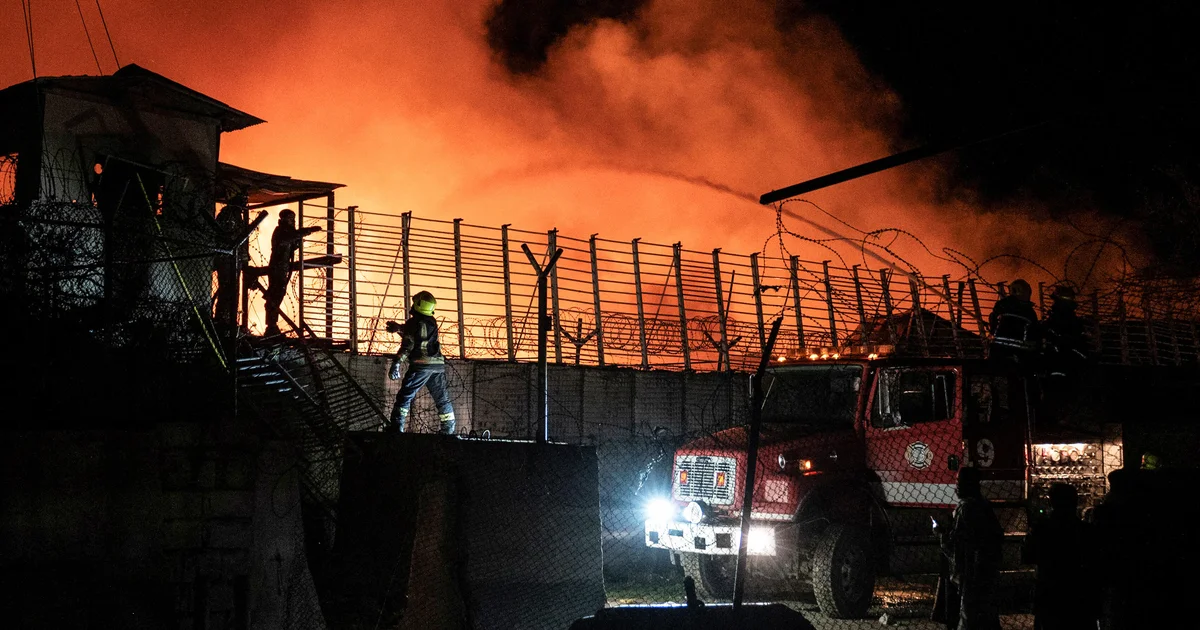
In Kabul’s Secondary Rehabilitation Services Centre, the war on drugs was supposed to be one of the few battles Afghans could still hope to win. Men and women clawing their way back from opium lay on iron cots, clinging to the routine of medicines, group therapy, and the fragile dignity of being treated as patients rather than criminals. On the night of March 16, that fragile world was blown apart. Afghan officials say Pakistani airstrikes hit the vast 2,000‑bed complex around 9 p.m., killing at least 400 people and injuring some 250, mostly vulnerable addicts in treatment, in what may be one of the deadliest attacks on a health facility in recent memory. Fires raged, bodies were pulled from pancaked wards, and rescuers dug through rubble where people had sought healing, not death. The air over Kabul’s District 9 still carries the sour mix of smoke, chemicals, and grief.
Islamabad rejects responsibility for any civilian casualties. Its military insists it struck only “terrorist support infrastructure” and “military installations” linked to the Tehrik‑i‑Taliban Pakistan (TTP) in Kabul and Nangarhar, framing the operation as lawful self‑defense against cross‑border attacks. Yet the basic architecture of the law of war is not ambiguous here.
The Geneva Conventions and their Additional Protocols require that hospitals and medical facilities be protected unless they are being used for “acts harmful to the enemy,” and even then only after warning, verification, and with strict proportionality. No independent evidence has emerged that this rehab center was doubling as a weapons depot or command node. Afghan health officials and Taliban spokesmen describe it as a dedicated treatment facility, part of a strained network confronting one of the world’s most entrenched opioid crises, with millions of Afghans struggling with addiction after decades of conflict and economic collapse. Even if some intelligence suggested that militants were present, the obliteration of a sprawling civilian hospital full of patients in withdrawal raises a simple question: what conceivable military advantage justifies that scale of loss?
Statement by the International Human Rights Foundation (IHRF)
— International Human Rights Foundation (@IHRF_English) March 16, 2026
The International Human Rights Foundation strongly condemns the reported bombardment by Pakistan of a rehabilitation hospital in Kabul, Afghanistan treating drug addicts, an attack that has reportedly killed a large… pic.twitter.com/wbaM3Y2nvT
This strike did not come out of the blue. It is the bloodiest episode so far in a sudden, sharp escalation along the Pakistan‑Afghanistan border that began in late February and has intensified over the last three weeks. Afghan and Pakistani forces have traded artillery, drones, and airstrikes across Kandahar, Khost, Nangarhar and other provinces, amid mutual accusations of harboring hostile militants. What makes this escalation distinctive is its timing and the wider storm gathering beyond the Durand Line. Around the same period, a separate conflagration has been unfolding to the west: Iranian attacks on Saudi Arabia and other Gulf targets as Tehran retaliates against U.S.–Israeli operations. Regional air defense systems have been activated, oil markets are on edge, and Gulf capitals are talking openly about red lines. Against that backdrop, Pakistan’s choice to pour air power into Afghanistan just as the Gulf crisis flared invites a closer look at its strategic calculus.
–#Pakistan commits war crime, kills over 400 civilians in an #Afghanistan hospital
— Insightful Geopolitics (@InsightGL) March 17, 2026
-Why #PakistanArmy is getting more & more enmeshed into an artificial war?
-Because Pakistan is scared & doesn't want to commit to #IranWar on behalf of #SaudiArabia as per the defence pact pic.twitter.com/5dtOKK10Er
Only months earlier, Pakistan and Saudi Arabia had unveiled a Strategic Mutual Defence Agreement (SMDA), trumpeted by both governments as a landmark in their long‑standing security partnership. Signed in September 2025 at Al‑Yamamah Palace, the pact declares that any aggression against one will be treated as an attack on both, promises deeper defense cooperation, and envisions joint deterrence against threats, including drones and missiles. In theory, this should mean that Iranian strikes on Saudi territory, widely condemned as violations of sovereignty, activate not just diplomatic support from Islamabad, but a concrete defense posture. Pakistani officials have indeed “reaffirmed” their commitment, with a government spokesman saying there is “no question” Pakistan will aid Saudi Arabia when needed. Yet, so far, there is little visible sign that Pakistan has deployed significant defense assets to Saudi soil in response to Tehran’s attacks, beyond symbolic coordination and shuttle diplomacy designed to calm tempers in both Riyadh and Tehran.
Instead, Pakistan’s most kinetic moves in early March have been eastward, across the Afghan frontier. It is, of course, possible that much of the SMDA activity is taking place behind closed doors, quiet intelligence sharing, contingency planning, and high‑level consultations that do not require public military deployments. Pakistan has always tried to walk a narrow, tightrope between its financial dependence on Saudi Arabia and its geographic and religious ties with Iran, and officials say openly they want de‑escalation, not a new front. But the juxtaposition is hard to ignore: a country that has pledged to treat an attack on Saudi Arabia as an attack on itself appears more willing, at this tense moment, to expend jets and missiles over Kabul than to visibly bolster Saudi air defenses already under strain from Iranian drones.
That tension between treaty language and operational reality raises uncomfortable questions about motive and priority. Did Islamabad see the SMDA primarily as a vehicle to shore up its ailing economy with Saudi investment and loans, rather than as a binding promise of reciprocal defense? If Iran’s strikes on Gulf targets do not trigger discernible Pakistani deployments under a “mutual” defense pact, what threshold must be crossed before the commitment is tested in practice? And if Pakistan is simultaneously asking the world to accept that its devastating raid on a Kabul rehab hospital was a necessary act of self‑defense, how should observers interpret its relative caution when the partner it has sworn to defend comes under fire?
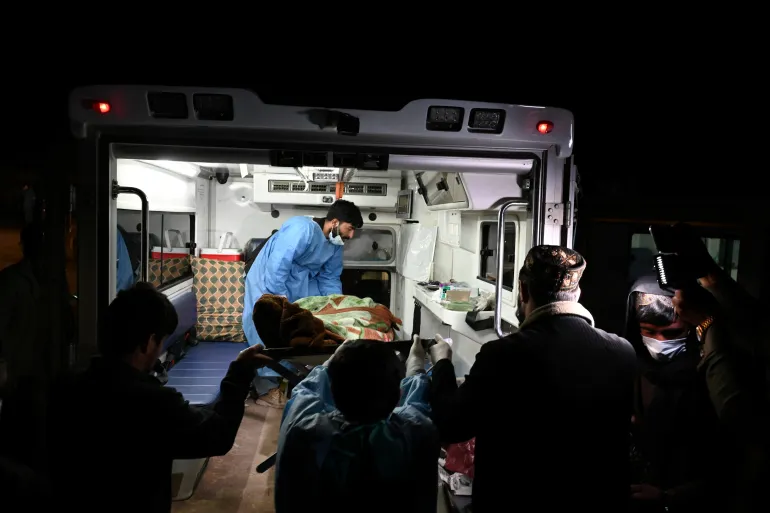
International humanitarian law does not adjudicate grand strategy; it judges concrete actions against clear standards. On the available record, the Kabul strike sits on the wrong side of those standards. Reports from Reuters, Al Jazeera, Deutsche Welle, CBS and others describe smoke billowing from the hospital, firefighters battling flames, and ambulances shuttling the wounded as Taliban security forces sealed off the site. Satellite images and video show collapsed wards and charred equipment where patients once lined up for methadone and counseling. Islamabad’s claim of precision targeting sits uneasily beside the sheer scale of the casualties, hundreds killed in a single health complex, raising serious doubts about compliance with the principles of distinction, proportionality, and precaution that underpin the laws of war.
The world has been here before. From Kunduz in 2015 to Mariupol and Gaza more recently, attacks on hospitals have become a grim hallmark of modern conflict, too often explained away as tragic accidents or blamed on adversaries allegedly “hiding among civilians.” When the victims are drug‑dependent Afghans, often stigmatized at home and invisible abroad, the risk of indifference is even greater. Yet their status as patients does not confer fewer rights; if anything, their extreme vulnerability should heighten the obligation to protect them. The Rome Statute treats deliberate or reckless attacks on medical facilities as potential war crimes, and the Kabul strike demands nothing less than a thorough, independent investigation by the UN, UNAMA, and the International Committee of the Red Cross, with full access to the site, records, and witnesses.
I am very sad to read on TOLO News that some 400 Afghan civilians have been killed and hundreds injured. My condolences and sympathy for the affected families.
— Zalmay Khalilzad (@realZalmayMK) March 17, 2026
The massacre of Afghan civilians is the result of barbaric Pakistani air attacks on Kabul. The Afghan people are…
Accountability, however, is only one part of the story. The deeper danger is of a slow normalization: border skirmishes drift into cross‑border air campaigns, and strikes on hospitals become just another data point on a crowded map of crises stretching from the Hindu Kush to the Gulf. Pakistan and the Taliban both insist they are acting in self‑defense; both accuse the other of harboring terrorists; both talk of red lines. But the patients at Omar or Omid, the fathers, brothers, daughters who checked into rehab to fight a private war against addiction, were not part of that calculus. Bombing their refuge was not “defense”; it was the abandonment of the minimal rules meant to preserve a shred of humanity amid conflict.
There is a temptation, in a year of overlapping wars, to see the Kabul hospital case as just another outrage in a crowded news cycle, overshadowed by missile barrages in the Gulf and saber‑rattling elsewhere. That would be a mistake. The way Pakistan’s actions are scrutinized, or glossed over, will send a signal not only about the value of Afghan lives but about the credibility of mutual defense pledges, the seriousness of legal constraints on airpower, and the incentives for other states weighing similar choices. If a state can invoke self‑defense to devastate a rehab center while hesitating to visibly honor its mutual defense obligations to an ally under attack, what message does that send about which commitments truly bind?
One night in Kabul, a hospital full of addicts became a graveyard. The world cannot resurrect the dead, but it can still insist on answers, from Islamabad, from Kabul, and from those who broker and bankroll the security arrangements that shape such decisions. The first question is legal: who ordered the strike, on what intelligence, under what safeguards? The second is strategic: why this ferocity on the Afghan frontier at the very moment the Gulf is on fire, and what does that imply about Pakistan’s reading of its own promises? The third is moral, and it belongs not just to lawyers and diplomats but to anyone watching: if even places of healing can be traded away in the balance of regional politics, what remains of the idea that some spaces, and some people, are off‑limits in war?