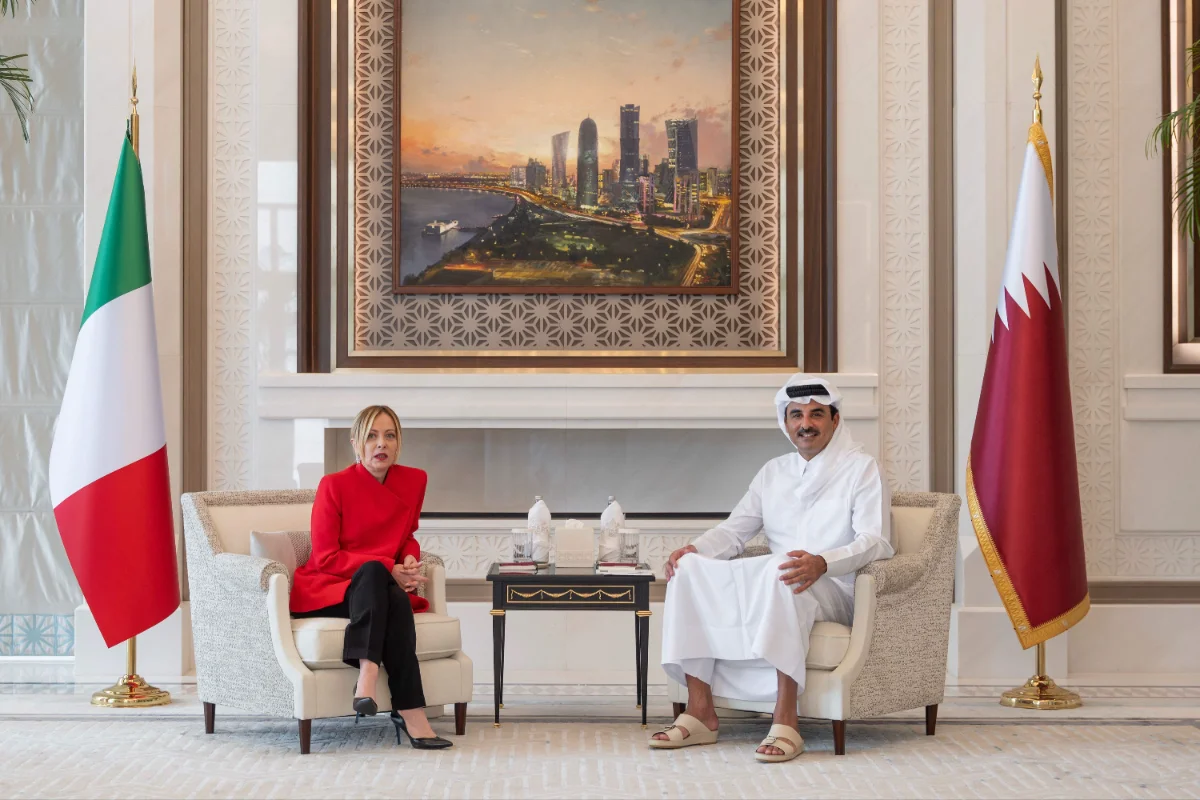
When Italian Prime Minister Giorgia Meloni touched down in Jeddah on April 3rd, she did something no other leader from the European Union, NATO, G7 or G20 had dared since the U.S.-Israeli war on Iran erupted in February: she showed up. Over two whirlwind days she met Saudi Crown Prince Mohammed bin Salman, Qatar’s Emir Sheikh Tamim bin Hamad Al Thani, and UAE President Sheikh Mohamed bin Zayed Al Nahyan. The trip was deliberately unannounced for security reasons. Its purpose was not photo-ops but cold calculation—securing Italy’s energy lifeline at a moment when the Strait of Hormuz teeters on the edge of closure and European households stare at another winter of punishing fuel bills.
Italy is not a Middle East power in the classic sense, yet geography and geology have made it one. Roughly 12 percent of its oil and 10 percent of its natural gas flow from the Gulf. Qatar’s LNG deliveries—already curtailed by Iranian actions—directly heat Italian homes and power its factories. When Hormuz is blocked, the price at the pump in Rome and Milan rises faster than any politician’s poll numbers. Meloni understands this arithmetic. In a video message released at the end of her tour she put it bluntly: Italy must be “in the places where a fundamental part of our security is being decided, and also our economic future.” Instability in the Gulf is not a distant headline; it is a line item on every Italian family’s energy bill.
Her objectives were threefold and refreshingly unvarnished. First, solidarity with Gulf partners under Iranian fire. By becoming the first Western leader to visit since the war began, Meloni signaled that Italy will not treat its friends as disposable. She offered concrete support—discussions on air-defense cooperation, defense-industrial ties, and help restoring damaged Qatari energy infrastructure. These are not blank checks; they are calibrated moves to protect Italian troops, citizens, and commercial interests already in the region.
Second, energy security. Meloni’s team pressed for assured supplies, alternative routing options, and accelerated investment in renewables and green hydrogen to reduce long-term vulnerability. In the UAE, talks reportedly covered fresh capital commitments in energy and defense—building on existing strategic agreements. With Qatar she backed diplomatic efforts to reopen Hormuz and stabilize LNG flows. Saudi Arabia offered the political weight and production capacity that only Riyadh can deliver. The message to Gulf producers was clear: Italy is a reliable European partner that puts national interest above Brussels consensus or ideological fashion.
Third, and most strategically, Meloni is positioning Italy as a bridge. Europe’s larger powers have been slower to act. France and Germany remain entangled in domestic politics and ideological debates about “de-risking” from the Gulf. Italy, with its Mediterranean exposure, cannot afford such luxury. By moving first, Meloni is carving out a distinctive Italian foreign policy—Atlanticist yet autonomous, pragmatic rather than performative. She has already diversified supplies by courting Algeria and Azerbaijan; the Gulf trip completes the circuit.
Critics on the left will call this “transactional.” They prefer lofty declarations about multilateralism while Italians pay the price at the pump. Meloni’s record suggests otherwise. Since taking office she has consistently chosen results over rhetoric—on migration, fiscal discipline, and now energy. Her Gulf tour is the latest example of a leader who treats foreign policy as an extension of domestic responsibility: keep the lights on, keep industry competitive, keep citizens warm.
The risks are real. The Iran conflict could spiral. Iranian proxies remain active. Yet Meloni’s calculation is that absence is riskier than engagement. By standing with Gulf capitals now, Italy gains leverage later—whether in brokering de-escalation, securing post-conflict reconstruction contracts, or shaping Europe’s collective response.
In an era when great-power competition has returned and energy is once again a weapon, small-to-medium powers like Italy have a choice: outsource their destiny to Brussels communiqués or act decisively in their own name. Meloni chose the latter. Her two-day blitz through Jeddah, Doha and Abu Dhabi was not grand strategy theater. It was something rarer in contemporary Europe: adult diplomacy.
If she delivers tangible supply guarantees, defense partnerships, and investment inflows, the visit will be remembered not as a gamble but as the moment Italy stopped pretending it could insulate itself from the world’s most volatile energy theater. In the end, voters care less about ideological purity than whether their factories stay open and their homes stay lit. Meloni’s Middle East mission understands that truth—and acts on it.