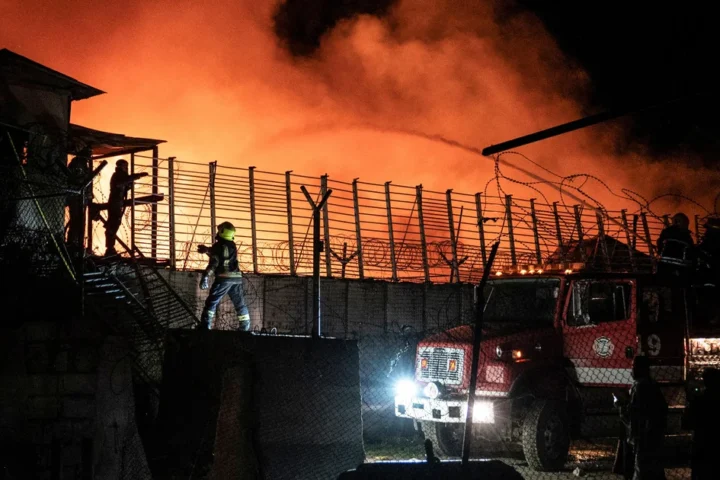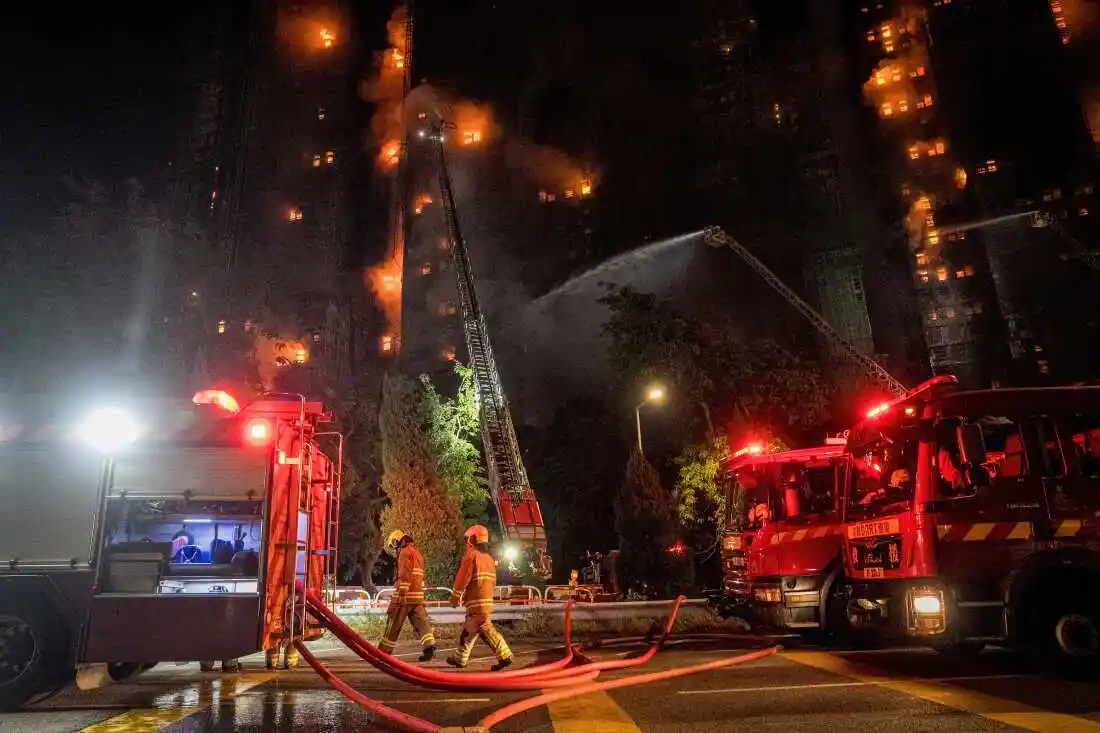
In the early hours of a wind-battered night in Hong Kong, a fire leapt across the façade of Wang Fuk Court, a sprawling high-rise residential complex. What began as a sudden blaze quickly transformed into an urban catastrophe—one of the city’s deadliest building fires in living memory. Today, officials confirm 44 people are dead, dozens more lie in hospital with life-threatening injuries, and nearly 300 residents remain unaccounted for. As smoke still curls faintly from the charred scaffolding, Hong Kong is reckoning with its worst fire tragedy since the Garley Building blaze of 1996.
More than 900 residents have been evacuated, but the full scope of the devastation remains uncertain. Thick bamboo scaffolding—long a fixture of Hong Kong construction—acted as a ladder for the flames, allowing the fire to escalate from one tower to the next. Strong winds fanned the blaze upward and sideways, turning the heights of Wang Fuk Court into a lethal trap.
Yet behind the grim statistics lies another truth: this tragedy is not solely about fire. It is a story about the inherent vulnerabilities of high-rise living, the limits of human endurance, and the complex choreography of evacuation when danger unfolds vertically instead of laterally.
A Race Against Gravity
High-rise fires are uncommon, but when they occur, the consequences are often catastrophic. Cities like Hong Kong are built upward, stacking homes in the sky to compensate for scarce land. But height, for all its efficiency, creates a unique and unforgiving battlefield during emergencies.
Stairwells become the only dependable escape routes once lifts shut down—and they present their own hazards. In ideal conditions, researchers note that people descend stairs at around 0.4 to 0.7 metres per second. During drills, even faster. But real emergencies strip away that predictability. Smoke, darkness, heat, and fear slow the descent dramatically.
On September 11, 2001, survivors descending the World Trade Center reported speeds slower than 0.3 m/s. That fractional difference becomes monumental when multiplied across dozens of floors. Every metre feels steeper. Every step heavier. Small pauses transform into cascading delays.
And those delays add up—sometimes fatally.
Fatigue alone significantly slows evacuees, particularly in tall buildings. Long, uninterrupted stairwells sap energy quickly. Many evacuees from the 2010 high-rise fire in Shanghai said they needed to stop repeatedly. For older residents, pauses were not optional but necessary.
At Wang Fuk Court, many of those trapped are believed to be elderly—a demographic that has grown throughout Hong Kong’s vertical neighbourhoods. For them, the journey down dozens of floors can be insurmountable even in calm conditions. In a choking, smoke-filled stairwell, the challenge becomes overwhelming.
Add to that the architectural realities of tall buildings. Narrow staircases. Converging flows of people from multiple floors. Sharp turns at landings that naturally create pinch points. A single slow mover—someone elderly, injured, or guiding children—can reduce the speed of an entire line of evacuees.
Then there is visibility. Low lighting or smoke makes every step uncertain. Experimental studies show that when people cannot clearly see the stairs beneath them, they move more cautiously, slowing significantly. In Wang Fuk Court, as smoke thickened and power flickered, many residents likely found themselves descending into darkness.
The Human Instinct That Makes or Breaks Survival
Yet evacuation is never just a test of physical capacity. It is a test of human behaviour—unpredictable, emotional, often irrational in its logic.
When alarms sound, people rarely bolt for the exit. They hesitate, gather possessions, attempt to confirm what is happening. They check on neighbours. They call family. They wait—hoping for reassurance, or clarity, or a signal that the threat is real.
Research from the World Trade Center evacuation reveals that people who encountered multiple cues—smoke, movement, noise—did not flee more quickly. Instead, they sought more information. They turned on radios. They scanned for official announcements. Some waited for colleagues or friends to coordinate their departure.
In residential buildings, this dynamic is even more pronounced. Families, couples, neighbours all attempt to evacuate together. Groups tend to move more slowly, widening their formation across stairwells or clustering protectively around children or older relatives.
Experts say groups move fastest when they adopt a single-file “snake” formation. But in emergencies, instinct often outweighs strategy. People want to see their loved ones in front of them, not behind. They want to hold hands, not stretch into a disciplined line. Safety feels like proximity, even if it slows the escape.
In the chaos at Wang Fuk Court, with smoke rising rapidly and communication unclear, these very human impulses likely amplified delays.
When Stairs Fail
The deeper issue illuminated by the fire is structural: the assumption that stairs alone are a sufficient evacuation mechanism for high-rise living.
That assumption no longer holds.
As cities build taller and populations age, continuous downward evacuation becomes unrealistic. Some residents physically cannot descend more than a handful of floors. Others will move too slowly to clear the building before conditions worsen.
Countries facing similar challenges have embraced architectural solutions. Refuge floors—fire-protected, pressurised spaces spaced periodically throughout a tower—serve as safe havens. They break long descents into stages, provide rest, and reduce congestion. Occupants can wait in safety for conditions to improve or for firefighters to assist.
Evacuation elevators represent the next frontier. Engineered to function during fires, these lifts use pressurised shafts, protected lobbies, and backup power to transport evacuees efficiently. When combined with stairs and refuge floors, they create a multi-path evacuation system tailored to modern high-rise populations.
Hong Kong, like many dense cities, has begun adopting some of these measures. But the Wang Fuk Court tragedy underscores how urgent and widespread such implementation needs to be.
The Scaffolding That Carried Flames—and a Warning
In the aftermath, investigators will look closely at the bamboo scaffolding that helped the fire leap between buildings. Used for centuries in Hong Kong construction, bamboo is inexpensive, flexible, and treasured by builders. But in this case, it became a deadly conduit—one that circumvented fire barriers and allowed the blaze to spread horizontally across towers.
That vulnerability, combined with strong winds and dense residential stacking, created a perfect storm.
The lesson is not just about scaffolding. It is about the ways modern urban life often pushes technology, safety systems, and human capabilities to their limits. High-rise living concentrates people vertically, demanding evacuation methods that go far beyond narrow stairwells designed decades ago.
The Future of Vertical Safety
As Hong Kong mourns the victims of the Wang Fuk Court fire, experts say the path forward is clear: high-rise safety must evolve.
That means designing buildings where evacuation is not a single, brittle point of failure but a flexible system—one combining protected elevators, refuge floors, smart evacuation modelling, and early warning communication that guides residents clearly and calmly.
It also means acknowledging the human dimension of evacuation: panic, hesitation, group behaviour, physical limitations. Safety planning must adapt to people, not expect people to adapt flawlessly to a crisis.
The fire at Wang Fuk Court will be remembered as a tragedy of lives lost and families fractured. But it should also be remembered as a turning point—a stark reminder that as cities reach ever higher into the sky, safety must rise with them.