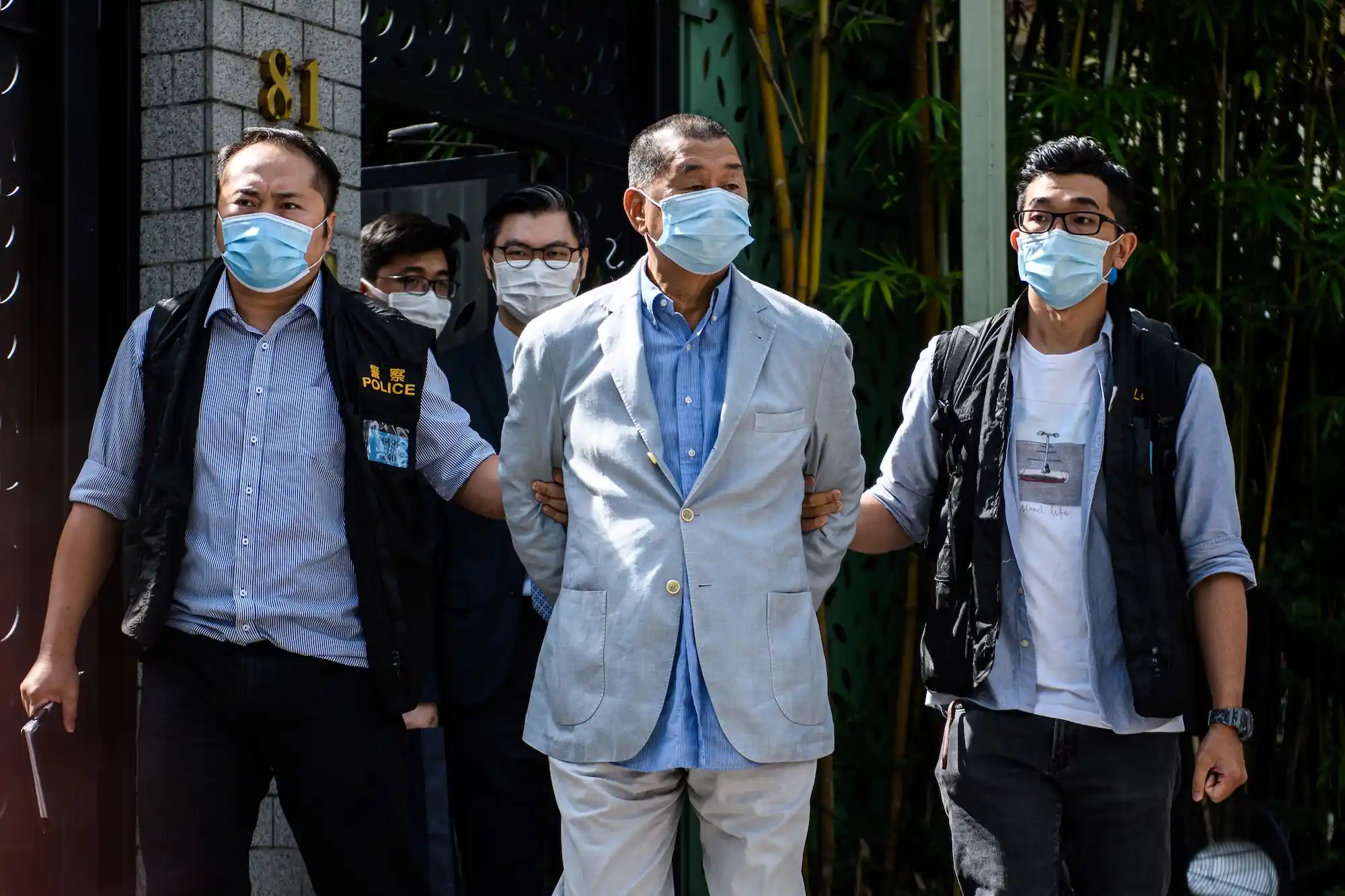
China’s prosecution and conviction of Hong Kong media tycoon Jimmy Lai under the National Security Law (NSL) is widely seen by rights groups, UN experts and many governments as a politically driven, legally hollow case that weaponises the courts to eliminate dissent and independent media – and it is a warning of how Beijing intends to govern not just Hong Kong, but any space under its reach. The case signals that advocacy, journalism and external engagement can be retroactively criminalised as “foreign collusion”, turning basic democratic activity into a national security crime.
Who is Jimmy Lai, and Why He Matters
Jimmy Lai, 78, is the founder of the now‑defunct pro‑democracy tabloid Apple Daily, once one of Hong Kong’s most popular and outspoken newspapers. A self‑made garment magnate who turned to media and politics, Lai became one of the most visible backers and funders of Hong Kong’s democracy movement and a prominent critic of Chinese Communist Party rule.
For Beijing and the Hong Kong authorities, Lai embodies three threats at once: a wealthy local power centre outside Party control, a media platform capable of shaping public opinion, and a bridge between Hong Kong’s streets and Western policymakers. Neutralising him – and making an example of his newspaper and staff – therefore serves both punitive and deterrent purposes.
Lai’s latest conviction follows a years‑long cascade of overlapping prosecutions: earlier fraud and unauthorised‑assembly convictions were effectively used to keep him behind bars while the NSL case was prepared. He has been continuously detained since December 2020, much of it in solitary confinement, and already served multiple sentences before even reaching this national security verdict.
In December 2025, a three‑judge panel designated under Hong Kong’s NSL system found Lai guilty of two counts of conspiracy to collude with foreign forces and one count of conspiracy to publish seditious publications, following a 156‑day trial without a jury. Prosecutors argued that his articles, public advocacy, meetings with foreign officials and media interviews calling for sanctions on Hong Kong and Chinese officials amounted to “foreign collusion” and sedition, even though such advocacy was lawful in Hong Kong at the time it occurred.
UN experts and rights organisations highlight serious due‑process concerns: the use of specially selected national‑security judges, the absence of a jury, prolonged pre‑trial detention, and allegations that at least one key witness had been tortured in mainland China, which were neither fully investigated nor excluded. In 2024, the UN Working Group on Arbitrary Detention had already found Lai’s detention unlawful and arbitrary, urging his immediate release – a finding effectively ignored by the authorities.
Beijing’s Narrative vs Global Alarm
Chinese and Hong Kong officials insist the case has “nothing to do with press freedom”, framing Lai as a “mastermind” of anti‑China activities who colluded with hostile foreign forces to endanger national security. Official statements stress that the NSL is applied only to a “small minority” and that all defendants receive fair trials based on evidence and law, portraying criticism as politically motivated interference.
By contrast, press‑freedom and human‑rights groups describe the verdict as a death knell for media freedom in Hong Kong and an act of persecution. The Committee to Protect Journalists, Amnesty International and others argue that Lai’s “crimes” are indistinguishable from running a newspaper, hosting pro‑democracy commentary and engaging foreign publics and politicians on Hong Kong’s future.
UN special rapporteurs have condemned the conviction as a direct assault on freedom of expression and judicial independence, warning that the authorities are using law as a tool to silence dissent rather than to protect genuine security interests. Their statements underline that criminalising peaceful political advocacy under vague national‑security categories violates Hong Kong’s obligations under international human‑rights law.
The Lai case caps a systematic dismantling of Hong Kong’s once‑vibrant independent media and civil society since the NSL’s imposition in 2020. Apple Daily was forced to shut down after its newsroom was raided, executives arrested and its financial assets frozen; other outspoken outlets like Stand News and Citizen News also closed under legal and regulatory pressure.
Former Apple Daily journalists describe a climate in which reporters have left the profession or gone into exile, and remaining newsrooms operate under pervasive self‑censorship to avoid crossing opaque red lines. Experts and rights groups warn that Lai’s conviction will deepen this chilling effect, signalling that contact with foreign organisations, critical commentary and mobilisation around protests can all be retroactively rebranded as national‑security threats.
The trial also accelerates Hong Kong’s reputational slide as an open international financial hub governed by common‑law norms. International business and legal communities have raised concerns that the same elastic security framework used against journalists and activists could, in principle, be deployed against NGOs, academics or even foreign firms seen as politically inconvenient.
Why it is a Warning Far Beyond Hong Kong
Lai’s conviction is a warning on several levels: to Hong Kong’s remaining dissenters, to Taiwan and neighbouring societies, and to liberal democracies engaging with China. Domestically, it demonstrates that no combination of wealth, international profile or prior legal protections can shield a critic once Beijing decides to define ordinary political advocacy as a security crime.
Regionally, the case fits a broader pattern of “law‑based governance” as practiced by the Chinese Communist Party: using broad, vaguely defined security laws to give a veneer of legality to what are fundamentally political crackdowns. The message to Taiwan and others is that Beijing’s promises of autonomy and rights – whether under “one country, two systems” or similar frameworks – are contingent and reversible when they collide with Party imperatives.
For democracies, the Lai verdict underscores that engagement with China now takes place in an environment where international norms on free expression, fair trial and treaty commitments can be overridden by domestic security narratives. Governments that champion press freedom must now decide whether their rhetoric will be matched with consequences – through targeted sanctions, asylum and relocation pathways for at‑risk journalists, or measures to reduce dependence on Hong Kong as a legal and financial jurisdiction.
The deeper warning is that if an internationally known publisher in a global financial centre can be held for years, tried without a jury and effectively criminalised for speaking to foreign media and politicians, then no journalist or civil society actor in China’s shadow can assume safety.