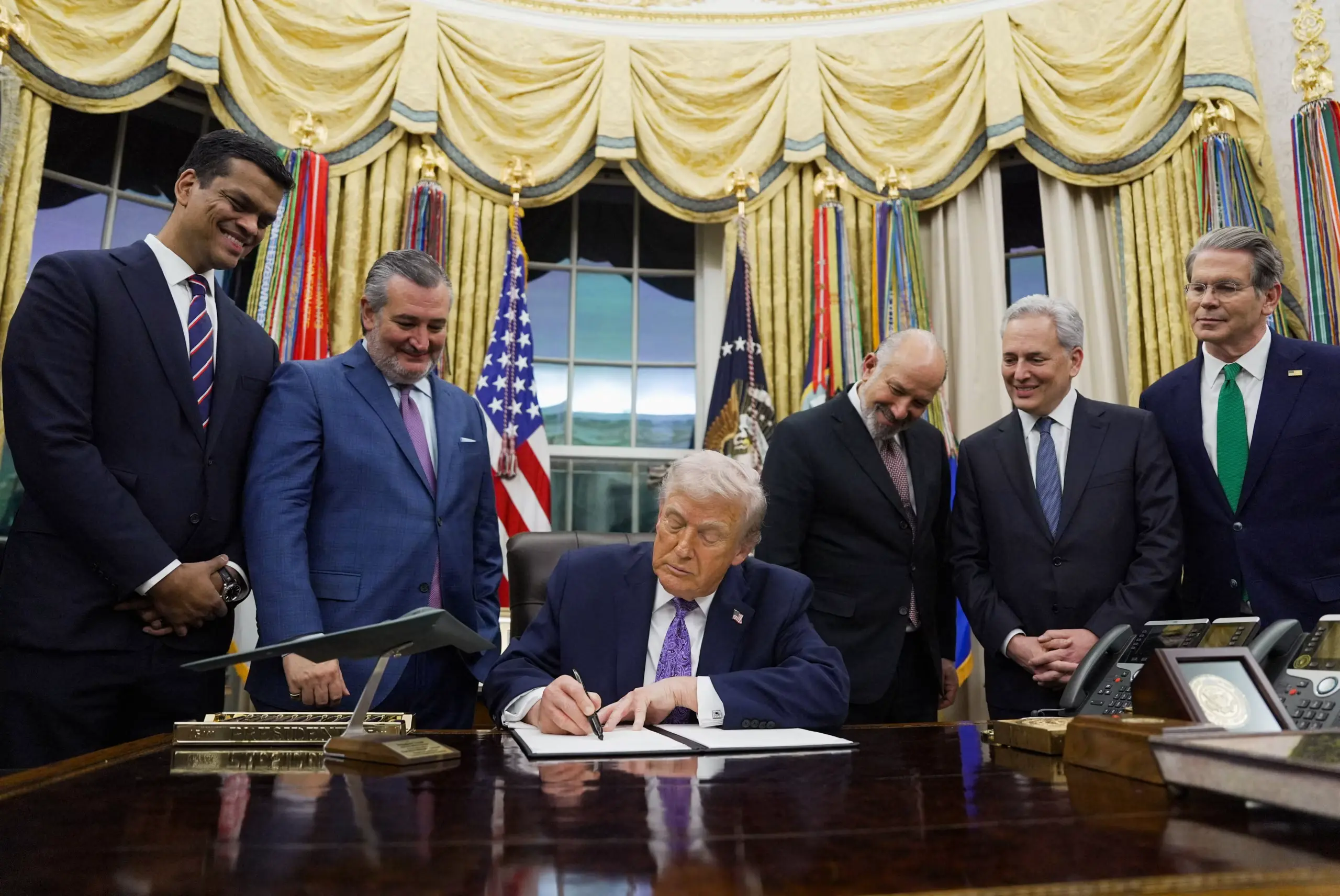
President Trump’s new executive order on artificial intelligence reflects a deeply rooted American instinct: don’t choke the next great technology before it has a chance to grow. It is an instinct forged by experience, not ideology. In the 1990s, Washington largely resisted the urge to smother the early internet with heavy-handed regulation. Under Bill Clinton, policymakers chose restraint over control, betting that innovation would outrun the risks. That decision helped the United States dominate the digital age while much of the world scrambled to catch up.
Donald Trump is clearly drawing from that playbook.
His executive order pushes back against a growing maze of state-level AI rules that threaten to slow innovation just as the global AI race is accelerating. From a strategic standpoint, that matters. This is not a friendly competition between like-minded democracies. China is racing full throttle to dominate artificial intelligence, pouring state resources into systems tightly integrated with surveillance, censorship and military power. Beijing does not have 50 states debating regulatory frameworks. It has one plan—and it is executing it with discipline and speed.
On that front, Trump is right. America cannot afford to regulate itself into second place.
But speed alone will not save us.
As I argue in my 2025 book AI for Mankind’s Future, artificial intelligence is not simply “the internet all over again.” The internet connected people. AI evaluates them. It decides who gets a loan, who gets hired, who gets flagged by authorities, who gets silenced online, and—more ominously—who gets targeted on the battlefield. It scales power faster than any technology in human history, and when it goes wrong, it does not fail gradually. It fails at machine speed.
We already know how this story can end. The internet grew rapidly, and only later did Americans fully grasp the costs: lost privacy, online manipulation, monopolistic platforms, mass digital surveillance and nonstop disinformation. Washington waited too long to act. Now regulators are stuck trying to bolt guardrails onto systems that are already embedded in daily life, politics and the economy.
Artificial intelligence compresses that danger into years, not decades.
Trump’s executive order correctly identifies the threat posed by a fragmented, state-by-state regulatory patchwork. Conflicting rules discourage investment, slow deployment and hand an advantage to foreign competitors who face no such constraints. But there is a flip side Americans should worry about just as much. An executive order can preempt the states, but it does not automatically protect the people. If state authority is chilled and Congress fails to act, the result is not “smart regulation.” It is a regulatory vacuum.
And in that vacuum, ordinary Americans lose.
Children are exposed to predatory AI systems optimized for addiction and manipulation. Workers are displaced by automation with little warning and even less retraining. Deepfakes flood elections and financial scams proliferate. Algorithms quietly make life-altering decisions about credit, housing, employment and policing, while the logic behind those decisions remains opaque and unchallengeable. Power shifts upward—to corporations and governments—while accountability evaporates.
China understands exactly what it is doing. There, artificial intelligence is already fused with state surveillance, social credit scoring and military planning. U.S. intelligence officials have warned repeatedly that the AI race is existential. If America loses, we do not just lose tech jobs or market share. We lose strategic freedom—the ability to operate, defend ourselves and set global norms on our own terms.
Yet winning does not mean copying China’s model. Nor does it mean turning AI loose with no rules at all.
The real challenge is proving that a free society can lead in artificial intelligence without surrendering human judgment, liberty and dignity to machines. That is the test of democratic governance in the 21st century. It requires national leadership—one coherent federal framework rather than 50 competing state rulebooks, but also something more than blind faith in Silicon Valley’s assurances that innovation will magically self-correct.
Trump is right to demand speed and unity. He is right to recognize that regulatory paralysis is itself a strategic risk. But speed without direction is not leadership, and unity without substance is hollow.
Washington must now deliver what the executive order alone cannot: clear federal guardrails that protect innovation while defending citizens. That means transparency standards for high-risk AI systems. It means accountability when algorithms cause real-world harm. It means safeguards for children, workers and democratic processes. And it means ensuring that human beings—not machines—remain responsible for decisions that shape lives and nations.
If we repeat the internet era’s mistake—moving fast and thinking later—we may well win the global AI race and still lose the country we are trying to defend.