Mark Carney’s $2.6‑billion uranium supply deal with India is not just an export win; it’s a strategic pivot that rewires Canada’s place in the Indo‑Pacific, in clean-energy geopolitics, and in a global economy that is rapidly de-risking away from single-market dependence. From Canada’s perspective, this is significant because it links a premium Canadian resource to one of the world’s fastest-growing energy markets while simultaneously reopening the path to a broad trade agreement that could reshape Canada’s long-term growth story beyond the U.S. orbit.
Canada has spent the last decade talking about “diversification” the way people talk about starting the gym: always next Monday. The numbers never lie. Trade, investment, and even political attention remain structurally tilted toward the United States, for rational reasons, geography, integrated supply chains, shared infrastructure, and the gravitational pull of the world’s largest consumer market. Yet the vulnerability of this posture has become increasingly obvious. A single disruptive election cycle, a single “Buy American” wave, or a single cross-border regulatory spat can suddenly turn complacent integration into strategic exposure.
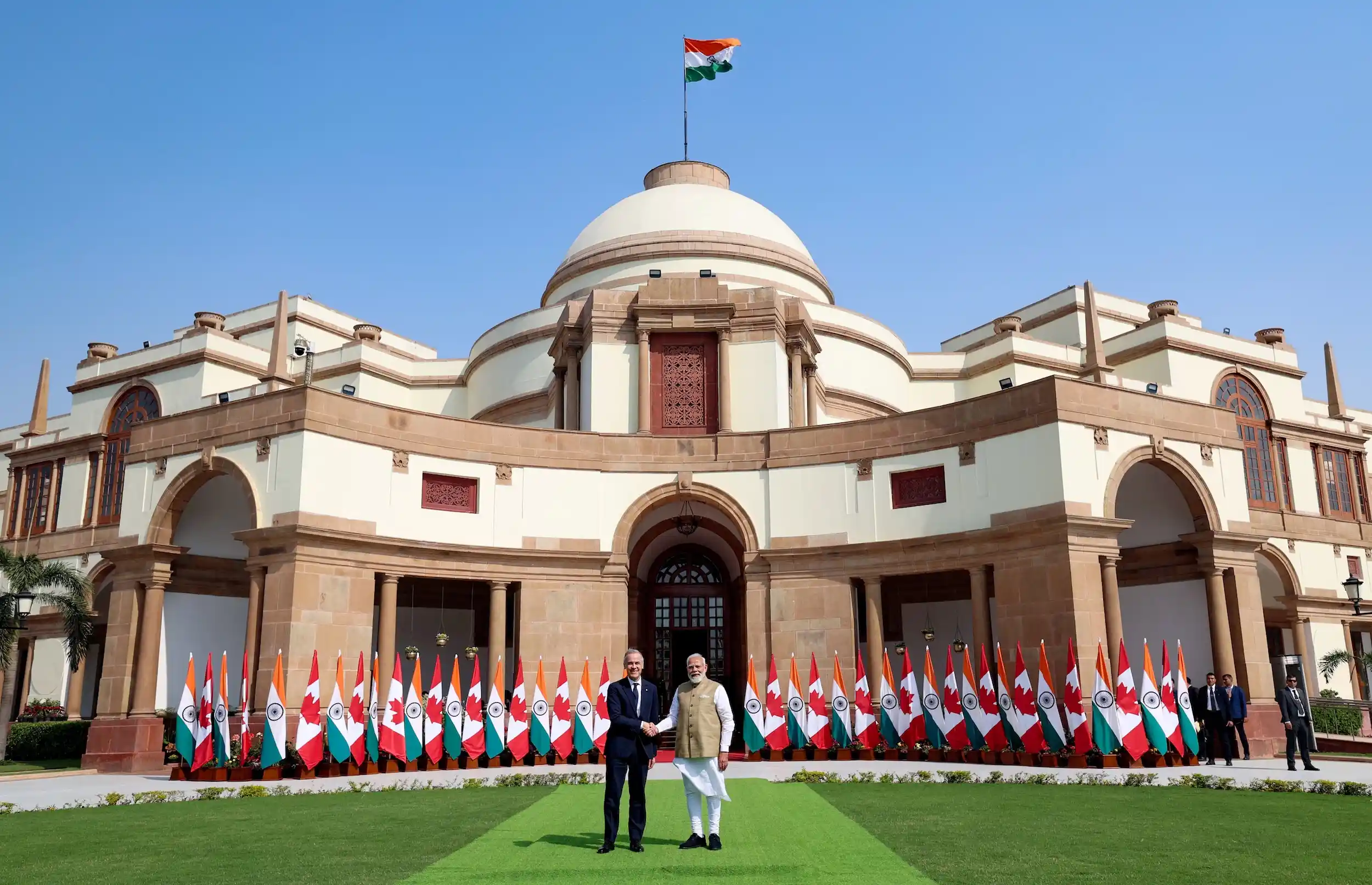
Carney appears to be acting on that reality with unusual speed. In New Delhi, Canada and India announced a “Strategic Energy Partnership” spanning LNG, LPG, uranium, solar, and hydrogen, an intentional bundle that treats energy not as a commodity transaction, but as the anchor for a wider economic reset. At the center is the uranium contract: Cameco will supply nearly 22 million pounds of uranium from 2027 to 2035, fuel for India’s civil nuclear energy system, and a long-term revenue stream for Canada’s uranium champion and the communities tied to that supply chain.
That alone is meaningful; in a world of short political time horizons, an eight-year supply arrangement is an exercise in strategic patience. But the deeper significance comes from what this deal signals about Canada’s intent, and about India’s evolving role in Canada’s strategic imagination.
The commodity Canada should be proud to sell
Canada is often uneasy about being “just” a resource exporter, as though the act of selling atoms dug from the ground is inherently less sophisticated than selling apps or financial services. That insecurity has been costly. The uranium deal should be read as an argument for a different kind of Canadian ambition: not post-resource, but resource-smart.
Uranium is not oil. It is compact, high value, and tightly governed, which means it sits at the intersection of energy security and national security in a way few commodities do. The Carney government’s release explicitly frames the uranium supply as foundational to a broader strategic partnership and places it within a larger effort to diversify supply chains. In other words: this is Canada exporting something the world will compete for, under rules that favor stable, reputable suppliers.
And Canada has a credible claim to that role. Cameco is not a marginal player; it is a major global supplier, and this contract ties Canadian production to Indian demand at precisely the moment nuclear power is being reconsidered worldwide as a firm, low-carbon backbone for electrification. The result is a form of industrial policy without the usual Ottawa temptations: no make-work subsidies, no speculative tech bets, just a structured, multi-year market for an existing Canadian comparative advantage.
A bet on India’s scale and Canada’s relevance
There is a tendency in Ottawa to treat India as either a diaspora story or a diplomatic headache. Both are incomplete. India is, simply, scale: scale of population, scale of energy demand, scale of industrial growth, and scale of geopolitical weight. The Canadian readout leans into that reality, calling India the world’s fastest-growing major economy and emphasizing its rising energy demand.
From Canada’s perspective, attaching Canadian energy and critical minerals capacity to India’s growth arc is a way to remain relevant in the century’s primary theater: the Indo-Pacific. The release is explicit that stronger ties in the region are “crucial to our security and sovereignty,” and it pairs the economic announcements with expanded defence cooperation, including maritime security and potential naval activities. This matters because Canada’s Indo-Pacific rhetoric has often outpaced its tangible commitments; energy is the rare domain where Canada can show up with real leverage.
The uranium contract also forces a more mature Canadian approach to “values versus interests.” Carney himself has publicly acknowledged that partners will disagree and that progress can be incremental, language that appears designed to inoculate the relationship from moralized whiplash. That may frustrate parts of the Canadian foreign policy community, but it is a realistic basis for doing business with a country as strategically autonomous as India.
Trade talks: the second, quieter bombshell
The uranium deal grabbed headlines because $2.6 billion is a crisp number and nuclear carries symbolism. But the more transformative element may be the announcement that Canada and India are moving to conclude a Comprehensive Economic Partnership Agreement (CEPA), with chief negotiators meeting and terms of reference signed. The Carney government is explicitly tying CEPA to a goal of more than doubling two-way trade to $70 billion by 2030.
If that target is even partially realized, it changes the composition of Canada’s external economic posture. It is not merely about selling more lentils, lumber, or uranium; it is about embedding Canadian firms deeper into Indian markets and supply chains, while pulling Indian capital and technology operations more decisively into Canada.
The announcement already gestures at that two-way logic. HCL Technologies plans to expand in Canada, increasing its workforce by 75% by 2030 and creating “thousands” of high-paying jobs, according to the Canadian government. Carney also brought senior executives from nine major Canadian pension funds and met Indian business leaders with a combined market capitalization of about $600 billion, classic “Canada as a destination for global capital” statecraft.
That’s significant because Canadian diversification cannot rely only on export promotion. It requires investment flows, joint ventures, and institutional relationships that survive political cycles. Pension funds are built for that timeframe.
The diplomatic reset is the point
None of this happens in a vacuum. The new announcements explicitly include enhanced cooperation on security and law enforcement, including fentanyl precursors and transnational organized crime networks.
From Canada’s perspective, this security track is not a side dish; it is the precondition for sustainable economic engagement. Trade agreements and strategic energy partnerships do not survive if the political relationship is perpetually one crisis away from rupture. Carney’s approach seems to be to build a thick web of interests, energy, education, AI, space cooperation, so the relationship cannot be reduced to any single dispute.
Why this is “extremely significant” for Canada
Put simply, the uranium deal is a flagship contract, but the real significance is structural.
First, it positions Canada as a supplier of strategic clean-energy inputs to a fast-growing power, exactly the kind of relationship that creates long-term influence. Second, it treats trade diversification as an operational project, not a slogan, by pairing a marquee commodity deal with a revived, time-bound push toward CEPA. Third, it ties economics to security in a way that acknowledges the Indo-Pacific is not a trade fair; it is a contested region where resilience, supply chains, and maritime stability matter.
Finally, it reflects a more grown-up Canadian statecraft: use what Canada has (resources, capital, institutional stability) to build durable partnerships, even when values don’t align perfectly, while still asserting domestic security imperatives.
Canada cannot diversify by wishing for a different geography. It can only diversify by choosing different relationships, big ones, complex ones, and long ones. A uranium supply deal running from 2027 to 2035, wrapped inside a strategic energy partnership and linked to trade talks aimed at a CEPA, is exactly that kind of choice.