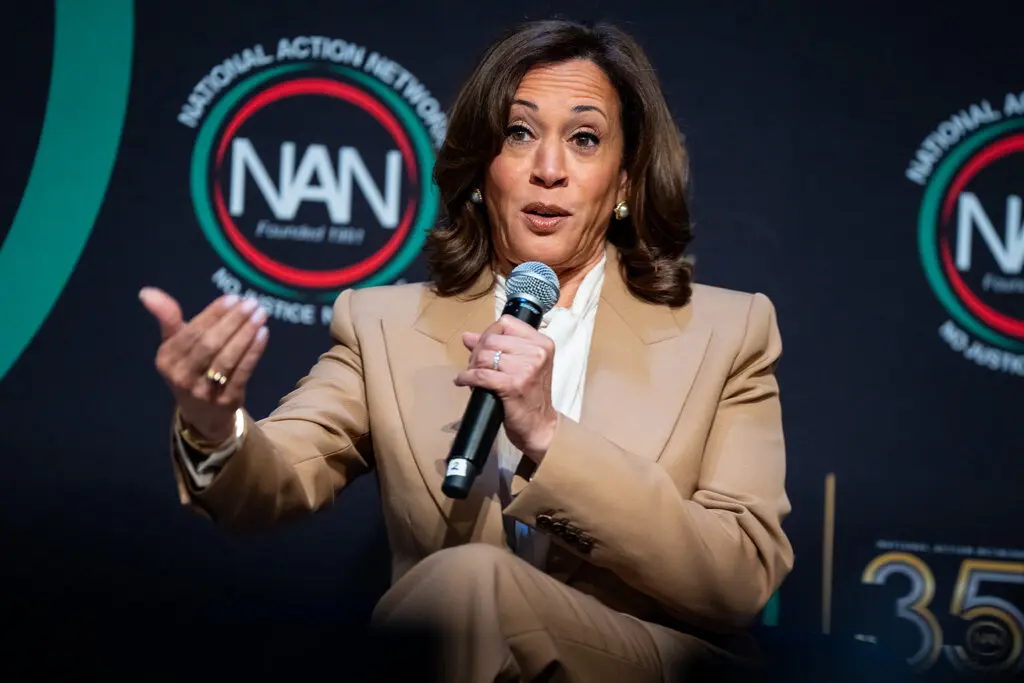
Kamala Harris is no longer acting like a former vice president trying to fade from the spotlight. In New York this week, she told a crowd at the National Action Network that she is “thinking about” a 2028 presidential run — her clearest public signal yet that she may seek a return to the White House. That matters because Harris has now done what ambitious politicians do when they want to be taken seriously: she has left the door open, kept the conversation alive, and avoided the kind of definitive no that would shut down speculation.
This is not just idle theater. Harris has already ruled out a run for California governor in 2026, saying she would not seek elected office in the near term while leaving open the possibility of broader public service and future plans. In practical political terms, that decision narrowed her options to a presidential comeback, a party-building role, or a long pause. Instead, she is choosing visibility. She is appearing before Black activists, traveling to support Democrats, and speaking in the language of a national leader-in-waiting. That is the posture of someone trying to stay in the center of the Democratic map.
The most important question is what this means for Harris herself. The answer is that she remains one of the most recognizable Democrats in the country, but recognition is not the same as inevitability. Recent polling suggests she still has real strength inside the party: one national survey found Harris with 31 percent support among Democrats and left-leaning independents in a 2028 primary test, while another put her at 39 percent among registered voters if she ran again. A March survey also showed her ahead of Gavin Newsom, with 21 percent to his 19 percent, underscoring that she remains the benchmark candidate in the early field. Even so, early leads are fragile, especially for a politician whose 2024 campaign ended in defeat to Donald Trump.
That defeat is the shadow hanging over everything. Harris brings built-in advantages: national name recognition, a large donor network, and a historic profile that continues to matter to many Democrats. She also has a loyal base; one recent survey found that 82 percent of voters who backed her in 2024 still view her favorably, and another said 90 percent of likely Democratic voters had a positive opinion of her. But she also carries the burden of having already been tested on the biggest stage and lost. That means her 2028 bid, if she makes it, will not begin as a blank slate. It will begin as a referendum on whether voters think the country is ready to revisit a familiar candidate.
For Democrats, Harris’s signal creates both opportunity and tension. On the one hand, she can offer continuity at a moment when the party is still defining itself after the Biden years and trying to rebuild after Trump’s return to power. On the other hand, her likely candidacy could complicate the party’s search for renewal. Polling and commentary already show a crowded bench forming behind her, with Newsom, Pete Buttigieg, Alexandria Ocasio-Cortez, Josh Shapiro, and others all hovering in the early conversation. That means Harris’s presence could freeze the field early, making it harder for a new generation of Democrats to break through.
Still, her political case is not empty. Harris is leaning into the issues Democrats most want to emphasize: affordability, health care, reproductive freedom, and the defense of democratic institutions. At the National Action Network convention, she and other Democrats also used the moment to attack Trump’s economic stewardship and warn about foreign policy instability, signaling that the party’s 2028 argument may center on competence as much as ideology. If Harris runs, she will likely frame herself as the candidate who understands both the stakes of Trump-era politics and the practical concerns of voters who are anxious about daily life.
There is also a broader meaning to her signal. In a political era that rewards constant drama but punishes indecision, Harris is trying to control the narrative before someone else defines it for her. By speaking publicly about 2028 now, she can test reactions, build anticipation, and keep donors and activists engaged without fully committing to a campaign. That is smart politics, but it is also a high-wire act. The longer she waits, the more time rivals have to organize. The sooner she runs, the more she risks turning a comeback into a relitigation of her last defeat.
So what does her signal mean? It means the Democratic primary for 2028 has effectively begun, even if no one is saying it out loud yet. It means Harris remains a serious contender, not a symbolic one. And it means Democrats are about to confront a familiar strategic question: do they want the candidate who can command attention immediately, or the one who best represents the party’s future? Harris’s answer, for now, is that she may be both.