Something shifted in European security on March 2nd. Not in the way most headlines suggested — France has always considered Europe part of its vital interests, and the strategic logic of a second nuclear decision center within NATO has been implicit since the Cold War. What changed was the surrounding landscape. The United States is openly pressing Europeans to carry more of their own defense burden. The continent is rearming at a pace not seen since the postwar years. And Emmanuel Macron, sensing both an opening and an obligation, has placed France’s nuclear arsenal at the center of that transformation.
His proposal — an expanded stockpile, bilateral nuclear steering committees, joint exercises with eight named partners, and the conditional forward deployment of nuclear-capable Rafale aircraft — is being debated mostly as a question of French credibility. That is the wrong frame. The more interesting question is what France is actually building, and whether it can hold together when it matters most.
The Architecture of Ambiguity
Macron’s framework is deliberately constructed to avoid two failure modes. France cannot appear to be replacing the United States as Europe’s security guarantor — that would fracture NATO and antagonize Washington. Nor can it repeat the vague assurances of previous decades that convinced no one. The result threads a careful needle: Germany, Poland, the Netherlands, the United Kingdom, Belgium, Greece, Sweden, and Denmark are drawn into French nuclear exercises and consultation structures, while sole launch authority stays in Paris. Partners receive neither warheads nor decision-making power. French nuclear forces will not be deployed beyond French territory. The existing launch authority is not altered.
This is not weakness disguised as caution. It is a deliberate choice to make French resolve more legible without triggering the proliferation concerns that a more aggressive posture would invite. Operation Poker — France’s quarterly nuclear strike rehearsal — now incorporates allied conventional assets in escort, refueling, and electronic warfare roles. The geography of the eight partners, from Denmark in the north to Greece in the south, creates what one might call an archipelago of commitment: dispersed, visible, and harder to dismiss than any single bilateral guarantee.
What France Is Really Selling
Strip away the strategic language and the French initiative is also an industrial proposition. Germany’s accelerating defense build-up, backed by historic deficit spending, poses a genuine competitive threat to the French defense sector. If Germany develops domestic alternatives to French fighters, cruise missiles, and early-warning systems, France’s position in European defense markets could erode sharply over the coming decade.
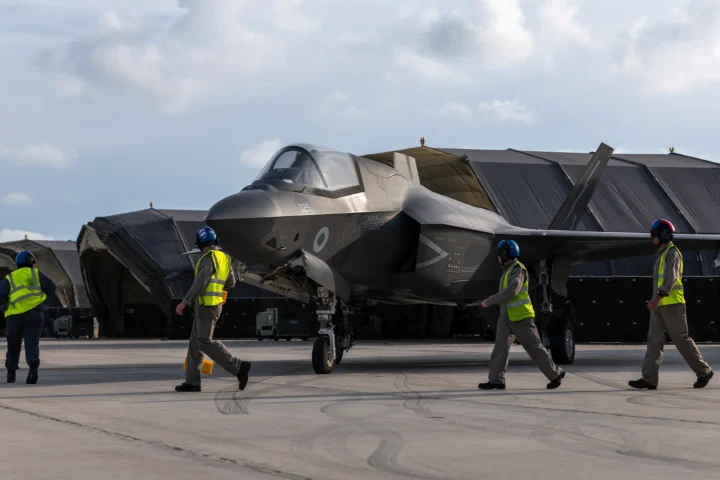
Countries joining Operation Poker must prepare their facilities for Rafale aircraft, creating infrastructure that favors French platform acquisition in future procurement cycles. Countries contributing conventional assets develop interoperability with French systems. Countries investing in the JEWEL satellite network or the SAMP/T NG air defense system embed themselves in French-anchored technological ecosystems. Each dependency translates, over time, into export contracts, investment, and employment — outcomes that improve France’s industrial position and, critically, broaden domestic political support for the initiative.
That last point matters more than it initially appears. A future populist government might be tempted to abandon forward deterrence; National Rally figures have already expressed skepticism. But a nationalist government calculating whether to withdraw from bilateral nuclear structures would be withdrawing from structures that employ engineers at Dassault’s Mérignac facility, technicians at Thales radar plants, and workers across the MBDA supply chain. Economic interest creates a cross-partisan constituency for continuation that purely strategic arguments cannot guarantee.
Where Things Get Complicated
The peacetime logic is coherent. The wartime logic has gaps that deserve more public attention than they have received.
Under current doctrine, French nuclear warheads cannot leave French territory. A nuclear-capable Rafale deployed to a Polish or German air base cannot execute a nuclear strike from that base — it must return to France to be armed. That round trip adds vulnerability and creates windows for preemptive targeting in fast-moving escalation scenarios. Meanwhile, the critical strategic enablers — the JEWEL satellites, the SAMP/T NG network, the ASN4G hypersonic missile — will not reach operational maturity before the mid-2030s. Until then, the air-based leg of French deterrence remains exposed to improving Russian air defenses.
The deeper problem is arithmetic. France fields roughly 290 operational warheads against a Russian arsenal approaching 4,300. French doctrine rests on inflicting unacceptable damage rather than matching Russia warhead for warhead — but even a limited nuclear exchange would be catastrophically more costly for France than for Russia. A government confronting that calculus in a genuine crisis would face a stark choice: accepting the loss of non-French territory that might eventually be recovered, or accepting the possible loss of everything. France has not resolved that dilemma. Neither has anyone else.
What the Initiative Is Actually For
None of this necessarily undermines forward deterrence as a concept. Russian strategic analysts appear to read French nuclear posture as implying eventual US involvement: a French strike on Russian forces would invite retaliation against France, which Washington could not accept. The French initiative may function most effectively as an indirect mechanism for keeping America tethered to European defense, rather than as a standalone guarantee.
That is a valuable role, even if it is not the one Paris publicly advertises. An initiative that is politically durable across electoral cycles, industrially embedded in Europe’s largest defense build-up, and operationally credible in the scenarios most likely to arise — sustained competition and managed crisis — does not need to resolve every wartime contingency to perform a deterrent function. Its predictability is itself a strategic asset.
In European security today, predictability is in desperately short supply. On that count alone, France is offering something real.