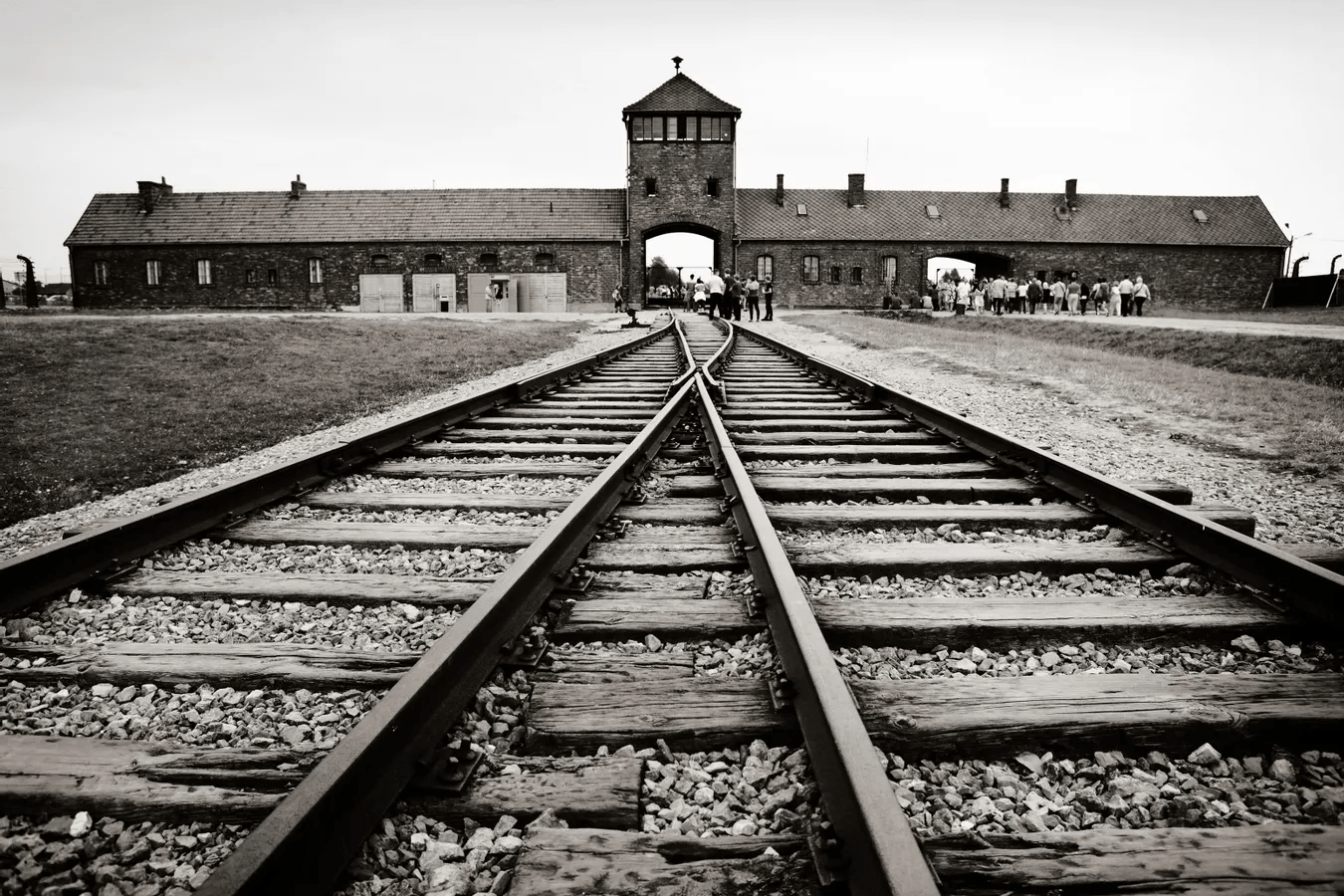
In 1944, a young Jewish couple was deported to Auschwitz, the Nazi death camp synonymous with industrialized murder. Upon arrival, the wife encountered Dr. Josef Mengele, the infamous “Angel of Death.” Against all odds, both survived, though the woman carried a lifelong memory of refusing to throw Jewish bodies into a mass grave despite orders from a German soldier.
Eighty years later, a visitor to Auschwitz expected a solemn tribute to the 1.1 million Jews murdered there. Instead, the official tour largely bypassed the Jewish narrative, focusing heavily on the suffering of non-Jewish Poles. While Polish victims endured horrific brutality, the omission of the central Jewish tragedy left the visitor deeply unsettled.
When Germany invaded Poland in 1939, the country was home to 3.5 million Jews—the largest Jewish population in Europe. Auschwitz began as a prison for Poles but expanded into a complex of death: Auschwitz I, the original camp; Auschwitz II-Birkenau, the primary site of mass gassings; and Auschwitz III-Monowitz, a forced labor hub. By war’s end in May 1945, the Nazis had murdered more than six million Jews—over one million at Auschwitz alone—yet this scale of annihilation was scarcely mentioned on the tour.
The guide cited figures for Polish, Romanian, Soviet, and other prisoners deported to the camp but gave little attention to the fact that most Jewish victims were never registered. Instead, they were sent directly from cattle cars to gas chambers where up to 2,000 were killed each day using Zyklon-B.
Much of the tour centered on Polish prisoners’ suffering—executions, medical experiments, and forced labor. While these accounts are historically accurate, the absence of equivalent detail on Jewish extermination was striking. Photos in the barracks honored Polish professionals and intellectuals, but only a handful depicted Jews, despite the fact that a large proportion of Poland’s pre-war doctors and lawyers were Jewish.
At Birkenau—the epicenter of mass murder—the visit lasted a mere 20 minutes. The wooden barracks, once crammed with up to 150,000 prisoners, stood in stark contrast to Auschwitz I’s preserved brick buildings. Four vast crematoria were destroyed by the Nazis before liberation, and many barracks were dismantled by locals after the war. Without much physical evidence remaining, the responsibility to convey the camp’s true history rests with guides—yet this one claimed she had to remain “objective.”
Objectivity, however, cannot mean erasing the primary victims of the Holocaust. Auschwitz receives thousands of visitors daily, while Birkenau sees only a fraction of that number. Its small bookshop and paid restrooms stand in sharp contrast to Auschwitz’s bustling tourist facilities, symbolizing the disparity in attention and care.
This concern is not isolated. Increasingly, visitors report that Auschwitz’s Jewish history is being sidelined. To counter this, greater emphasis must be placed on remembrance events at Birkenau—such as the March of the Living and JCC Krakow’s Ride for the Living—which honor both the survivors and the memory of the 1.1 million Jews who perished there.
The world must remember Auschwitz for what it was: the largest Jewish cemetery on earth. Anything less is a distortion of history.