Rice is a miracle grain that keeps billions alive—and a quiet accelerant of the climate crisis the world can no longer ignore. The question now is not whether we can give up rice, but whether we have the political courage and practical imagination to grow it differently.
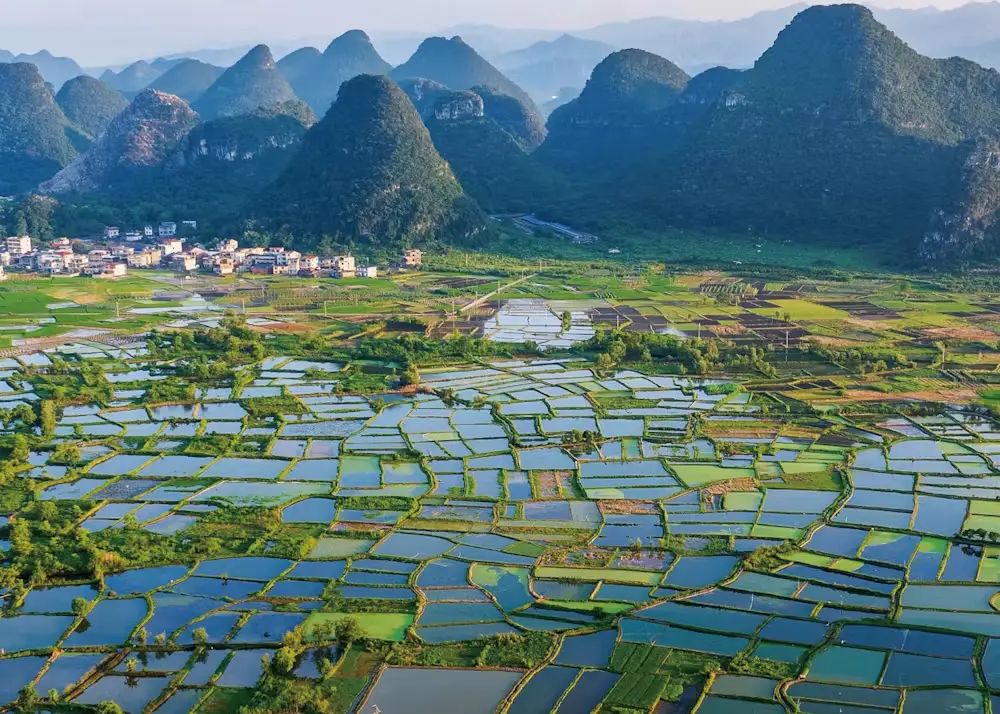
Rice is the daily calorie backbone for roughly half of humanity, especially across Asia and Africa. Yet the way we typically grow it—flooded paddies, season after season—turns vast landscapes into methane factories.
Understanding water, rice fields become oxygen-starved; microbes break down organic matter and release methane, which rice plants then ferry into the atmosphere through their tissues. Methane has a far shorter lifetime than carbon dioxide but a much higher warming punch, especially over a 20‑year period, making it a prime target for rapid climate action. Studies estimate that rice cultivation is responsible for around 10–12% of human-made methane emissions, and roughly half of all greenhouse gases from croplands.
This is the uncomfortable truth: the very system that lifted millions out of hunger is now deepening climate risks that will, in turn, destabilize food security.
How paddies emit methane
The problem is not rice itself, but the production model we have normalized. Continuous flooding keeps soils anaerobic for weeks on end, ideal conditions for methanogenic bacteria. Add crop residues, manures, or other organic inputs, and you feed the microbes that pump methane into the air.
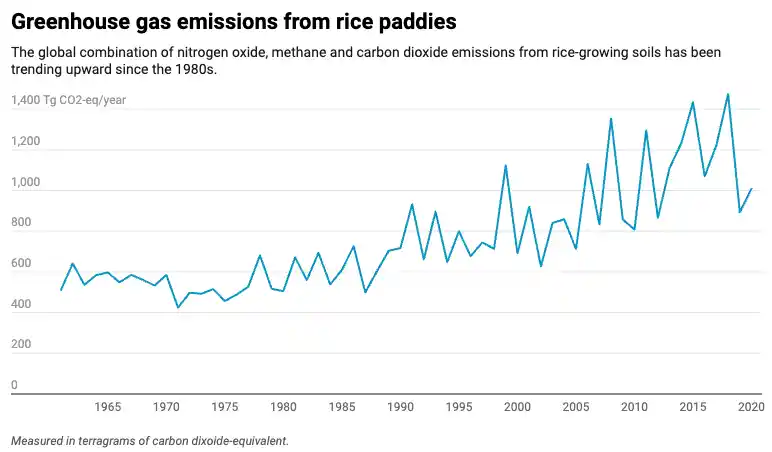
Researchers have shown that relatively simple shifts in water and nutrient management can dramatically curb these emissions. Alternate wetting and drying (AWD)—periodically letting fields drain before re-flooding—supplies oxygen to the soil and suppresses methane formation, while often saving irrigation water. Hybrid and improved rice varieties with shorter growing periods and better nitrogen use can further cut emissions by reducing how long fields stay flooded and how much fertilizer they require.
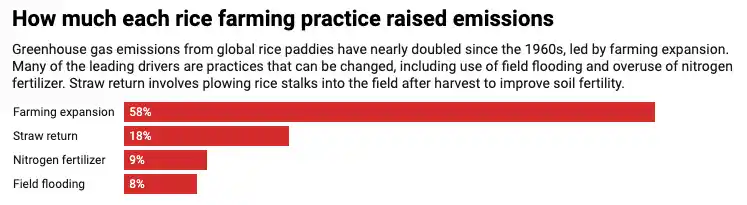
The science is clear: we already have a toolbox to tame rice’s methane footprint. The politics, economics and institutions are far murkier. That tension is visible in two telling national stories—India and Vietnam.
India’s cautious transition
India is one of the world’s largest rice producers, with more than 51 million hectares under paddy cultivation. Flooded rice fields are also a major slice of the country’s climate problem: India’s own reporting estimates that paddy cultivation emitted around 3.2 million tonnes of methane in 2020, roughly 23% of its agricultural methane emissions.
Yet when the Global Methane Pledge—a voluntary commitment to cut methane 30% from 2020 levels by 2030—was launched, India declined to sign. In a written explanation to Parliament, the government argued that methane from paddy and livestock are “survival emissions” from small and marginal farmers, unlike the “luxury emissions” of industrial agriculture in rich countries. It stressed that its Paris Agreement commitments are economy‑wide, not gas‑ or sector‑specific.
This framing is not just diplomatic spin; it reflects real political economy. Millions of Indian farmers rely on water‑intensive, heavily subsidized rice; telling them to change practices—or crops—without robust safety nets is unfair. But the danger of overplaying the “survival emissions” argument is paralysis: if everything is survival, nothing can change.
To its credit, India is not simply defending the status quo. Under the National Mission for Sustainable Agriculture, the government promotes climate‑resilient practices that also lower methane, including better water management in rice. The Indian Council of Agricultural Research, through the NICRA programme, has developed and tested several mitigation options. System of Rice Intensification (SRI) techniques have boosted yields by 36–49% while cutting water use by about 22–35% compared with conventional transplanted rice. Direct seeded rice (DSR), which sows seeds directly into fields without puddling and standing water, avoids continuous flooding altogether and can sharply reduce methane. Crop diversification schemes push farmers to shift some paddy area to pulses, oilseeds and agroforestry, effectively avoiding methane emissions where rice is not strictly necessary.
These are not fringe experiments. They are being scaled through Krishi Vigyan Kendras and national schemes, and recent analysis suggests that DSR can cut methane emissions by up to 40% and AWD by 30–70% under the right conditions, while saving water and sometimes costs. Yet adoption remains patchy, held back by risk aversion, lack of assured procurement for alternative crops, delayed subsidies and thin extension services.
India’s stance today is a study in ambivalence: it is quietly piloting the very practices that could make deep methane cuts possible, while loudly refusing to bind itself to quantified methane targets. That may be tactically shrewd in climate diplomacy. But domestically, it risks underplaying a hard truth—without transforming rice cultivation, India’s climate goals and its long‑term food security will collide.
Vietnam’s bold experiment
If India embodies cautious gradualism, Vietnam increasingly represents a bolder wager: that low‑emission rice can be a competitive advantage, not just a climate obligation. The Mekong Delta, Vietnam’s rice bowl, has embraced alternate wetting and drying not as a niche practice but as a central plank of national policy.
Research by the International Rice Research Institute (IRRI) and partners showed that AWD can significantly cut methane emissions while reducing irrigation water and maintaining yields. Vietnam’s Ministry of Agriculture and Rural Development took those findings and institutionalized AWD in technical guidelines and in the agricultural component of its national climate commitments (NDC). By 2019, AWD had been scaled across about 180,000 hectares in eleven provinces, avoiding an estimated 1.1 million tonnes of carbon‑dioxide equivalent emissions per year.
Crucially, AWD in the Mekong Delta is not just a climate story; it is a livelihoods story. Year‑round AWD has been shown to increase farmers’ profits by around 6% compared with conventional flooding, thanks to lower water and energy costs. Building on this success, Vietnam has launched an ambitious programme to develop one million hectares of “high‑quality, low‑emission rice” in the Mekong Delta by 2030—a vision that blends contract farming, improved varieties, rice‑straw valorization and water‑saving irrigation into a broader circular economy model.
In other words, Vietnam is treating methane‑efficient rice as industrial strategy. Its low‑emission rice initiative is already drawing interest from neighbours like Cambodia, which recently sent officials on a knowledge‑exchange visit to learn about AWD implementation and the one‑million‑hectare programme. Vietnam’s approach is not perfect—smallholders still face climate shocks, and market premiums for “green rice” are nascent—but it has moved from pilot plots to systemic change much faster than most.
Compare this with the global picture: in many rice‑growing regions, climate‑smart agriculture is still treated as a donor‑funded project rather than core national policy. Vietnam shows that, with the right mix of research, public policy and private investment, low‑emission rice can become a national brand.
Brazil’s under‑the‑radar opportunity
If India reflects caution and Vietnam ambition, Brazil represents a quieter but consequential frontier—one where rice is less dominant nationally, yet highly concentrated in ecosystems that make methane mitigation both urgent and tractable. Brazil produces roughly 10–11 million tonnes of rice annually, with nearly 70% coming from irrigated systems in Rio Grande do Sul. These southern paddies, often continuously flooded and highly mechanized, are among Latin America’s most emission‑intensive rice landscapes, but also among the easiest to monitor and manage at scale.
Brazil has not framed rice methane as a headline climate issue in the way Vietnam has, yet the building blocks for a transition are already in place. Research institutions such as Embrapa have spent years refining water‑management regimes—particularly alternate wetting and drying and mid‑season drainage—adapted to local soils and temperate conditions. Field trials indicate that periodic drainage can cut methane emissions by 30–60% without yield penalties, while also reducing pumping costs. Improved cultivars with shorter cycles and better nitrogen efficiency are further shrinking the emissions window. Unlike much of Asia, where millions of smallholders complicate coordination, Brazil’s larger farm sizes and strong producer cooperatives create a different political economy: fewer actors, better access to credit, and tighter links to agribusiness supply chains.
The constraint, as in India, is not science but incentives. Water in southern Brazil is relatively abundant, dulling the urgency to change irrigation practices, and there is as yet no consistent price signal for low‑emission rice. Still, early signals are emerging. Pilot carbon projects are exploring how to quantify and monetize methane reductions from irrigated rice, and sustainability protocols tied to export markets are beginning to reward traceability and environmental performance. If those financial rails strengthen—through domestic carbon markets or buyer‑driven standards—Brazil could pivot quickly, turning its irrigated rice belt into a proving ground for methane‑smart, large‑scale production.
In that sense, Brazil sits between India’s hesitation and Vietnam’s state‑led push: technically ready, institutionally capable, but waiting for clearer economic signals. Should those signals arrive, it may demonstrate a third pathway—where market alignment, rather than mandates alone, drives the shift to low‑emission rice.
The path ahead
Rice’s future will be decided not by a single model, but by how countries navigate three distinct pathways now visible in India, Vietnam and Brazil.
First, technology is not the bottleneck. Across all three cases, the core toolkit—alternate wetting and drying, direct seeded rice, improved varieties, and better nutrient management—already exists and has been field‑tested. Whether in India’s research programmes, Vietnam’s delta‑wide rollout, or Brazil’s Embrapa trials, the evidence is consistent: methane can be cut sharply without sacrificing yields. The real constraints lie in finance, risk, and institutional follow‑through. Farmers will not gamble their staple crop on new practices without insurance, credit, reliable extension services, and markets that recognize lower‑emission production.
Second, political economy shapes pace and ambition. India’s caution reflects the sheer scale of smallholder dependence on rice and the sensitivities around food security and rural livelihoods. Vietnam shows what is possible when the state aligns policy, procurement, and research around a clear low‑emission strategy, turning climate action into a competitive advantage. Brazil, by contrast, highlights a third route: a system that is technically ready and structurally capable of rapid change, but waiting for stronger price signals and market incentives to tip the balance. Together, they show that there is no one‑size‑fits‑all transition—but also no excuse for inaction.
Third, justice arguments cut both ways. India is right to distinguish “survival emissions” from luxury consumption. But climate change will not respect that distinction: erratic monsoons, salinizing deltas, and water stress will hit smallholders first and hardest. The same holds in Vietnam’s Mekong Delta and Brazil’s southern rice belt, where climate variability is already reshaping water availability. Protecting farmers, therefore, does not mean freezing current practices; it means accelerating the shift to systems that are both productive and climate‑resilient.
Finally, the international community has a clear role in determining which pathway dominates. Concessional finance, credible carbon markets for rice methane, and stronger public‑private research partnerships can help countries move from pilot projects to systemic change. Brazil’s emerging carbon projects, Vietnam’s scaling programmes, and India’s vast extension networks could all benefit from such support—if it is designed to reward real, measurable emission reductions.
Rice will remain central to global diets for decades to come. The choice is not whether to grow it, but how. India’s gradualism, Vietnam’s assertiveness, and Brazil’s latent potential together map the terrain of that choice. The coming decade will reveal whether the world treats rice as a stubborn climate problem—or as one of the fastest opportunities to bend the methane curve while securing the food systems billions depend on.