The Afsluitdijk is more than a feat of Dutch engineering; it has become a stage on which the Netherlands and India are quietly scripting a new kind of climate partnership rooted in shared vulnerability and mutual strength. The recent visit of India’s Prime Minister to this iconic dam, alongside his Dutch counterpart, signals that water is no longer a technical afterthought in bilateral ties but a central pillar of strategic cooperation.
When the Netherlands completed the Afsluitdijk in 1932, it effectively redrew its coastline. The 32‑kilometre dam sealed off the storm‑lashed Zuiderzee from the North Sea, transforming a dangerous saltwater inlet into the calmer freshwater IJsselmeer and protecting low‑lying communities that had suffered devastating floods.
The structure rises more than 7 metres above sea level and doubles as a major highway link between the country’s north and west, embodying the Dutch habit of combining safety, mobility and economic development in a single intervention. Behind it lay a political decision, taken after a severe 1916 flood, that patchwork repairs were no longer acceptable and that a bold, long‑term solution was needed.
The Afsluitdijk proved its worth early: during the catastrophic North Sea flood of 1953, when other defences failed, it held firm and shielded the hinterland from disaster. It turned a vulnerable bay into a controlled system of sluices and locks, giving the Dutch state unprecedented control over water levels for flood safety, agriculture and navigation.
A 20th‑century dam in a 21st‑century climate
Today, the same dam is being transformed again under the pressure of climate change. Rising seas and more intense storms have pushed Dutch engineers to reinforce and modernise the Afsluitdijk so it can meet far stricter safety standards than its designers could have imagined in the 1920s.
Since 2019, the Netherlands has launched a multi‑hundred‑million‑euro upgrade that raises the crest in critical stretches, armours the sea‑facing side with thousands of innovative XblocPlus concrete units, and expands sluicing and pumping capacity so river water can still be discharged against higher sea levels. The goal is to ensure the dam can withstand “10,000‑year” storm conditions, reflecting a sober reading of how much more volatile the North Sea could become.
This renovation is part of a broader Dutch programme that allocates many billions of euros to maintaining and upgrading dikes, dunes and river systems before they fail. The Afsluitdijk thus serves as both a symbol and a laboratory for climate‑resilient infrastructure – and it is this dual role that now attracts India’s interest.
India’s water stress at continental scale
India faces water challenges that differ in geography but resonate in their intensity. Instead of one low‑lying delta, it spans monsoon‑dependent agriculture, glacier‑fed rivers, rapidly growing megacities and a 7,500‑kilometre coastline exposed to cyclones and rising seas.
Monsoon variability already exerts a powerful grip on rural incomes, food prices and energy demand, with about half of India’s net sown area still reliant on rainfall rather than assured irrigation. Climate change is amplifying extremes, increasing the incidence of short, intense rainfall events alongside expanded drought‑prone areas, and forcing a costly cycle of relief and repair.
At the same time, sea‑level rise is steadily tightening constraints on India’s coastal cities. Studies show Mumbai has registered among the highest rates of sea‑level increase along Indian coasts, and projections suggest that by 2040 over 10 percent of land in cities like Mumbai and Yanam, and 5–10 percent in Chennai and Panaji, could be threatened by inundation in many scenarios. Himalayan glaciers, meanwhile, are retreating at worrying rates, with research warning that parts of the Hindu Kush–Himalaya could lose a majority of their ice by the end of the century, undermining long‑term water security in the Ganga and Brahmaputra basins.
Against this backdrop, India is forced to think not only in terms of more reservoirs or embankments, but in terms of integrated systems that handle floods, droughts, sea‑level rise and ecosystem health together. It is precisely here that Dutch experience becomes relevant.
A strategic water partnership gains momentum
Over the past decade, India and the Netherlands have steadily upgraded their cooperation on water. In 2021, they elevated this engagement into a Strategic Partnership on Water, committing at ministerial level to work together on water safety, availability and quality.
Under this umbrella, Dutch institutions are collaborating with India’s National Mission for Clean Ganga and several state governments on river rejuvenation, coastal resilience, urban flood management and smart water systems. Joint initiatives include research on delta management, support for basin‑level monitoring and decision support, and pilot projects that integrate nature‑based solutions with hard infrastructure in vulnerable areas such as the Sundarbans.
Knowledge flows in both directions. Dutch experts working on complex Indian rivers report that this experience sharpens their understanding of flood behaviour back home, while Indian agencies gain access to decades of Dutch trial‑and‑error in living with water risk. Indo‑Dutch centres of excellence are emerging as long‑term platforms for innovation, with a focus on AI‑based monitoring, urban water systems and river‑economy linkages.
A visit that turned symbolism into strategy
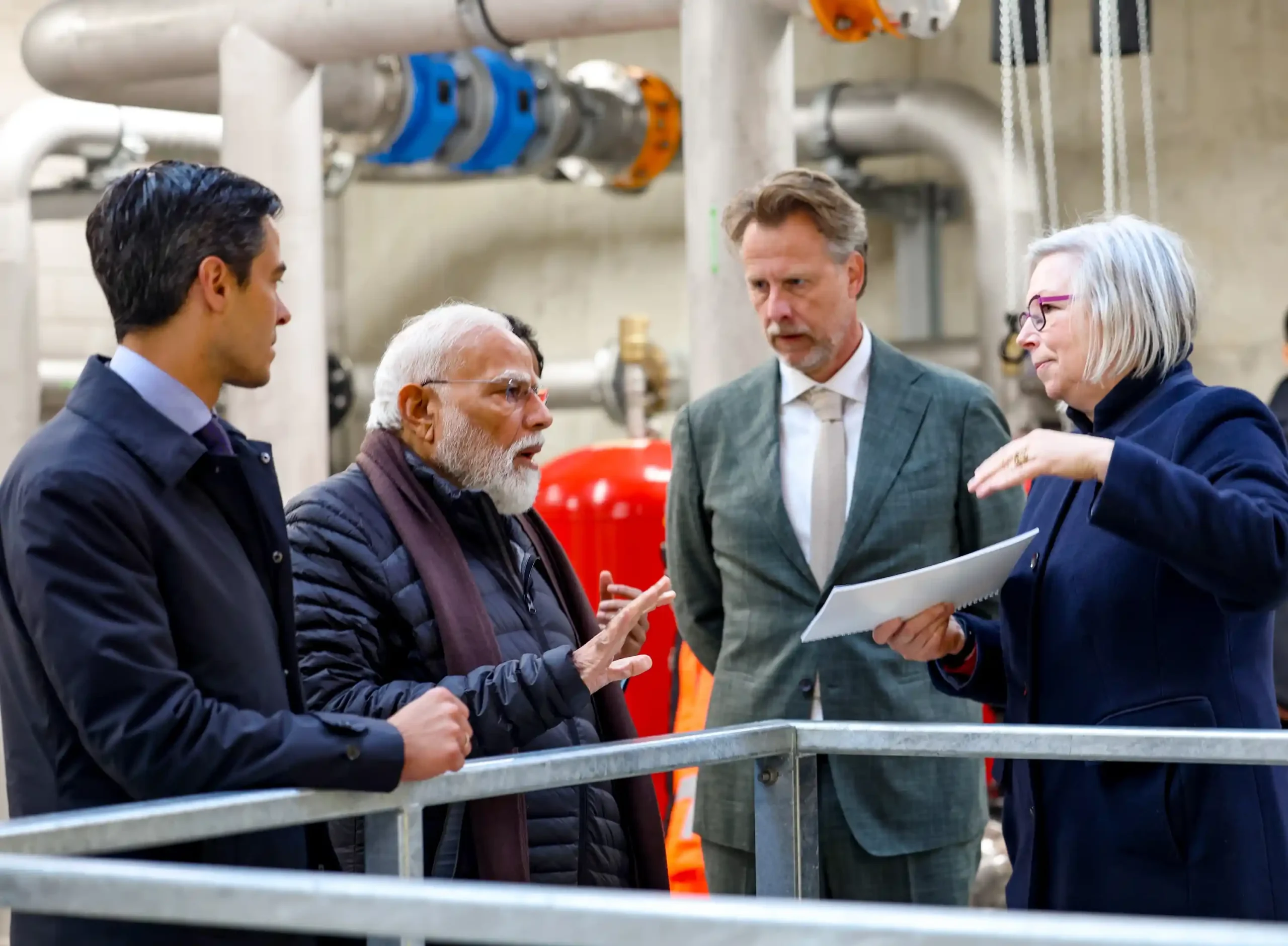
Indian Prime Minister Narendra Modi’s recent visit to the Afsluitdijk has given this partnership a highly visible focal point. Accompanied by Dutch Prime Minister Rob Jetten, he toured the dam, underscoring the structure’s status as a “global benchmark” in flood control, land reclamation and freshwater storage.
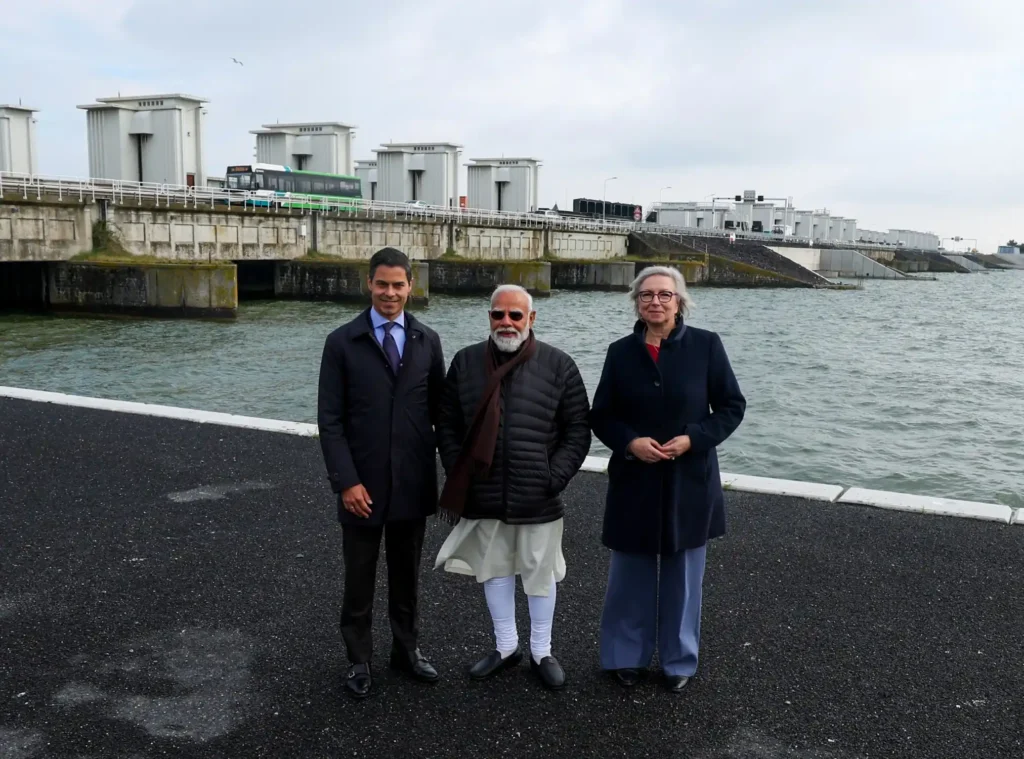
According to India’s Ministry of External Affairs, the visit highlighted the two countries’ shared commitment to innovative water management, climate resilience and sustainable infrastructure. Mr. Modi publicly praised Dutch pioneering work in water resources and stressed that the international community had much to learn from the Netherlands’ approach. In posts and statements, he linked this learning directly to India’s own efforts to adopt modern technology for irrigation, flood control and inland waterways.
Importantly, the visit was not limited to rhetoric. It was timed to coincide with a concrete step: the signing of a Letter of Intent between India’s Ministry of Jal Shakti and the Netherlands’ Ministry of Infrastructure and Water Management for technical cooperation on Gujarat’s Kalpasar project. This transformed a symbolic tour of a famous dam into the launchpad for a specific, long‑term collaboration.
Kalpasar: an Indian echo of the Afsluitdijk
The Kalpasar project, long discussed in Gujarat, aims to create a massive freshwater reservoir across the Gulf of Khambhat by constructing a dam that would also integrate tidal power generation, irrigation canals and transport infrastructure. Much like the Afsluitdijk in the early 20th century, it seeks to convert a challenging marine environment into a multi‑purpose asset for water security, clean energy and connectivity.
By explicitly drawing parallels between Afsluitdijk and Kalpasar, both governments have framed the Dutch dam as a reference point for Indian ambitions. The newly signed Letter of Intent opens the door for Dutch support in hydraulic engineering, coastal protection, sediment management and design optimisation, while allowing India to apply lessons to its own ecological, social and economic realities.
Officials on both sides have emphasised that Dutch expertise in water engineering, combined with India’s capacity for large‑scale implementation, creates opportunities for mutually beneficial partnerships. For India, this cooperation offers a chance to avoid costly mistakes and embed climate resilience into mega‑projects from the outset. For the Netherlands, it represents an opportunity to test and refine adaptation strategies in a demanding, high‑energy coastal environment.
From concrete walls to shared mindsets
The deeper significance of the Afsluitdijk–Kalpasar connection lies not only in the transfer of technology, but in the spread of a mindset. The Dutch have long treated water safety as a non‑negotiable national priority, backed by dedicated institutions and multi‑decade funding streams rather than ad hoc repairs.
India, by contrast, has often been forced into a reactive stance by the sheer scale and diversity of its water risks. Yet the Strategic Partnership on Water and the highly publicised Afsluitdijk visit suggest a deliberate shift toward more anticipatory thinking – toward projects that are evaluated over generations rather than electoral cycles.
The narrative surrounding the visit has been notably positive. Statements from both sides have highlighted innovation, sustainability, and “mutually beneficial” cooperation rather than zero‑sum debates about responsibility. Social‑media posts by leaders and ministers in both countries portrayed the visit as a milestone that “adds new momentum” to a friendship and opens “a massive partnership” in advanced water engineering, freshwater conservation and flood management.
In an era when climate debates can easily slip into pessimism, this framing matters. It positions adaptation as an area where countries can gain by sharing knowledge, where democratic partners can jointly design infrastructure that is both protective and productive.
A quiet template for climate cooperation
The sight of two prime ministers walking along a Dutch dam may seem like routine diplomacy. Yet behind the photo‑op lies a template for how countries can cooperate on climate resilience in tangible, politically durable ways.
The Afsluitdijk represents a century of Dutch experimentation in holding back the sea, now upgraded for a harsher climate. India’s Kalpasar and other large‑scale projects represent a new wave of infrastructure meant to secure water, energy and mobility for a far larger population under far more variable conditions. The choice to connect these two stories formally, through a Letter of Intent and a strategic partnership, illustrates how historical assets and future ambitions can be woven together across borders.
This cooperation is explicitly constructive. It does not ask one country to abandon its way of life; it invites both to refine it. The Netherlands brings deep technical knowledge and a culture of planning around water; India brings scale, urgency and the ability to deploy solutions in challenging environments. Both bring democratic legitimacy and a willingness to learn.
If the 20th century taught that dams and dikes can redefine national geographies, the 21st century is showing that they can also redefine international relationships. The Afsluitdijk began as a line between land and sea; it is now becoming a bridge between two countries that have decided to treat water not as a threat to be feared alone, but as a shared challenge that can bind them together.
In that sense, the image of India’s Prime Minister standing on the Dutch dam beside his counterpart is more than a snapshot of cordial ties. It is a quiet statement that in a warming world, the most enduring partnerships may be built not only on trade or defence, but on the shared determination to keep the water at bay—and to do so in ways that leave both societies safer, more resilient and more confident about the future.