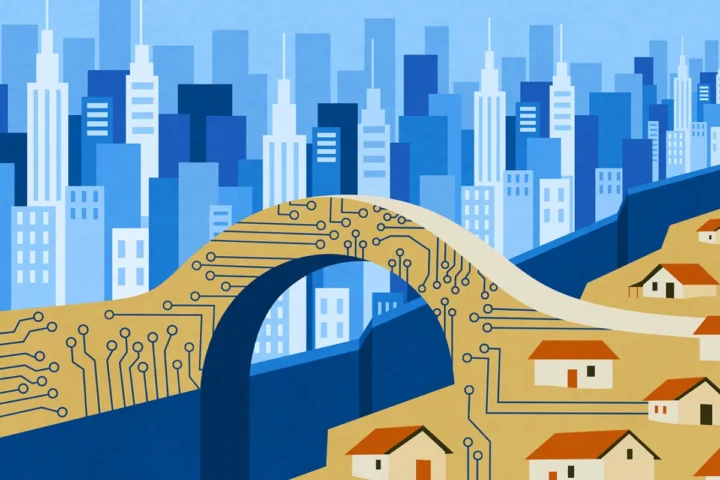

No matter what changes it brings, artificial intelligence (AI) fits into the long arc of human history. Understanding this historical dimension can help us to better critique AI, to use it more wisely – or with greater caution. AI continues the story of communication machines that began with the telegraph and, even further back, the story of animism: the tendency to imbue non-human entities that bear some resemblance to us with a human spirit.
The proliferation of debates about AI bears the marks of this history, even when they claim novelty, marvel at it, or express fear – for example, when people proclaim that AI could never replace the scholar, the artist, the philosopher, and so on, or, conversely, that it will dethrone humanity. This fear is often fueled by minor incidents, such as the case of a “Hong Kong philosopher” book generated by AI, but this says more about the shortcomings of certain types of philosophy and certain readers than it does about the strengths of AI.
Let us take a broader view. Modern technology has long given rise to ghosts in machines that produce language, regardless of the origin of that language. The past two centuries have witnessed a proliferation of “spiritual” technologies. As soon as Samuel Morse’s (1791-1872) telegraph was invented, it sparked beliefs in the possibility of communicating with the dead, and even, without any device, with distant people who were barely human. Books and journals analyzed this “spiritual telegraph,” imagined as connecting all of humanity into a single machine for collective thought.
The radio, before becoming a mass broadcasting machine for a well-formatted program, began as wireless telegraphy, and mysterious voices of distant humans – the dead, the disappeared – floated in the ocean of the ether, whose existence was long believed. The benevolent fairy of electricity radiated through these machines, while its promoters already knew how to hide the costs of coal power stations far from the dazzling lights.
Marconi, Edison, Einstein
Before being dismissed by science, telepathy was one of the “tele-” devices of modern communication at the end of the 19th century. Scientists such as Marconi (1874-1937), Edison (1847-1931) and Einstein (1879-1955) took an interest in these spiritual or spiritualized technologies. A century later, research (The Media Equation by B. Reeves and C. I. Nass, 1996) showed how users − even before the internet and AI − related to their computers and televisions as if they were people with distinct personalities. AI is simply the latest version of this dream of spiritual machines.
But to understand our contemporary passions, we must trace back to before the era of “tele-“(“graph,” “phone,” “vision,” “pathy,” and so on). The ghosts of AI have companions in the long history of animism. This old anthropological term, brought back into fashion, helps us better grasp the dawn of the 21st century. Not only do we seek spirits in animals and trees, but, with seemingly greater success, we communicate with heaps of plastic and metal animated by electricity.
One might object: Yes, but with AI, the spirit is really there. True or false? Even the telegraph translated human language into binary code; similarly, AI adds to this its unsettling ability to regurgitate reassembled human creations. But whatever processing is applied to this data, the language of AI, like that of earlier communication machines, is of human origin.
If AI is a powerful machine, it is an even more powerful belief whose genius was first and foremost rhetorical. Its prophets found for their god a compelling, irresistible name: “artificial intelligence,” for research whose aim was to reproduce forms of human reasoning through machines. The founding myth of this “Church” is the Turing test, which set as the ideal for computer scientists the creation of a machine whose interlocutor, left alone, would not know whether they were dealing with a human or a machine. That was a very particular way of naming and developing technology.
Hybrids of humans and machines
This “Church” has indeed triumphed: Even non-believers and skeptics cannot escape the language of faith. We converse with Claude or ChatGPT; we are surprised when AI “makes a mistake” or when it “hallucinates”; we play along and create semi-human avatars to guide us in life or to help us learn a language. Futurists now predict that soon, we will be hybrids of humans and machines, endowed with semi-machine brains and not mere prosthetics connected to our nerves and muscles.
Beyond the changes underway, placing AI within a historical perspective could help to temper our enthusiasm and to prompt us to reflect on ourselves – poor humans, a bit too eager to repopulate the world with elusive spirits. As with machines of the past, light metaphors – “clouds” and “currents” – conceal the industrial complexity of the process.
We are also far too eager to entrust the management of the world to AI instead of assessing its limits. Energy-hungry AI continues the story of a world damaged by our machines, even as we fantasize that AI might repair past and future harm, including its own.
If it were not too late, one might suggest renaming AI the “algorithmic machine” or “office assistant,” which we would use rather than communicate with. And we would remember that this machine, like our bedside lamps, is at the mercy of power outages that the future surely holds in store, more certain than any technological progress.