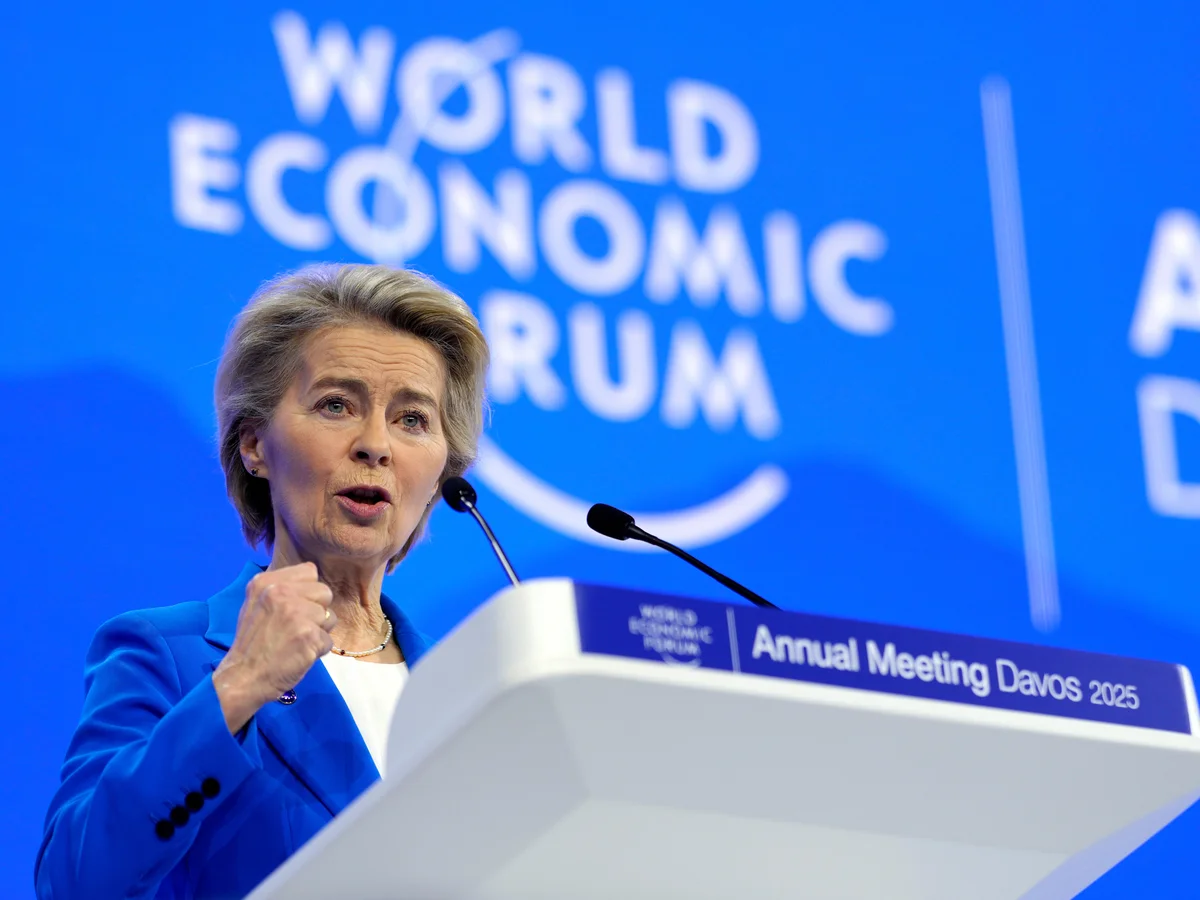
In her address at the World Economic Forum in Davos, European Commission President Ursula von der Leyen described the impending EU-India Free Trade Agreement (FTA) as the “mother of all deals.” She stated: “We are on the cusp of a historic trade agreement. Some call it the mother of all deals. One that would create a market of 2 billion people, accounting for almost a quarter of global GDP.” This characterization reflects the agreement’s scale: combining the European Union’s population of approximately 450 million with India’s 1.44 billion would form one of the world’s largest integrated markets, representing roughly 24-25% of global GDP based on current IMF projections (EU ~$20 trillion nominal GDP; India ~$4-4.5 trillion in 2025-26 estimates).
Negotiations, relaunched in 2022 after stalling in 2013, have accelerated amid geopolitical shifts, including U.S. tariff uncertainties under evolving policies. As of January 2026, multiple sources, including Reuters, BBC, and official statements, indicate the deal is nearing conclusion. An announcement of concluded negotiations is expected imminently, potentially formalized at the India-EU summit in New Delhi around January 27, 2026. The pact encompasses tariff reductions on goods, services liberalization, investment protection, geographical indications, public procurement access, and enforceable sustainability chapters on labor, environment, and climate.
Baseline Trade Data: Current EU-India Economic Interdependence
The EU stands as India’s largest trading partner bloc, while India ranks as the EU’s 9th largest overall. Bilateral merchandise trade reached €120 billion (~$140 billion) in 2024, per European Commission data, equivalent to 11.5% of India’s total external trade. Indian fiscal year 2024-25 figures show bilateral goods trade at approximately $136-136.53 billion, with India’s exports to the EU at $75.85-76 billion and imports from the EU at $59-60.68 billion (sources: Ministry of Commerce India, PIB, Reuters).
Key Indian exports to the EU include:
- Textiles and garments (facing average tariffs of up to 12% in some categories)
- Chemicals and pharmaceuticals
- Machinery, appliances, and base metals
- Jewelry and leather products
EU exports to India dominate in:
- Machinery and transport equipment (including automobiles and aircraft)
- Chemicals and pharmaceuticals
- Optical and precision instruments
Services trade has grown rapidly, totaling over €66 billion in 2024 (EU imports ~€37 billion, exports ~€29 billion), more than double the €30.4 billion in 2020. A significant portion involves IT, business process outsourcing, and financial services, where India holds a surplus.
Over the past decade, goods trade has expanded by nearly 90%, while services have more than doubled, underscoring untapped potential constrained by average applied tariffs (EU on Indian goods ~3.8% overall, but higher in labor-intensive sectors; Indian tariffs on EU goods often 10-20%+ in automobiles, wines, and machinery).
Projected Economic Impacts: Quantitative Estimates
Independent studies and post-negotiation projections highlight substantial gains. A 2020 European Parliament-commissioned study (updated scenarios) estimated that a comprehensive FTA could boost EU exports to India by 20-60% in optimistic models, with merchandise exports potentially reaching €112.5 billion by 2032 (a 107.6% increase from baseline levels, per International Economics Consulting analysis). Indian exports to the EU could see similar proportional gains, particularly in value-added sectors.
Bilateral merchandise trade is forecasted to climb toward $250 billion by 2030-31 in optimistic scenarios, from the current ~$136 billion. Combined goods and services trade could exceed $300 billion annually within a decade post-implementation.
Macro-level effects include:
- GDP uplift: CGE models (e.g., from pre-2022 assessments) suggest India’s GDP could rise by 0.3-1% cumulatively over 10 years due to enhanced export competitiveness, technology transfer, and FDI inflows. For the EU, gains are estimated at 0.1-0.5% GDP, driven by market access in a high-growth economy (India’s average annual growth ~6-7% per IMF).
- Employment: In India, labor-intensive sectors like textiles, apparel, jewelry, and pharmaceuticals could generate millions of jobs. Projections indicate export-led manufacturing growth could add 1-2 million direct jobs in these areas, with multiplier effects in supply chains. For the EU, automotive, machinery, and services sectors could see employment stabilization or modest gains through expanded exports.
- FDI flows: The investment protection chapter (including ISDS mechanisms) is expected to boost EU FDI into India, which stood at ~€100 billion cumulative stock pre-2025. Reduced risks could accelerate inflows into green energy, digital infrastructure, and manufacturing.
Sector-specific data:
- Automobiles: EU firms (e.g., German manufacturers) face 60-100%+ Indian tariffs; reductions could increase EU car exports significantly, while Indian auto parts gain tariff-free access.
- Textiles/Apparel: Indian exports (~€10-15 billion annually to EU) face peak tariffs; elimination could restore competitiveness lost from GSP+ graduations.
- Pharmaceuticals: India supplies ~20-25% of EU generics; streamlined regulations and IP provisions could expand this.
- Services: Mode 4 (movement of professionals) liberalization could boost Indian IT/BPO exports by 30-50% in targeted models.
Strategic and Geopolitical Dimensions
Beyond pure economics, the FTA aligns with de-risking strategies. The EU seeks diversification from over-reliance on certain Asian suppliers, while India pursues “China+1” manufacturing shifts and reduced dependence on single markets. In a fragmented global trade environment, with potential U.S. tariff escalations, the deal provides resilience. It covers sustainable development with binding commitments, supporting EU Green Deal goals (e.g., carbon border adjustments) and India’s net-zero ambitions by 2070.
Challenges remain: India seeks safeguards for agriculture (dairy, poultry) and sensitive sectors, while the EU prioritizes strong IP enforcement and labor standards. Balanced outcomes are emphasized in recent rounds.
In quantitative terms, the agreement could elevate bilateral ties from a €120-140 billion goods/services baseline to a multi-hundred-billion-dollar partnership, fostering supply chain integration in strategic sectors like semiconductors, renewables, and digital tech.
Ursula von der Leyen’s “mother of all deals” framing captures this transformative potential: not merely incremental trade growth, but a strategic economic bridge between two major democracies representing nearly a quarter of humanity and global output. As negotiations conclude in early 2026, implementation will test whether these projections materialize, delivering mutual prosperity in an uncertain world.
References and Further Reading
European Commission. (n.d.). EU trade relations with India. Directorate-General for Trade. https://policy.trade.ec.europa.eu/eu-trade-relationships-country-and-region/countries-and-regions/india_en (This is the primary official source for bilateral trade figures, including €120 billion in goods trade for 2024, sector breakdowns, and India’s position as the EU’s 9th largest trading partner.)
Council of the European Union. (n.d.). EU-India trade facts and figures [Infographic]. https://www.consilium.europa.eu/en/infographics/eu-india-trade-facts-and-figures (Provides detailed 2024 goods trade data: €120 billion total, €71.4 billion EU imports from India, €48.8 billion EU exports to India, and decade-long growth trends.)
Von der Leyen, U. (2026, January). Special address by the President von der Leyen: World Economic Forum [Speech]. European Commission. https://ec.europa.eu/commission/presscorner/detail/en/speech_26_150 (Direct transcript of the Davos 2026 speech where von der Leyen refers to the EU-India FTA as the “mother of all deals,” mentions a market of 2 billion people, and discusses its historic and strategic significance.)
Reuters. (2026, January 23). India-EU free trade pact: What’s agreed, what’s at stake after years of talks. https://www.reuters.com/sustainability/climate-energy/india-eu-free-trade-pact-whats-agreed-whats-stake-after-years-talks-2026-01-23 (Details current negotiation status, tariff barriers, e.g., weighted-average Indian tariffs ~9.3% on EU goods, EU tariffs on Indian goods, and potential impacts like restoring competitiveness lost from GSP withdrawals.)
Reuters. (2026, January 20). EU nears historic trade deal with India, von der Leyen says. https://www.reuters.com/world/india/eu-nears-historic-trade-deal-with-india-von-der-leyen-says-2026-01-20 (Reports von der Leyen’s Davos statement on being “on the cusp” of the agreement and its characterization as the “mother of all deals.”)
BBC News. (2026, January). India and EU set for ‘mother of all deals’ as Trump’s tariffs bite. https://www.bbc.com/news/articles/ckgyz1ejw9no (Covers the geopolitical context, including references to von der Leyen and Piyush Goyal calling it the “mother of all deals,” and strategic diversification amid U.S. tariff risks.)
European Parliament. (2020). Assessing the potential impact of an EU-India trade agreement (Study No. EPRS_STU(2020)642841). Directorate-General for Parliamentary Research Services. https://www.europarl.europa.eu/RegData/etudes/STUD/2020/642841/EPRS_STU(2020)642841_EN.pdf (Comprehensive ex-ante economic impact study using CGE modeling; includes scenarios for trade boosts of 20–60% in EU exports, comparisons to EU-South Korea FTA effects, and sector-specific projections.)
International Economics Consulting. (2025). European Union (EU27) – India: Trade updates [Report]. https://tradeeconomics.com/wp-content/uploads/EU-India-Trade-2024Q2_Final-V1.pdf (Provides projections: EU exports to India potentially reaching €112.5 billion by 2032, a 107.6% increase; bilateral merchandise export growth estimates.)