For decades, Seoul and New Delhi maintained a cordial, technically respectable partnership that never quite rose to the level of strategic necessity. South Korean President Lee Jae-myung’s visit to India was overdue because the relationship itself had become overdue for seriousness. That has changed. The recent visit marks the moment both capitals admitted that the old relationship was too small for a world of tariffs, chips, supply-chain shocks and great-power pressure.
The long delay was not an accident. It reflected habit, not hostility. India was busy building ties with the U.S., managing China, consolidating its Gulf relationships and asserting itself across the Global South. South Korea, meanwhile, spent years focused on North Korea, its security dependence on the United States and the awkward reality of doing business with China while worrying about China. In that crowded diplomatic calendar, India–Korea ties were important, but never urgent enough to force a summit breakthrough.
Trade explains much of the lag. The two countries signed a Comprehensive Economic Partnership Agreement in 2010, but the pact never became the engine of commerce either side hoped for. Bilateral trade has grown, but not with the kind of momentum that turns goodwill into political momentum. The problem has not been a lack of intent so much as a mismatch of expectations. Indian firms have long complained that Korean markets remain hard to enter. Korean firms have often found India attractive in theory and frustrating in practice. Negotiators spent years circling the same issues: tariffs, non-tariff barriers, rules of origin and the basic question of whether the agreement produced enough balance to justify its politics.
That is why the renewed push to upgrade CEPA matters so much. Both sides now speak of a $50 billion trade target by 2030, but the number is less important than the signal it sends. They are no longer treating the relationship as a symbolic supplement to larger alliances. They are trying to build a commercial architecture that can survive geopolitical volatility. That is a more serious ambition. It also reflects a hard truth: in the 2020s, trade agreements are no longer just about goods. They are about resilience, technology access, industrial strategy and economic security.
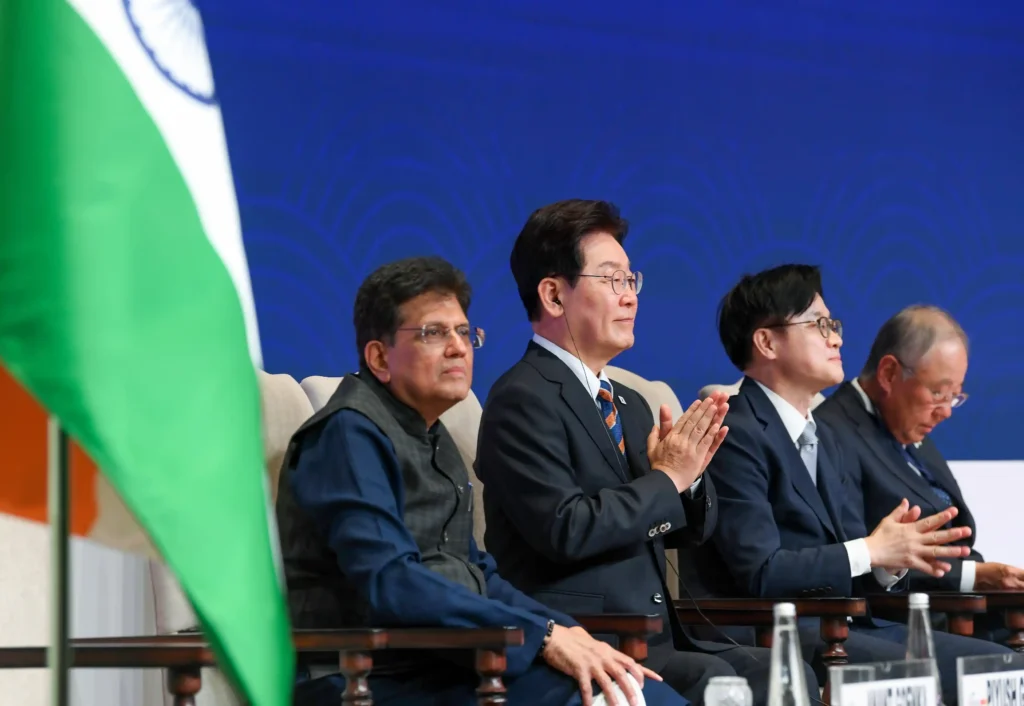
The real opportunity lies in technology. India and South Korea are no longer merely discussing automobiles and steel. They are talking about semiconductors, artificial intelligence, digital infrastructure, payments, battery supply chains and advanced manufacturing. That shift matters because the next decade will reward countries that can combine market scale with industrial depth. India brings the former; South Korea brings the latter. India has talent, data scale and a booming digital public infrastructure. South Korea has manufacturing discipline, export sophistication and deep experience in high-technology production. Together, they can do more than trade. They can co-build.
This is also why the “Digital Bridge” idea has significance beyond diplomacy-speak. It suggests that the two countries understand the strategic value of shared digital standards, interoperable systems and trusted technology partnerships. In a world where chips, cloud systems and AI models are increasingly tied to national security, a bilateral relationship that moves from software contracts to ecosystem cooperation is something much bigger. It is a way of reducing dependence on a narrow set of suppliers while opening up new industrial corridors.
Defense is another underappreciated pillar. South Korea has become an increasingly serious defense-industrial power. India, for its part, wants to indigenize more of its military production and reduce reliance on imports that can be vulnerable to political delay. The fit is obvious. Korean firms can supply equipment, technology transfer and manufacturing know-how. India offers scale, strategic demand and a market that rewards long-term industrial partnerships. Cooperation in artillery, cyber security, telecom equipment and co-development could help the relationship move from transactional procurement to strategic manufacturing.
Shipbuilding may be the most commercially underrated area of all. South Korea is one of the world’s great shipbuilding nations. India wants to expand maritime capacity, modernize ports and strengthen its blue-economy ambitions. That is not a trivial overlap. In the age of supply-chain nationalism, shipbuilding is a strategic industry, not just an industrial one. If the two countries build cooperation around ports, logistics, ship repair, vessel construction and maritime finance, they could create an economic lane that is both profitable and geopolitically meaningful.
There is a broader story here about the Global South. India has worked hard to present itself as the South’s leading voice: a large democracy, a postcolonial power, a bridge between developed and developing worlds. South Korea has increasingly cast itself as a “global pivotal state,” a country that is neither a superpower nor a passive bystander, but a middle power that can shape outcomes. That overlap is newly important. The Global South is often discussed as if it were a bloc. It is not. It is a field of competing ambitions. What India and South Korea can offer is a more practical model: a partnership between a large emerging democracy and an advanced industrial democracy that creates technology, capacity and jobs rather than just rhetoric.
That could subtly realign the concept of the Global South itself. Instead of a coalition defined mainly by grievance or resistance to the West, it could become a network of states building leverage through production, innovation and standards-setting. India brings political heft and market size. South Korea brings credibility as a manufacturing powerhouse that once climbed the development ladder and can now help others do the same. Together, they can show that the South does not need to be merely defensive. It can be constructive, technologically ambitious and commercially disciplined.
The geopolitical timing is ideal. Global supply chains are fragmenting. Countries are hedging more aggressively. Security and commerce are no longer separate conversations. India wants trusted partners that can help it deepen manufacturing and reduce exposure in critical sectors. South Korea wants to diversify beyond its traditional dependencies and avoid overconcentration in a volatile region. Both want more strategic autonomy without pretending that interdependence has disappeared.
That is why this visit took so long and why it matters now. For years, the relationship lacked urgency because it had not yet found a shared strategic language. Trade alone was too weak, symbolism too easy, and ambition too modest. Now the language is clearer: technology, industrial capacity, defense production, maritime resilience and a more serious role in shaping the Global South. If India and South Korea follow through, this visit may be remembered not as a diplomatic courtesy, but as the moment two major Asian democracies decided to stop underperforming and start building something that matches the world around them.