The global housing crisis is not a mystery. Its dimensions are well-documented, its victims numerous: more than 1.8 billion people worldwide lack access to adequate, affordable shelter. What remains scarce is not diagnosis but political will — the courage to pursue models that sit outside the tired binary of private market and state provision. Uruguay, a country of 3.4 million people wedged between Brazil and Argentina, has been quietly running one of the most instructive experiments in democratic housing for over half a century. The rest of the world has barely noticed.
Housing cooperatives are not a radical idea. The basic premise is simple: residents collectively own and manage their buildings, pooling resources and sharing decision-making through democratic processes. Several European cities have made cooperatives central to their housing strategies. In Zurich, nearly a fifth of all housing stock is cooperative. Yet across much of Latin America — a region with a deep tradition of community-driven mutual aid — housing cooperatives have struggled to gain institutional traction, undermined by weak legal frameworks and inconsistent political support.
Uruguay is the exception, and the reasons why matter enormously.
The story begins in the 1960s, a period of severe economic distress. Uruguay’s first cooperative pilot projects were not ideological statements — they were practical responses to crisis. Financed through a combination of government funds, Inter-American Development Bank loans, and member contributions, these early cooperatives outperformed conventional housing on every relevant metric: cheaper to build, faster to complete, higher in quality. The results were hard to argue with, and in 1968 Uruguay passed its National Housing Law, formally recognizing cooperatives and establishing the legal scaffolding they needed to grow.
The law enabled two primary models. The first, a savings cooperative, asks members to pool enough capital to cover roughly 15% of construction costs, unlocking access to a government-subsidized mortgage for the remainder. Members purchase shares proportional to their unit’s value; those shares are inheritable and partially refundable should a member choose to leave. The second model — mutual aid — removes the savings barrier entirely. Households contribute 21 hours of labor per week toward construction instead, with tasks allocated according to skill and capacity, ranging from physical labor to ordering materials to administrative work. Both models share a foundational principle: the land and housing are held collectively and permanently removed from the private market.
This is not a minor detail. It is the architecture of long-term affordability. Once established, cooperatives charge members a monthly fee covering loan repayment and maintenance. In exchange, members hold an unlimited, inheritable right of use — genuine housing security, not a temporary lease subject to market whims. If someone leaves, they are reimbursed for their contributions minus a small retention kept by the cooperative. The model is designed to serve people across the income spectrum, but its greatest impact is at the bottom of that spectrum, where housing insecurity is most acute and alternatives most scarce.
Today Uruguay counts 2,197 housing cooperatives, housing approximately 5% of the country’s households. About half are concentrated in Montevideo, the capital, where over 1,000 cooperatives operate, ranging from intimate clusters of a dozen homes to complexes with 700 apartments. This scale did not emerge from goodwill alone. It required institutional architecture: a legal framework with clear rights and obligations, state oversight, access to land, and two powerful federations that organize and advocate on behalf of cooperative members. FECOVI represents over 100 savings cooperatives. FUCVAM, the larger and more politically active federation of mutual aid cooperatives, represents more than 35,000 households across 730 cooperatives, offering legal counsel, management training, and conflict mediation to its members.
Crucially, Uruguay also institutionalized independent technical support. The National Housing Law recognized nonprofit Technical Assistance Institutes — organizations that advise cooperatives through the labyrinthine complexity of large-scale construction. Most people who want a home have no background in project management or structural engineering. These institutes bridge that gap. Without them, the model would have remained the province of the already-organized, already-capable. With them, it became genuinely accessible.
What is perhaps most remarkable about Uruguay’s cooperative housing sector is its capacity to evolve. The earliest cooperatives followed Garden City ideals, building low-density homes on the urban periphery — a model that, over time, contributed to sprawl, longer commutes, and inefficient land use. As Montevideo’s historic center began to empty and decay in the 1970s, cooperatives adapted. Thirteen mutual aid cooperatives were established in the historic Ciudad Vieja district, accounting for around 6% of all housing units there and helping to stabilize a neighborhood at risk of hollowing out entirely.
Among the most striking of these is MUJEFA — Mujeres Jefas de Familia, or Women Heads of Household — founded in 1995 by low-income single mothers. Led by architect Charna Furman, the project set out to address a structural problem: housing systems, like most systems, were designed around male breadwinners, leaving single women without savings, credit history, or institutional support. MUJEFA didn’t just build homes; it built them specifically for women, by women, in a central location that kept residents close to jobs, schools, clinics, and community. A derelict heritage building was transformed into 12 apartments. The cooperative model had to flex — municipal authorities temporarily relaxed certain regulations to allow historic buildings to be rehabilitated — but the principle held. Today, 12 women and their children live there in security.
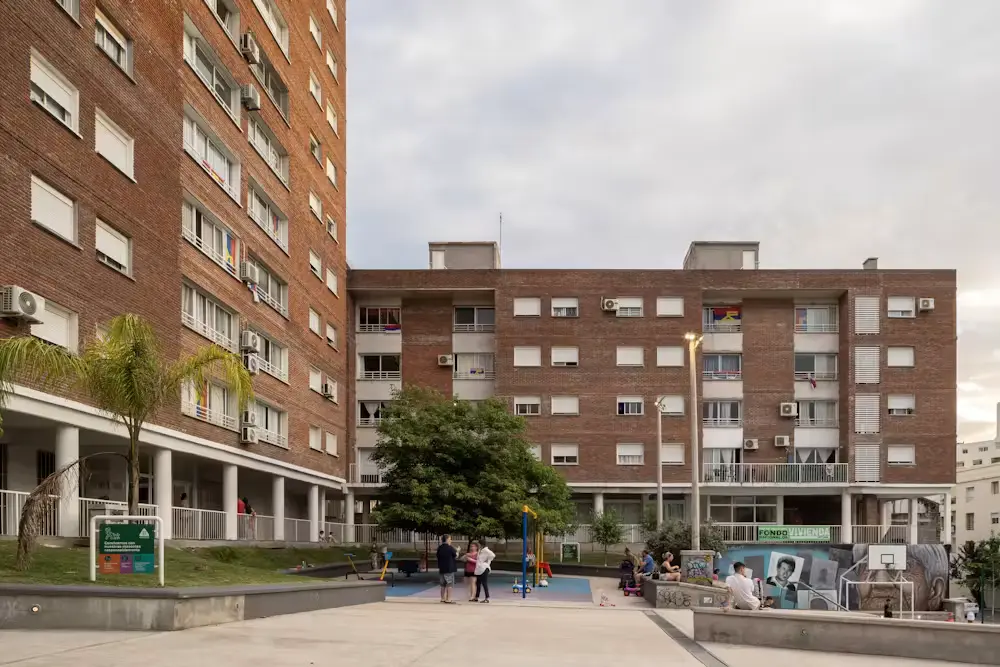
More recently, cooperatives have moved vertical. COVIVEMA 5, completed in 2015, became Uruguay’s first high-rise mutual aid cooperative in a central Montevideo neighborhood, housing roughly 300 residents across 55 units. Members trained in vertical construction and safety protocols, working alongside skilled labor when necessary. They also built a public square for the neighborhood — an act of civic generosity built into the model’s DNA.
The lesson Uruguay offers is not that housing cooperatives are a silver bullet. They require sustained state investment, clear legal frameworks, technical expertise, and organized civil society. They are neither a public housing project nor a private development — they are something more demanding and more rewarding than either. Residents are not recipients or consumers; they are owners, builders, and decision-makers.
In a world where the affordable housing crisis is deepening, and where the political appetite for bold public housing programs has largely collapsed, the cooperative model deserves serious attention. Not as a utopian ideal, but as a proven, replicable mechanism — one that a small South American nation has spent 50 years quietly perfecting. The question is not whether it works. Uruguay has answered that. The question is whether other governments have the institutional courage to try.