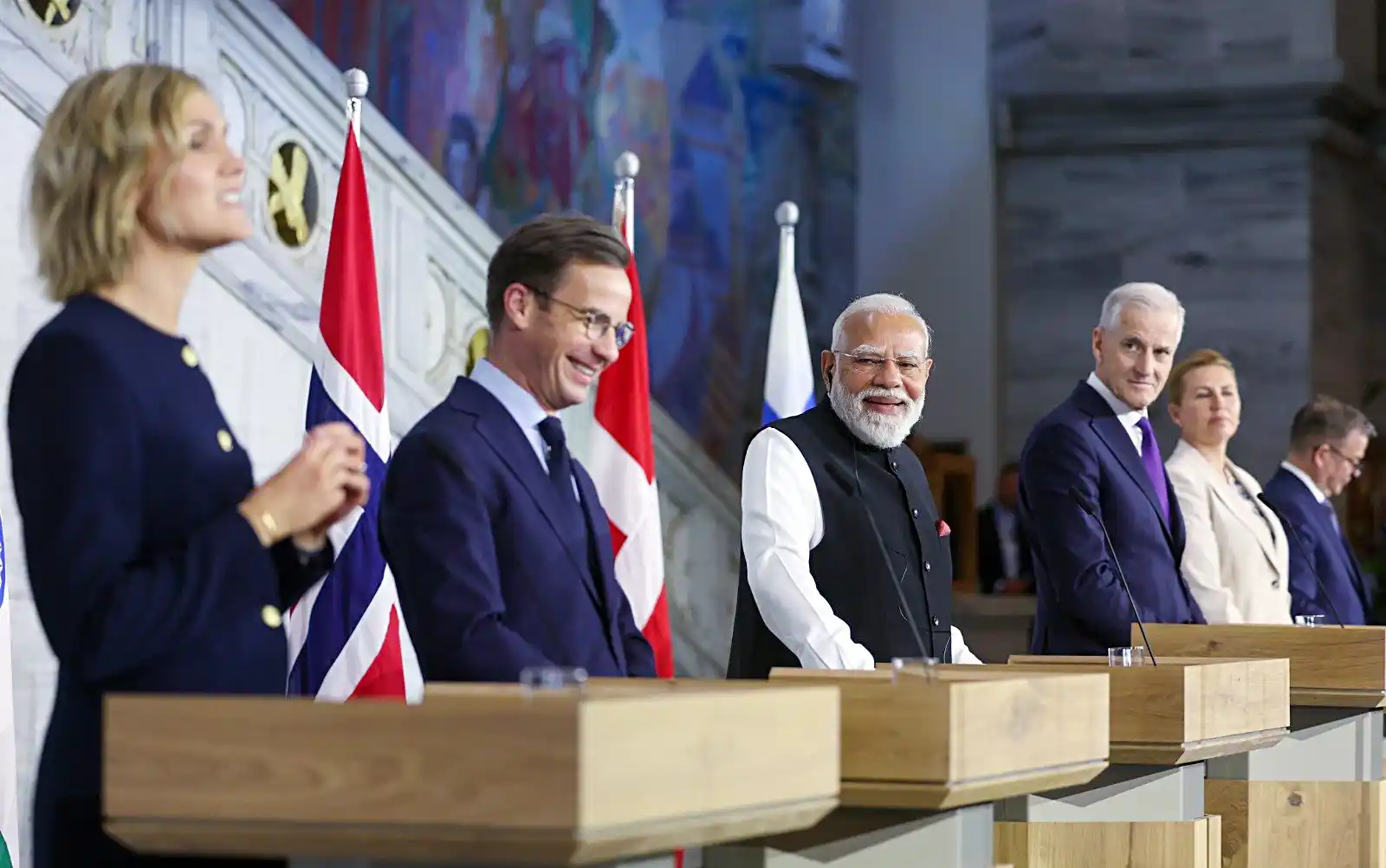
The Norwegian capital Oslo hosted the third edition of the India–Nordic Summit, a gathering that, on the surface, brought together the leaders of India and five small Nordic states around a shared agenda of climate and technology. Beneath the surface, however, something more consequential was taking shape. Denmark’s Prime Minister Mette Frederiksen looked across the table at India’s delegation and said aloud what many in Western policy circles had long been reluctant to declare: India is “not a middle power, but one of the world’s greatest powers.” That statement, delivered in Oslo, may well serve as a marker for when Europe’s official perception of India permanently shifted.
The 3rd India–Nordic Summit was not merely another diplomatic rendezvous on the calendar of an increasingly busy Indian foreign policy. It was the moment a relationship that had been, at best, a “nice-to-have” arrangement crystallised into a strategic alignment, one explicitly framed around green technology, digital governance, Arctic affairs, and the architecture of a new global order. Understanding why this matters requires looking closely at what was agreed, what was said, and what it all signals about India’s evolving place in the world.
The most concrete development at Oslo was the elevation of India–Nordic ties to a “Green Technology and Innovation Strategic Partnership.” This is not mere semantic upgrading. By explicitly linking cooperation to the clean energy transition, trade and investment flows, and the blue economy — covering oceans, shipping, and fisheries — the five Nordic states and India committed to a structured, purpose-driven relationship rather than the generalist political dialogue that had characterised earlier summits.
The timing was propitious. The India–EU Free Trade Agreement had been concluded just months earlier in January 2026, and the India–EFTA Trade and Economic Partnership Agreement, which includes Norway and Iceland, had been operationalised in late 2025. These frameworks provided institutional scaffolding for the ambitions declared at Oslo. Under the TEPA alone, EFTA states have committed to a 100-billion-dollar investment ambition in India over fifteen years, with a meaningful portion earmarked for green hydrogen and digital infrastructure. Bilateral trade in goods and services between India and the Nordic countries already stands at approximately 19 billion dollars, split roughly equally between exports and imports, while over 700 Nordic companies currently operate in India. The summit’s roadmap was designed to deepen and accelerate this economic integration, with India specifically inviting Nordic firms to use GIFT City as a financial and technology hub and to enter sectors ranging from shipbuilding to renewable energy to defence.
The logic of the partnership is mutually reinforcing. Nordic states are global leaders in wind energy, green hydrogen, geothermal technology, battery systems, maritime decarbonisation, and digital governance. India, for its part, offers scale — a vast market, a manufacturing base energised by the Make in India programme, and a talent ecosystem that few countries in the world can match. For Nordic innovation to achieve global impact, it needs markets and manufacturing partners of India’s size. For India’s green and digital ambitions to be realised, it needs the technological depth that Nordic economies have spent decades cultivating. The Strategic Partnership formalises this complementarity.
Climate Leadership, Not Supplicant
Perhaps the most politically significant dimension of the Oslo summit was how it reframed India’s position in global climate diplomacy. For too long, the standard narrative in Western policy discourse cast India as a reluctant participant in the climate transition — a large emitter resistant to binding targets, a country that needed cajoling and financing before it would act. Oslo delivered a decisive rebuttal to that narrative.
Nordic leaders explicitly endorsed India’s Mission LiFE — the Lifestyle for Environment initiative — and the Leadership Group for Industry Transition (LeadIT 3.0), both Indian conceptual contributions to global climate architecture. This is not the language of a donor-recipient relationship; it is the language of co-architects. When five of the world’s greenest and most innovation-driven economies rally behind frameworks conceived in New Delhi, they are acknowledging that large-scale climate solutions will be shaped by India, not merely implemented there.
The joint emphasis on affordable climate finance, technology transfer, and capacity building for developing countries further underscored India’s role as a bridge. New Delhi is not simply advocating for itself; it is channelling the priorities of the Global South — equity, access, and just transition — into a dialogue with advanced Nordic economies. This bridge function gives India a form of diplomatic leverage that no other major emerging economy can replicate with quite the same credibility. India speaks the language of development finance to the Global South and the language of technology partnerships and rule-based order to the Global North, and it is increasingly fluent in both.
Setting the Terms of the Digital Age
The Oslo summit’s digital and AI agenda carried implications that extend well beyond bilateral cooperation. Leaders agreed to deepen joint work on secure and trusted digital infrastructure, industrial research and development, and artificial intelligence, with a shared emphasis on what they called “inclusive, human-centric AI.” Nordic leaders explicitly welcomed India’s hosting of the AI Impact Summit in New Delhi in February 2026 — an acknowledgement of India’s growing convening power on some of the most contested questions in global technology governance.
This matters because the rules of the digital age are still being written. Standards for AI ethics, digital identity systems, payment architectures, and data governance will shape economic and political power for decades. India has already demonstrated, through its digital public infrastructure — Aadhaar, UPI, the open credit stack — that it is capable of building systems that can be adopted, adapted, and scaled globally. Nordic cooperation in 6G, quantum computing, semiconductors, and AI now positions India not as a market for others’ digital products but as a co-designer of the norms and systems that will define the next generation of the global economy. Sweden’s Ericsson, active in the 6G ecosystem, and the broader Nordic semiconductor and software landscape, are being drawn into partnership with India’s talent base and regulatory frameworks in ways that will shape global standards.
The Arctic Frontier
One of the summit’s quieter but strategically revealing outcomes was the agreement to deepen India–Nordic collaboration in the Arctic. The two sides agreed to explore joint research projects and formalised India’s role as a constructive observer in the Arctic Council. Areas of cooperation include scientific research, sustainable Arctic economy, maritime cooperation, and the integration of indigenous knowledge into environmental governance.
India’s engagement with the Arctic has historically been viewed with some puzzlement in Western capitals — what business does a tropical nation have in polar affairs? Oslo provided an answer. As climate change accelerates the opening of Arctic shipping routes and unlocks energy resources in the region, India’s energy security and blue economy strategy are directly implicated. The Nordic states, who collectively dominate Arctic governance, are now welcoming India as a scientifically and strategically engaged stakeholder rather than a peripheral observer. This represents a qualitative shift: India is moving from the margins of Arctic governance toward active participation in shaping its future.
A New Place in the Global Order
Taken together, the outcomes of the Oslo summit paint a coherent picture of where India stands in 2026. It is not a middle power managing its relationships with great powers; it is itself a great power managing coalitions and setting agendas. The explicit framing by Denmark’s Prime Minister was significant precisely because it came from a European head of government — a signal to Western policy circles that the old taxonomy no longer applies.
India’s position at Oslo exemplified what might be called strategic multi-dimensionality. On climate, it is simultaneously a large developing economy with legitimate equity concerns and a conceptual innovator whose frameworks advanced nations are adopting. On technology, it is both a massive consumer market and an emerging norm-setter for AI and digital governance. On geopolitics, it backs multilateral reform and a rule-based order while maintaining the strategic autonomy to engage across geopolitical divides. On Arctic affairs, it is a near-polar actor whose scientific engagement is shaping a region it does not border.
The 150 Indian companies operating in the Nordic region and the 700-plus Nordic firms present in India represent the economic foundation of this evolving relationship. The 100-billion-dollar investment ambition under TEPA is its financial expression. The Strategic Partnership elevated at Oslo is its institutional form. But the deeper significance lies in what the summit declared about India’s identity: a country whose choices on green transition, digital standards, climate finance, and global governance now shape outcomes for the rest of the world.
India arrived in Oslo not to be lectured or assisted but to co-author. That is the difference the 3rd India–Nordic Summit inscribed into the record of global affairs — and it is a difference that will compound in the years ahead.