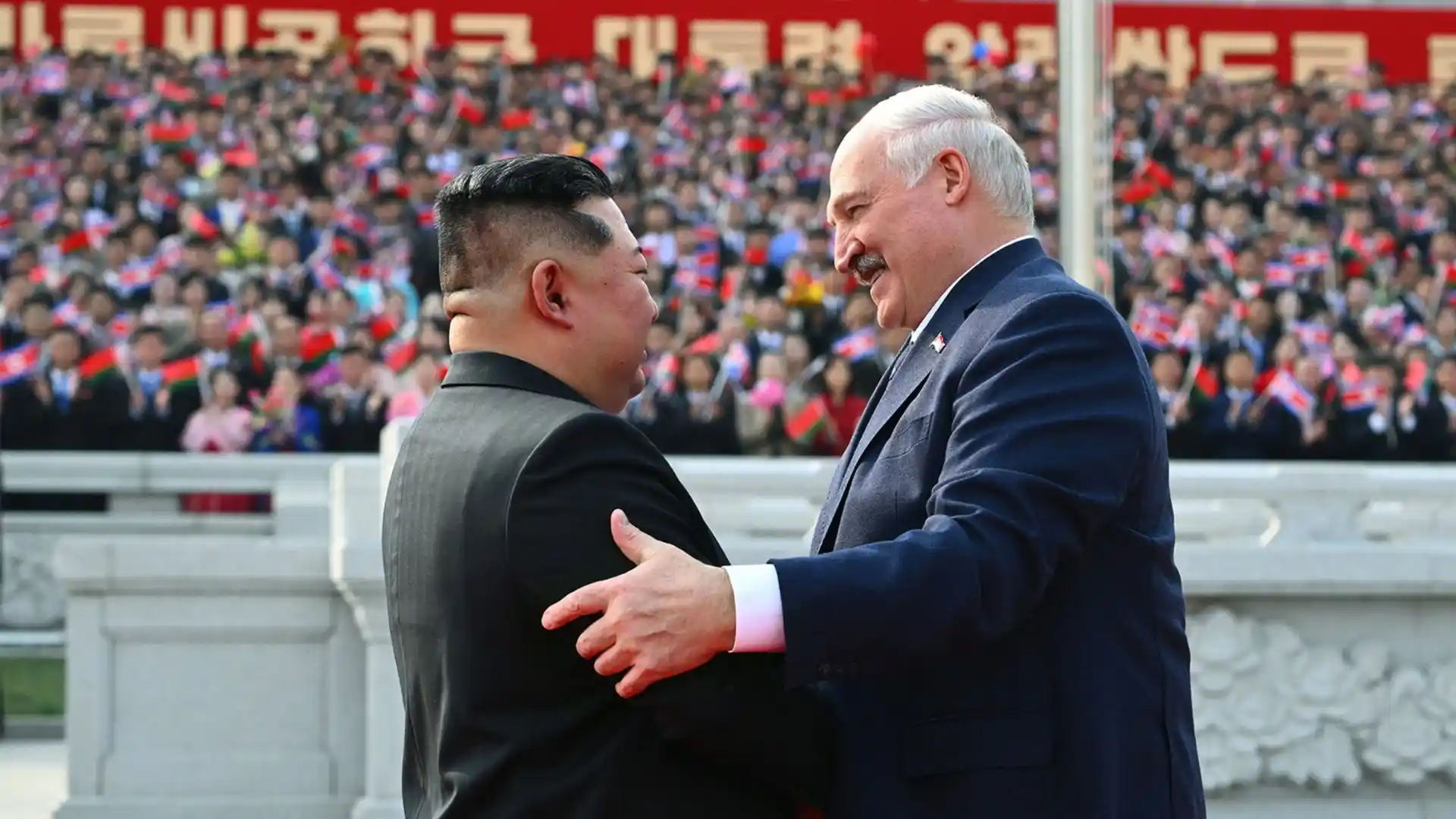
On March 25, in Pyongyang, Alexander Lukashenko and Kim Jong Un stood shoulder to shoulder and signed a Treaty of Friendship and Cooperation. The Belarusian strongman called it “fundamental.” Relations between Minsk and Pyongyang, he declared, were “entering a fundamentally new stage.” Kim, according to Belarusian state media, offered “solidarity and full support” against “unlawful pressure” from the West. Lavish ceremonies, goose-stepping guards, and a 21-gun salute completed the pageant.
To the casual observer, this looks like two isolated dictators throwing each other a lifeline. Dismiss it at your peril. The treaty is a concrete brick in an emerging architecture of authoritarian solidarity—one that links Moscow, Pyongyang, Minsk, Tehran, and others in a loose but functional network designed to survive Western sanctions, evade international norms, and sustain long wars of attrition.
The timing is no accident. Both regimes are Russia’s most reliable enablers in Vladimir Putin’s war against Ukraine. Belarus provided the launchpad for the 2022 invasion and now hosts Russian tactical nuclear weapons. North Korea has shipped thousands of troops and millions of artillery shells, with its soldiers reportedly dying in the Kursk region. Lukashenko’s visit included laying a bouquet sent by Putin himself at the Kumsusan mausoleum—an unsubtle reminder that this is a family affair. South Korean analysts already speak of a “Pyongyang-Moscow-Minsk axis.”
The treaty itself is deliberately vague on military matters—standard diplomatic hygiene for regimes under scrutiny—but the accompanying package of roughly ten sectoral agreements covers agriculture, education, healthcare, information, science, and trade. Belarusian pharmaceuticals and food are already trickling into North Korea; the real value lies in what is left unsaid. Belarus retains pockets of Soviet-era industrial and military technology. North Korea has demonstrated a ruthless capacity for reverse-engineering and mass production of munitions. History suggests such “friendship” treaties between pariahs quickly become conduits for dual-use goods, training exchanges, and sanctions-busting logistics.
Significance first: this is proof that comprehensive sanctions, the West’s favorite blunt instrument, have limits. For years, the strategy was to isolate regimes until they cracked or begged for mercy. Instead, the sanctioned have discovered the power of horizontal networking. North Korea has reduced its dependence on China by courting Russia; Belarus, squeezed by European sanctions, now has another market and diplomatic patron. The rhetoric is telling. Lukashenko spoke of “global transformation” in which “major powers openly ignore and violate the norms of international law.” Translation: the liberal order is collapsing, and sovereign authoritarians must band together to protect themselves. It is the multipolar world that Xi Jinping and Putin have long advertised—now with Pyongyang and Minsk as eager junior partners.
Consequences are already rippling outward. Most immediately, the treaty entrenches support for Russia’s war machine. Any technical cooperation between Minsk and Pyongyang will almost certainly find its way to the Ukrainian battlefield—whether in the form of improved artillery fuses, drone components, or simply more reliable supply lines. Longer term, it normalizes the transfer of sensitive technologies among states the Nuclear Non-Proliferation Treaty was meant to constrain. North Korea already possesses nuclear weapons and ICBMs; Belarus, while not nuclear-armed itself, sits on Russian tactical nukes and has a competent defense industry. A friendship treaty provides plausible deniability for quiet collaboration.
Geopolitically, the pact accelerates the fragmentation of the international system. It signals to other would-be pariahs—Iran, Myanmar, Venezuela—that the club is open and the dues are merely anti-Western rhetoric and a willingness to ignore UN resolutions. South Korea’s Unification Ministry correctly noted that trilateral coordination among North Korea, Russia, and Belarus is the real prize. That coordination makes deterrence harder: three capitals can now rotate pressure points, share intelligence, and dilute the impact of any single set of sanctions.
For ordinary Belarusians and North Koreans, the consequences are bleaker. Their leaders gain breathing room, but the underlying economic misery—hyperinflation in one case, famine-level food shortages in the other—will not be solved by tractor parts or propaganda exchanges. The treaty buys time for regimes that have no intention of reforming. Lukashenko’s domestic legitimacy rests on Russian patronage; Kim’s on nuclear blackmail and cult of personality. Neither has an exit ramp that includes genuine prosperity or political openness.
The West’s response so far has been ritual condemnation and incremental sanctions. That is necessary but insufficient. The blunt truth is that isolation alone creates the very incentives for these states to cluster together. A smarter strategy would combine unrelenting pressure on military proliferation with selective, transactional engagement where possible—off-ramps that make defection from the axis more attractive than loyalty. At the very least, democratic capitals must stop treating every new authoritarian handshake as a surprise. It is the predictable outcome of a world in which great-power rivalry has returned and middle-sized autocracies have learned to play the margins.
History rarely repeats, but it rhymes. In the 1930s, ideological fellow travelers formed the Axis; today, pragmatic survivalists are forming something looser but no less disruptive—an axis of the sanctioned. Lukashenko and Kim’s treaty is a modest document with outsized implications. It tells us the post-Cold War illusion of a rules-based order enforced by Western dominance is over. The new reality is competitive blocs, and the authoritarians are already organizing theirs.