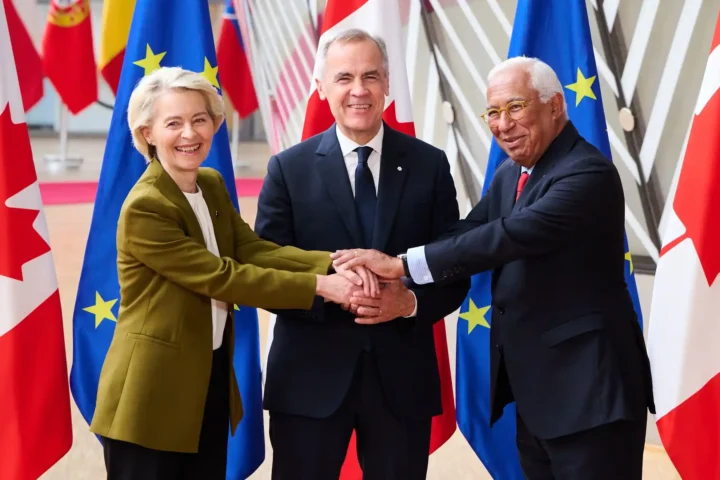
In an era of unraveling global order, the European Union’s free-trade agreements with far-flung partners—India’s “Mother of All Deals,” Mercosur’s long-stalled pact, Australia’s minerals lifeline—are no longer mere economic afterthoughts. They are the quiet architecture of survival. As America turns inward under President Trump’s tariff regime and China tightens its grip on vital supply chains, Brussels has rediscovered trade as a weapon of statecraft, forging pacts that blend market access with geopolitical ballast.
The Death of Naive Globalization
Picture the EU a decade ago: a regulatory colossus presiding over an open world, where trade flowed like a river and rules were sacrosanct. That illusion shattered amid pandemics, wars, and protectionist surges. By 2025, U.S. tariffs had battered European exporters—steel, autos, chemicals—costing billions and exposing the bloc’s overreliance on Washington’s whims. China, meanwhile, dominates 80 percent of rare-earth processing and key battery components, turning commodities into choke points.
Enter “open strategic autonomy,” the EU’s doctrinal pivot. Trade chief Maroš Šefčovič frames it as selective openness: liberalize with friends, fortify against foes. These FTAs embody that shift. India promises diversification into a 1.4 billion-person market; Mercosur locks in Latin American foodstuffs and resources; Australia delivers lithium and cobalt for the green transition. Together, they cover 2 billion people and trillions in GDP, but their true value lies in resilience—re routing supply chains away from Beijing and hedging against Trump’s “America First” redux.
India: The Grand Bargain
The EU-India FTA, inked amid 2025’s tariff turmoil, is the crown jewel—dubbed the “Mother of All Deals” for its audacious scope. Negotiations, dragged out since 2007, accelerated when U.S. duties hit Indian steel and EU machinery alike, nudging both toward mutual insurance. The pact slashes tariffs on 90 percent of goods, projects €200 billion in new trade by 2030, and opens India’s services sector—IT, pharma—to European firms.
Yet economics masks deeper plays. India, wary of Chinese encirclement, craves EU tech for semiconductors and renewables; Brussels eyes New Delhi as a counterweight in the Indo-Pacific, a manufacturing alternative to Vietnam or Mexico. Data from the European Commission shows EU imports of Indian pharmaceuticals up 25 percent in 2025, while joint ventures in solar panels and AI ethics standards signal alignment on values—from data privacy to carbon borders. Geopolitics sealed it: As Russia’s Ukraine war drags into 2026, India’s oil hunger and EU energy needs converge, with the deal including defense-tech side agreements.
Mercosur: Betting on the Southern Cone
Mercosur’s resurrection tests the EU’s nerve. Stalled for two decades over hormone-treated beef and deforestation, the deal surged forward in late 2025, ratified provisionally amid Brazilian President Lula’s green pledges. It spans 780 million consumers, eliminates 91 percent of tariffs, and boosts EU exports by €40 billion annually—wine, machinery, chemicals for Brazil’s soy and Argentina’s beef.
Geopolitics propelled it. China’s Belt and Road has ensnared Latin America—$150 billion in loans since 2005—while U.S. attention wanes. The EU, Mercosur’s top investor at €400 billion stock, uses the FTA to embed standards: sustainability clauses mandate zero-deforestation by 2030, tying trade to Amazon preservation. European diplomats whisper of countering Beijing’s lithium grab in the Lithium Triangle, where Mercosur nations hold 60 percent of global reserves.
Domestic pushback rages—Irish beef farmers and French greens cry foul—but the calculus has flipped. In 2025’s trade wars, food security trumps protectionism; Mercosur insulates Europe from U.S. ag volatility and African droughts. It’s raw power projection: Europe as the hemisphere’s rulesetter.
Australia: Minerals and Much More
Australia’s pact, sealed in March 2026, reads like a geostrategist’s wishlist. Tariffs drop on 99 percent of goods, unlocking €80 billion in two-way trade—EU luxury autos for Aussie beef, wine, and above all, minerals. Australia supplies 50 percent of Europe’s lithium imports, critical for 1 million EVs annually under the REPowerEU plan.
China’s rare-earth monopoly—98 percent processing share—looms large; the deal includes joint ventures for downstream refining, slashing EU dependence from 98 percent to under 70 percent by 2030. Indo-Pacific logic amplifies it: Australia’s AUKUS ties and Quad role align with Europe’s security outreach, from joint naval drills to tech-sharing on hypersonics. As Trump’s tariffs bite, Canberra offers a “friendshoring” haven—stable, democratic, resource-rich.
The Broader Reckoning
These FTAs form a lattice: India for scale and tech, Mercosur for food and leverage, Australia for inputs and alliance. EU exports rose 12 percent to these partners in 2025, per Commission data, while FDI flows hit €150 billion. They operationalize “de-risking”—EU imports from China fell 5 percent, offset by partner gains.
Risks abound. Trump’s 2026 tariff wall could shave 1.5 percent off EU GDP; China retaliation looms. Domestically, Green Deal tensions pit climate hawks against exporters. Yet in a G-Zero world—neither U.S.-led nor Sino-centric—these pacts carve Europe’s niche.
The EU isn’t building an empire; it’s stitching a safety net. Trade, once globalization’s cheerleader, now guards the bloc’s sovereignty. As von der Leyen declared in Davos 2026, “We trade to thrive, but first to endure.” In today’s arena, that’s no platitude—it’s doctrine.