As protectionism resurfaces across the Atlantic, the European Union and India are racing to deliver on a long-awaited trade pact — one that could reshape the architecture of global commerce. With just three months left to meet their ambitious target, negotiators on both sides are trying to bridge complex divides in agriculture, sustainability, and market access.
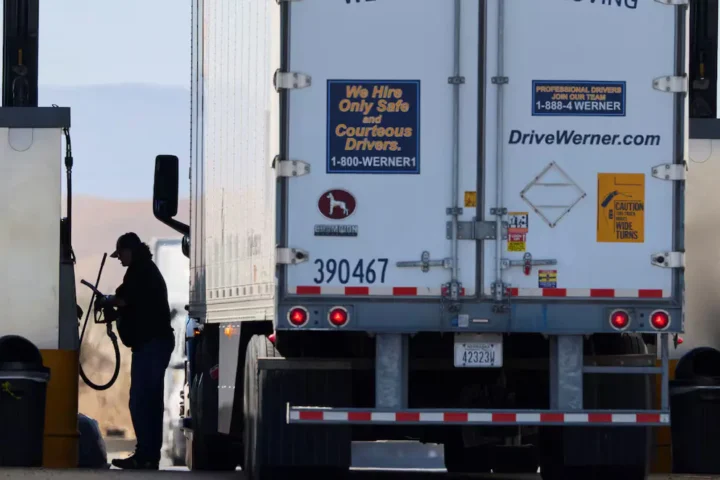
Ironically, the catalyst for this renewed momentum comes not from Brussels or New Delhi, but from Washington. U.S. President Donald Trump’s tariff offensive — which hit Indian goods with duties of up to 50 percent and spared few European exports either — has jolted both powers into rethinking their economic alignments.
But where the EU’s approach is driven by the need to shield its market from global volatility, India’s motivation is strategic. Having emerged from a decade of steady growth and economic reform, New Delhi sees this deal not as an act of desperation but as an assertion of its global economic confidence — a step toward shaping, rather than merely adapting to, the new trade order.
1. Trump’s Tariffs, India’s Opportunity
Trump’s aggressive tariffs have upended decades of global trade orthodoxy. Yet, in doing so, they have opened new pathways for India’s diplomatic and economic agility.
As Garima Mohan of the German Marshall Fund notes, India “started sending smoke signals to capitals across Europe” soon after Trump’s re-election, signaling a serious intent to diversify its trade portfolio. This early outreach underscores a key shift in India’s external economic posture — from cautious protectionism to calibrated global engagement.
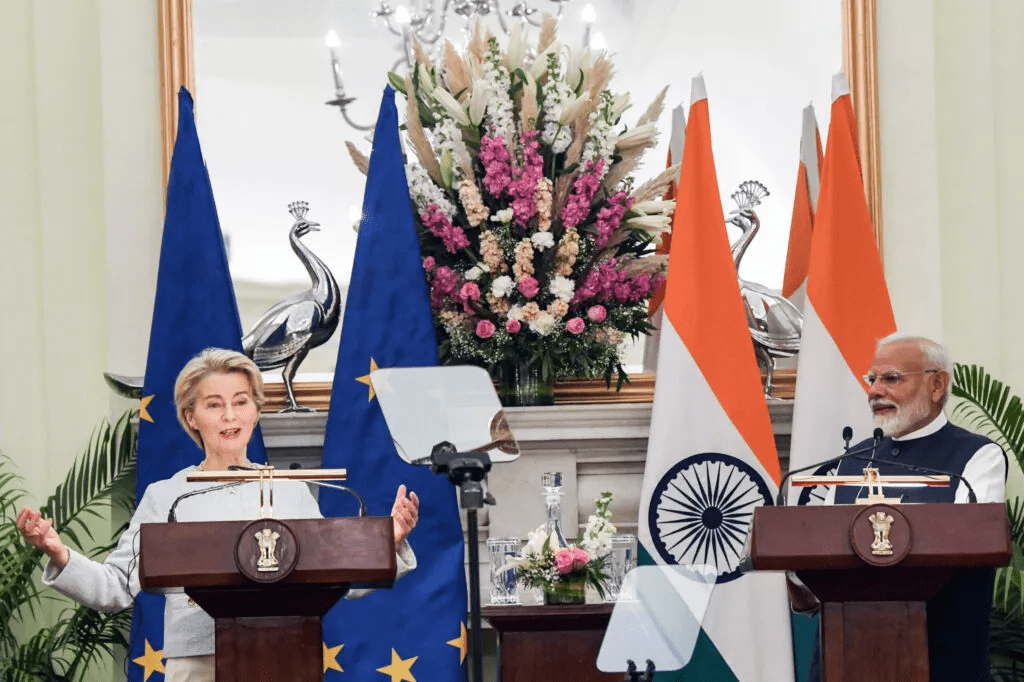
Brussels, quick to grasp India’s rising economic centrality, responded in kind. European Commission President Ursula von der Leyen’s high-profile visit to New Delhi, accompanied by her entire College of Commissioners, reflected Europe’s recognition that India is no longer a marginal trading partner but a pivotal global actor. “This partnership comes at the right moment for both of us,” von der Leyen said — and indeed, it does.
While the EU hopes to hedge against U.S. unpredictability, India is seizing the moment to solidify its role as a key node in a multipolar trading system. The momentum is political, yes — but increasingly, it is also structural. India’s expanding manufacturing base, deepening digital economy, and robust domestic demand make it an indispensable market and production hub for European firms seeking alternatives to China.
2. The Long Road to Mutual Understanding
The EU-India trade relationship has long been defined by complexity. The two sides began talks in 2007, but by 2013, negotiations had stalled amid disagreements on agricultural tariffs, market access for automobiles and spirits, and intellectual property protections. Those issues — long symbolic of differing development priorities — still loom large today.
But the broader context has changed dramatically. Over the past decade, India has transformed its trade diplomacy, signing agreements with Japan, the UAE, and Australia, and joining the Indo-Pacific Economic Framework. The Modi government’s “Atmanirbhar Bharat” (self-reliant India) vision — often misunderstood as isolationist — has, in practice, pushed India to pursue selective openness: protecting key domestic sectors while expanding its footprint in global value chains.
As Ignacio García Bercero, a former EU negotiator for India, acknowledged, “India can be difficult,” but this “difficulty” increasingly reflects the country’s confidence in defending its developmental interests. In contrast, Brussels’ rigid adherence to regulatory orthodoxy has often limited its flexibility in dealing with dynamic, emerging economies.
This time, negotiators from both sides insist that lessons have been learned. Talks have resumed on a more pragmatic footing, focused on aligning priorities rather than imposing one side’s framework over the other’s.
3. Navigating the Geopolitical Crosscurrents
Beyond economics, the EU-India trade talks are inescapably shaped by geopolitics — especially the war in Ukraine.
Europe’s desire to “de-risk” from Russia and China has made India a critical partner in its diversification strategy. But India’s independent foreign policy — including its continued engagement with Moscow — has raised eyebrows in Brussels. Recent imagery of Prime Minister Narendra Modi and President Vladimir Putin walking hand-in-hand at a summit alongside China’s Xi Jinping has fueled unease among European policymakers.
Yet such concerns often overlook the strategic nuance of India’s position. New Delhi’s ties with Russia are long-standing, driven by defense and energy interests that predate the current conflict. Abandoning Moscow outright would hand geopolitical advantage to China — something no Indian government can countenance.
As Indian analysts frequently note, neutrality is not equivalence. India’s balanced diplomacy — engaging Russia while expanding defense and technology ties with the U.S. and Europe — has made it one of the few global players capable of dialogue across rival blocs.
For the EU, engaging India despite differences over Ukraine is therefore less a moral compromise than a strategic necessity. As one senior EU official conceded, “We need to do more to bridge gaps where they are.” For both sides, the trade deal is as much about affirming India’s place as a democratic counterweight to China as it is about tariffs and quotas.
4. Technical Hurdles or Strategic Leverage?
Negotiating the technical details of trade is rarely glamorous — and the EU-India talks are no exception. Disagreements persist over tariffs on cars, spirits, and agricultural products. Yet, framing these as “obstacles” misses a larger point: India’s caution in these areas is not obstructionism but a reflection of its developmental priorities.
Agriculture remains the livelihood of over 40 percent of India’s population. Protecting this sector from abrupt liberalization is therefore a social and political imperative. While the EU has pushed for greater agricultural access, India has skillfully balanced openness with sovereignty — setting aside ultra-sensitive areas like dairy and sugar while moving forward on others.
On sustainability, the divergence is philosophical. Brussels insists on a binding Trade and Sustainable Development (TSD) chapter, while India favors a more flexible framework that recognizes differing capabilities. As Commerce Minister Piyush Goyal argued, the EU’s Carbon Border Adjustment Mechanism (CBAM) “does not meet the test of fair play.” From India’s perspective, such unilateral measures risk penalizing developing economies for historical emissions they did not cause.
Even the much-publicized dispute over basmati rice reflects New Delhi’s growing assertiveness in defending its cultural and agricultural heritage. Far from being a sticking point, it signals India’s determination to ensure that trade agreements respect its identity and economic interests alike.
5. Redefining Europe’s Trade Vision — with India at the Center
For Brussels, the deal with India represents more than a bilateral success — it is a test of whether the EU can adapt its trade policy to a rapidly changing world. Europe’s traditional model of linking trade liberalization with rigid sustainability clauses has worked with smaller partners, but India’s scale, strategic weight, and democratic legitimacy demand a different approach.
Angelika Niebler of the European Parliament framed it succinctly: “We hope that the result of the trade negotiations will be a commercially meaningful agreement.” That statement captures a broader European realization that pragmatic partnerships with emerging powers are essential for the EU’s global relevance.
For India, the negotiations embody its growing confidence as a rule-maker, not a rule-taker. The trade talks are not just about access to Europe’s 450 million consumers — they are about setting the tone for how large developing economies engage with the West on equal terms.
India’s Moment in the Global Trade Rebalance
As the EU-India talks enter their final stretch, the stakes extend well beyond tariffs and technicalities. The outcome will determine whether two of the world’s largest democracies can forge a genuinely balanced economic partnership — one that respects development priorities while advancing shared strategic interests.
If sealed, the deal would mark India’s arrival as a decisive player in shaping global trade rules. If delayed, it would reflect not failure, but the realism of a complex negotiation between equals.
Either way, one fact is clear: in a world of shifting alliances and economic nationalism, India is no longer a passive participant in global trade — it is one of its architects.
References and Further Reading
- European Commission. (2025, July 8). EU-India trade negotiations: New momentum in global trade landscape. European Commission. https://ec.europa.eu/commission/presscorner/detail/en/IP_25_3521
- Bradsher, K. (2025, August 2). India and the EU edge closer to a landmark trade agreement. The New York Times. https://www.nytimes.com/2025/08/02/business/india-eu-trade-deal.html
- Erlanger, S. (2025, June 19). As Trump shocks traders, India and Europe rethink economic strategies. The Washington Post. https://www.washingtonpost.com/business/2025/06/19/trump-tariffs-india-eu/
- Mohan, G. (2025, March 15). Europe and India: Beyond tariffs. German Marshall Fund Insights. https://www.gmfus.org/news/europe-india-beyond-tariffs
- Parker, G. (2025, July 23). Brussels in talks with New Delhi to counter U.S. protectionism. Financial Times. https://www.ft.com/content/9f21ae5b-998b-4f43-8fca-de9a463e188e
- Lawder, D. (2025, June 11). Trump’s tariffs reshape global commerce, drive EU–India accord. Reuters. https://www.reuters.com/world/india-eu-trade-tariffs-2025-06-11/
- von der Leyen, U. (2025, April 27). Comments at EU–India Summit: Partnership for a changing world. Politico Europe. https://www.politico.eu/article/eu-india-summit-von-der-leyen-commentary/
- Bercero, I. G. (2024, December 14). Trade negotiations: Lessons from the EU–India experience. European Centre for International Political Economy. https://ecipe.org/blog/eu-india-trade-negotiations-lessons/
- Sengupta, R. (2025, June 30). India’s trade ambitions and the global outlook. The Economist. https://www.economist.com/asia/2025/06/30/indias-trade-ambitions-global-partnerships
- Sweeney, R. (2025, July 15). Ukraine war shifts EU–India strategic calculation. BBC News. https://www.bbc.com/news/world-asia-india-57439521
- Goel, A. (2025, June 5). Modi’s balancing act: Russia, China, and the West. Foreign Policy. https://foreignpolicy.com/2025/06/05/modi-russia-china-eu-balancing-act/
- Goyal, P. (2025, May 18). India’s perspective on CBAM and trade fairness. Bloomberg Opinion. https://www.bloomberg.com/opinion/articles/2025-05-18/india-cbam-trade-fairness-goyal
- Niebler, A. (2025, July 21). Europe’s trade future: Finding meaningful partnerships. Politico Europe. https://www.politico.eu/article/europe-trade-future-partnerships-niebler/
- Basu, K. (2025, June 8). India’s economic transformation and its impact on global trade. Brookings Institution. https://www.brookings.edu/articles/indias-economic-transformation-global-trade-impact/