When policy debate becomes ethnic hostility, something has gone badly wrong.
A new report from the Network Contagion Research Institute should disturb anyone who cares about the direction of American political culture. Published earlier this month in partnership with the University of Miami’s Frost Institute for Data Science and Computing, it documents something that has been building in plain sight: the systematic transformation of a legitimate immigration policy debate into a vehicle for ethnic hatred directed at Indian Americans.
The numbers are striking. Anti-Indian content on X tripled in weekly volume over the course of 2025, accumulating over 300 million views across more than 24,000 posts. The researchers found that major immigration policy announcements, the DHS H-1B modernization rule in January, State Department visa restrictions in May, and the White House’s $100,000 H-1B petition fee in September, each triggered measurable surges in ethnic generalizations, slurs, and deportation rhetoric. Policy announcements became, in effect, a starter’s pistol for coordinated abuse.
What makes this more than the usual background noise of internet ugliness is the concentration of the activity. The three most prolific accounts, NeonWhiteCat, MattForney, and TheBrancaShow, attracted over 10% of all likes and 20% of all retweets in the dataset. This is not organic sentiment bubbling up from ordinary Americans frustrated by the labor market. It is a small, dedicated network with documented ties to white nationalist movements, strategically amplifying content that wraps ethnic hatred in the respectable clothing of economic grievance.
The NCRI report identifies a telling rhetorical evolution. Early in 2025, the dominant mode was explicit slurs. As the year progressed, that vocabulary gave way to the language of “replacement” and “invasion.” The researchers suggest this shift may reflect adaptation to content moderation, policy-framed hostility travels further on platforms than outright slurs, while conveying the same underlying animus. It is a lesson in how prejudice launders itself through the respectability of political discourse.
The targets have not been abstract. Indian-American members of Congress, Representatives Shri Thanedar and Pramila Jayapal among them, have been singled out in coordinated harassment. Vivek Ramaswamy, whatever one makes of his politics, was subjected to ethnically charged attacks after voicing support for high-skilled immigration. Usha Vance, the Second Lady of the United States, became a focal point for what can only be called racial purity rhetoric. Nick Fuentes, a white nationalist who first drew notoriety at the 2017 Charlottesville rally, and the social media personality known as Sneako directed explicit slurs at her based solely on her Indian heritage. The subtext was unmistakable: Indian ancestry, to this crowd, disqualifies a person from belonging to American public life.
The online hostility has not remained online. The report notes harassment at Hindu temples in 2025. Masked protesters appeared outside tech offices carrying signs reading “Deport H-1B Scammers.” Elected officials have called for mass deportation of Indians. These are not isolated incidents. They are the downstream consequence of a sustained online campaign that has normalized dehumanizing language about an entire ethnic group.
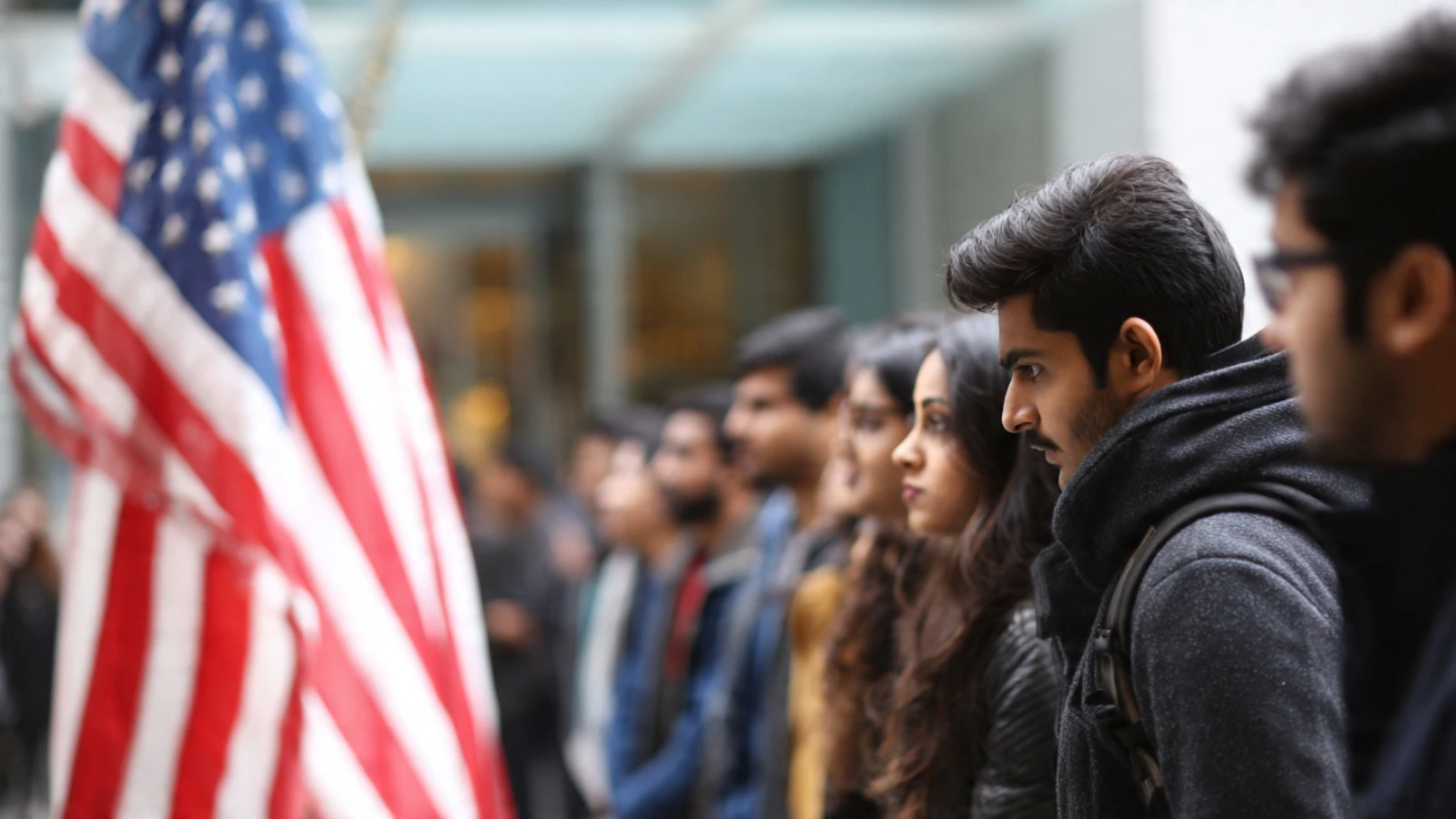
There is an irony here that deserves to be stated plainly. Indian Americans are, by virtually every measure, among the most successfully integrated immigrant communities in American history. Their median household income is the highest of any major ethnic group in the country. More than three-quarters hold a bachelor’s degree or higher. Indian-born entrepreneurs represent the largest single national-origin group among founders of billion-dollar American startups. They are civically engaged, economically productive, and, by Pew’s own surveys, among the most favorably disposed toward the United States of any immigrant group measured. This is not a community at war with America. It is a community that has built a significant part of it.
None of this means the H-1B program is above criticism. It is not. There are genuine and important questions about wage suppression, about the use of visa programs to undercut American workers, about fraud within the system, questions that deserve serious, evidence-based debate. The NCRI report is careful to make this distinction: legitimate policy critique is not the problem. The problem is when critique of a program becomes a license for collective blame against an entire ethnic community. That shift, from “this program has flaws” to “Indians are replacing us”, is not a difference of degree. It is a difference of kind.
The NCRI researchers also flag something worth noting for readers in Britain and Canada, both countries with substantial and rapidly growing South Asian diaspora communities. The extremist networks driving this content are not parochially American. They operate across platforms without borders, and the “replacement” narratives they deploy travel. Britain has already seen coordinated online campaigns targeting British South Asians in the wake of its own immigration debates. Canada has experienced similar dynamics. The rhetorical infrastructure being built in American corners of the internet does not stay there.
The NCRI report ends with a set of recommendations: platforms must develop better detection capabilities for coded anti-Indian language; law enforcement and civil society need education on emerging tropes; the Indian-American community itself should update security measures. These are sensible starting points. But they address symptoms rather than the underlying condition, which is the willingness of mainstream political discourse to provide cover for the extremist fringe by treating “replacement” language as acceptable political speech rather than what it is: ethnic hostility with a vocabulary upgrade.
What the data ultimately shows is that the machinery of ethnic scapegoating in America has found a new target. It is the same machinery, the same concentrated networks, the same escalation from online rhetoric to offline harassment, the same fusion of policy grievance with racial animus, that the NCRI has previously documented in antisemitic campaigns. The playbook does not change. Only the target does.
Reasonable people can argue about how many H-1B visas should be issued, or under what conditions, or with what wage protections. That is a policy debate worth having. What is not a policy debate, what should not be treated as one, is whether people of Indian origin belong in America at all. That question was settled long ago. The fact that it is being relitigated in the language of “invasion” and “replacement,” and that this language is achieving hundreds of millions of views, is not a footnote to the current political moment. It is a warning.