India’s green energy transition just became more geopolitical. With Prime Minister Mark Carney’s visit to New Delhi and a new Strategic Energy Partnership on the table, India and Canada now have a chance to turn climate diplomacy into hard infrastructure across solar, hydrogen, wind and low‑carbon LNG—and either set a model for North–South energy cooperation or miss a narrow window for course correction.
The scale of India’s challenge
India has committed to 500 GW of non‑fossil power capacity by 2030, up from earlier renewable goals of 175 GW by 2022. As of this month, it has already crossed roughly 50% non‑fossil power capacity, with more than 270 GW coming from renewables. That is rapid progress for a country where electricity demand is still rising fast, urbanisation is incomplete, and per‑capita emissions remain well below the global average. But hitting 500 GW requires adding on the order of 40–50 GW of clean capacity every year through the rest of the decade, far above historic averages.
These are not just climate numbers; they are development numbers. Every gigawatt of solar or wind installed is a hedge against volatile coal imports, urban air pollution, and stranded fossil assets that could choke India’s growth story in the 2030s. The political logic is straightforward: India wants growth, energy security, and cleaner air simultaneously, and it will use all available tools—solar parks, nuclear, green hydrogen, and yes, gas—to get there.
What the Carney visit really changed
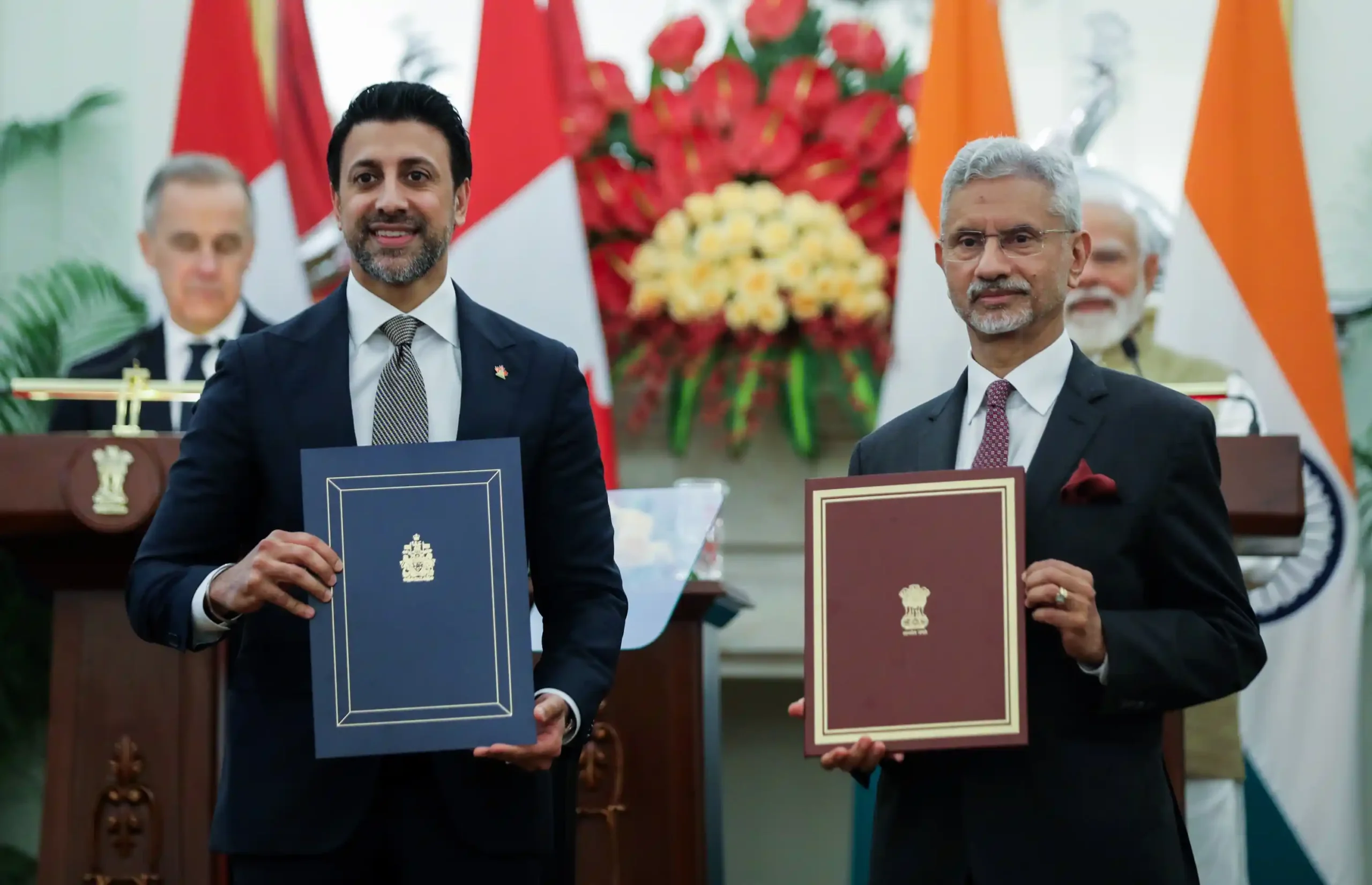
Carney’s trip produced more than photo‑ops. Canada and India announced a Strategic Energy Partnership covering LNG, LPG, uranium, solar, hydrogen and critical minerals, backed by commercial deals worth over CAD 5.5 billion. Ottawa also committed to join the India‑ and France‑led International Solar Alliance and upgrade to full membership in the Global Biofuels Alliance, putting Canada inside India’s preferred multilateral clean‑energy clubs. A separate clean energy MoU lays out cooperation on solar, wind, bioenergy, small hydro, storage and capacity‑building, anchored by a Joint Working Group.
On the supply side, Canada is positioning itself as a reliable provider of some of the world’s lowest‑carbon LNG, uranium and critical minerals, as well as a partner in grid expansion and storage. On the demand side, India offers scale: a gigantic power system that is expanding faster than almost any other, and a policy target that mandates hundreds of gigawatts of additional clean capacity by 2030. This is classic complementarity—but only if both sides are honest about trade‑offs.
Key pillars of the new partnership
| Pillar | India’s role and needs | Canada’s assets and offers |
|---|---|---|
| Solar and wind | Large‑scale deployment, ISA leadership, 500 GW target | Capital, technology, grid know‑how, ISA membership, storage expertise |
| Hydrogen and biofuels | Industrial decarbonisation, pilot projects, GBA platform | Research tie‑ups, biofuel feedstock, upgraded GBA membership |
| LNG and LPG | Gas as transition fuel, rising LNG share in energy mix | Low‑carbon LNG exports from West Coast, first long‑term LPG arrangement |
| Nuclear and uranium | Expanding civil nuclear for baseload clean power | Long‑term uranium supply deal, nuclear technology cooperation |
| Critical minerals | EVs, batteries, solar supply chains, stockpiling | MoU on lithium, cobalt and secure mineral supply chains |
The LNG dilemma: bridge fuel or new lock‑in?
Carney’s speech openly acknowledged that India plans to almost double the share of LNG in its primary energy mix by 2030, even as it adds 500 GW of clean capacity. Canada, for its part, aims to produce around 50 million tonnes of LNG annually by 2030 and wants India to be a key market. Proponents frame this as pragmatic: displacing coal with lower‑carbon gas, providing firm power to back intermittent renewables, and supporting industrial heat where electrification is hard.
Yet the climate math is unforgiving. Long‑term LNG contracts signed this decade will still be on the books in the 2040s, when both Paris‑aligned pathways and India’s own net‑zero‑by‑2070 pledge demand deep decarbonisation of power and industry. If infrastructure—import terminals, pipelines, gas‑fired plants—is sized for aggressive LNG scenarios, it risks becoming stranded or politically difficult to retire just as cheaper storage, demand response and green hydrogen scale up. The test of this partnership will be whether gas is clearly capped and time‑bound as a transition fuel, with parallel investment in the technologies that will ultimately replace it.
From symbolism to bankable projects
The most encouraging part of the Carney visit is not any single deal, but the ecosystem it hints at. Canada and India agreed to deepen collaboration on investment for clean energy technologies, critical minerals and “future‑oriented industries”, tying public diplomacy to private capital. Universities and research institutes have begun to connect, as seen in Simon Fraser University’s agreement with the Hydrogen Association of India, which can seed innovation in electrolyser design, storage and industrial applications.
But India’s transition is now less about pilots and more about pipelines—of projects, not just gas. To add 40–50 GW of non‑fossil capacity annually, India needs predictable auction schedules, grid build‑out that actually precedes generation, and concessional finance that lowers the cost of capital for renewables and storage. Here Canada’s role should be judged on whether its development finance institutions, pension funds and export credit agencies actually underwrite solar, wind, storage and transmission at scale, not just LNG trains and uranium shipments.
If the Strategic Energy Partnership becomes a platform for joint solar manufacturing zones, battery supply chains, grid‑balancing pilots, and resilient critical mineral supply, then Carney’s India visit will mark a true inflection point. If it defaults to a familiar pattern—fossil exports wrapped in green language—the opportunity cost will be counted not only in gigawatts, but in credibility.