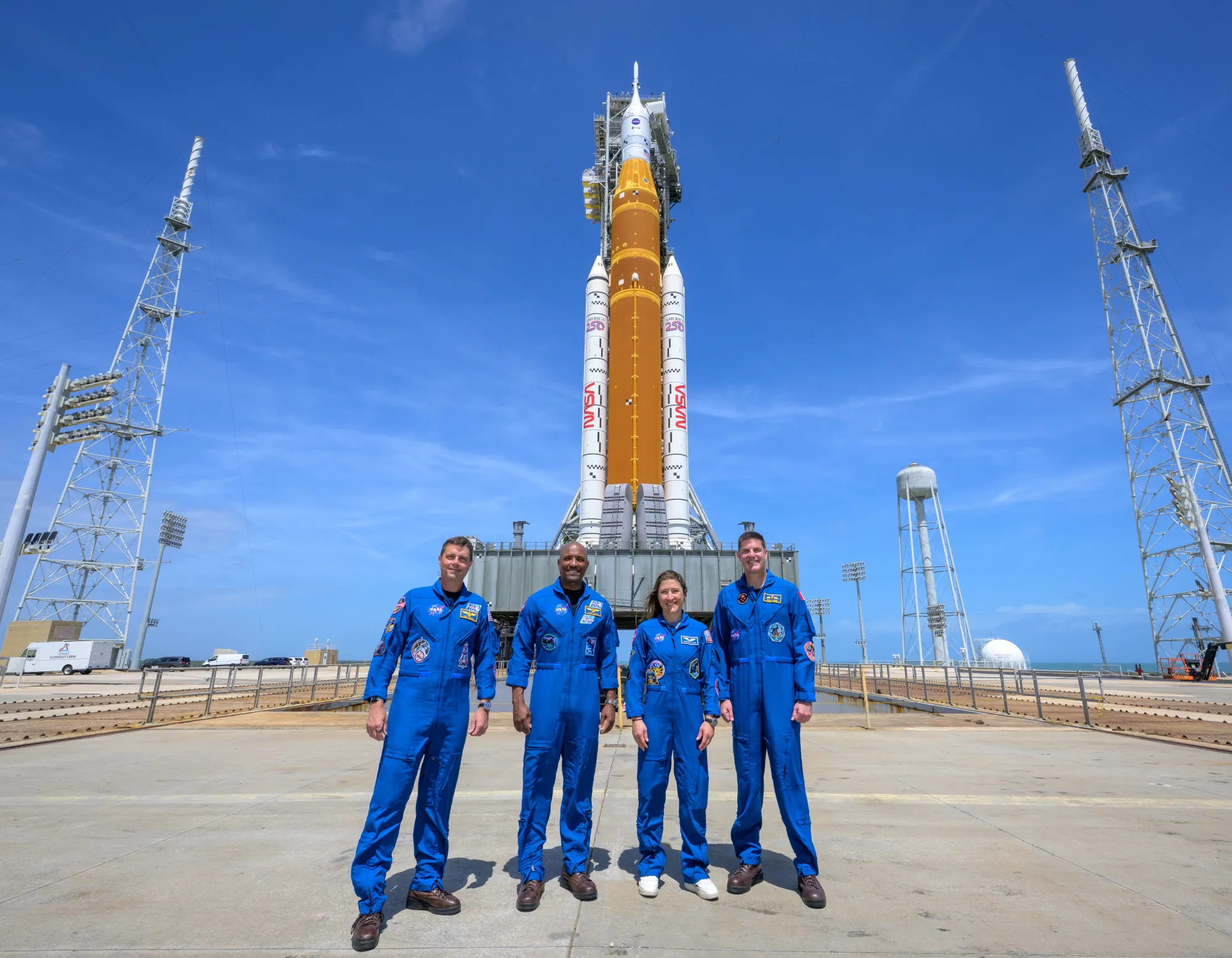
On April 1, 2026, at 6:35 p.m. EDT, the roar of NASA’s Space Launch System (SLS) rocket echoed across Florida’s Kennedy Space Center as it lifted off from Launch Pad 39B, carrying four astronauts on a daring 10-day journey around the Moon and back. This was no ordinary launch. Artemis II marks the first time humans have ventured toward the Moon in over 50 years—since Apollo 17 in 1972—and the first crewed flight of the powerful SLS and Orion spacecraft. Commander Reid Wiseman, Pilot Victor Glover, Mission Specialist Christina Koch (all NASA), and Mission Specialist Jeremy Hansen of the Canadian Space Agency are now blazing a trail that could redefine humanity’s future in space.
The mission is as high-stakes as it is historic. After separating from the SLS, the Orion capsule will carry the crew into high Earth orbit for systems testing before a critical engine burn propels them on a free-return trajectory. They will slingshot around the far side of the Moon, harnessing lunar gravity to whip them back toward Earth without entering lunar orbit. At their farthest point, the astronauts will travel thousands of miles beyond the Moon—potentially setting a new record for the greatest distance humans have ever traveled from our home planet, surpassing even Apollo 13’s mark. During the flyby, they will glimpse regions of the lunar surface few have seen up close and provide vital real-world data on Orion’s life support, navigation, and re-entry systems.
This isn’t just a test flight; it’s a proving ground for ambition. Artemis II builds directly on the uncrewed Artemis I success in 2022 and paves the way for Artemis III and beyond—missions that aim to return humans to the lunar surface, this time near the south pole, as early as 2028. The long-term vision is bolder still: sustainable lunar presence, resource utilization, and ultimately crewed journeys to Mars. International partnership is baked in from the start, with Canada’s contribution to the crew and hardware underscoring how space exploration has evolved from Cold War rivalry to global collaboration.
Yet the journey carries real risks. Traveling at speeds up to 17,500 mph, enduring the harsh radiation environment of deep space, and relying on a brief communications blackout during the lunar flyby demand flawless performance from both machines and humans. The crew will face isolation, the psychological weight of distance, and the unforgiving physics of a high-speed return through Earth’s atmosphere at nearly 25,000 mph before splashing down off California’s coast.
Why does this matter now? In an era of geopolitical tensions, climate challenges, and rapid technological change, Artemis II reminds us of humanity’s capacity for wonder and ingenuity. It revives the spirit of exploration that once united millions watching grainy Apollo footage on television. Today, with advanced computing, reusable rockets from the commercial sector, and a new generation of diverse astronauts, we are better equipped than ever to push the boundaries.
Critics rightly point to costs and delays—Artemis has faced both—but the payoff extends far beyond prestige. Technologies developed for lunar missions improve satellite systems, medical devices, materials science, and energy solutions here on Earth. A sustained presence on the Moon could unlock helium-3 for fusion research, rare minerals, and a platform for deeper space telescopes unhindered by Earth’s atmosphere or radio noise.
As Reid Wiseman, Victor Glover, Christina Koch, and Jeremy Hansen hurtle through the cosmos, they carry more than scientific instruments—they carry our collective aspirations. Their safe return will validate years of engineering grit and inspire the next wave of scientists, engineers, and dreamers. This slingshot around the Moon is not the end of a story that began with Apollo; it is the ignition of a new chapter in humanity’s odyssey among the stars.
The night sky just got a little closer. And with it, our future in space feels within reach once more.