Washington rolled out bombers, pandas and a new helipad. Beijing left with the photographs—and almost none of the hard bargains the relationship required.
President Trump told reporters the meeting was “great.” He also reported, with the air of a man who had closed a deal, that Xi Jinping “loves good granite.” That is as good a summary as any of what the United States got from the Chinese leader’s first state visit to Washington in more than a decade: compliments, masonry talk, and a two-month stay of execution on a trade truce that was already scheduled to expire.
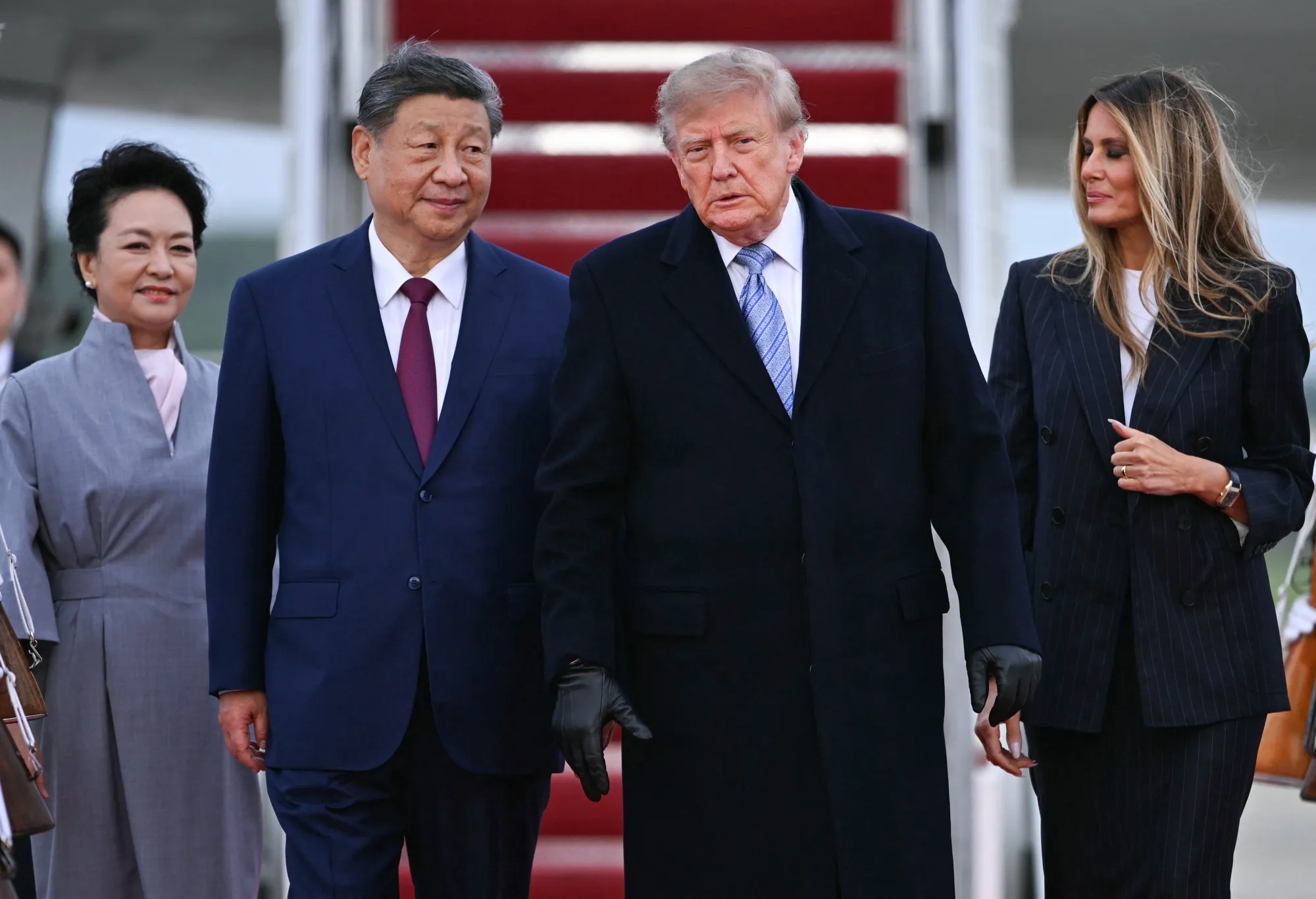
The pageantry was not incidental. Mr. Trump broke with decades of protocol to greet Mr. Xi at Joint Base Andrews. There were honor guards, a military flyover loud enough to make the president flinch, a tour of a new South Lawn helipad and Marine One, a remade Rose Garden, and a state dinner packed with the chiefs of Nvidia, OpenAI, Apple, Tesla, Microsoft and Google. China promised two giant pandas for the Atlanta zoo and floated an invitation for 100,000 American students. The two men agreed to back each other’s turn hosting this year’s remaining multilateral summits. Then they went home.
That is not nothing. Great-power diplomacy that ends without a rupture is preferable to the alternative. But it is a thin harvest from a meeting that was billed, by both capitals, as the moment to put a floor under the most dangerous rivalry on earth. On the issues that actually move markets, alliances and the risk of war—tariffs and rare earths, advanced semiconductors, Taiwan, artificial intelligence, and the unfinished war with Iran—the Washington summit produced no durable settlement. It produced a calendar reminder. January 10 is the new November 10. The hard questions were postponed, not answered.
A Pattern, Not a Breakthrough
This was the third face-to-face meeting between the two men in less than a year: Busan last October, Beijing in May, Washington this week. The rhythm is itself a kind of policy. Each encounter is staged as a reset. Each yields a short extension of the last truce, a handful of commercial gestures, and a fresh declaration that the personal relationship can carry what institutions no longer can. Then the underlying disputes reassert themselves.
The Busan arrangement of October 2025 ended a tariff spiral that had, at its peak, threatened triple-digit duties and a cutoff of Chinese rare-earth magnets. The United States eased some fentanyl-related and reciprocal tariffs. China paused its most aggressive mineral-export controls, resumed soybean buying, and promised to police precursor chemicals. The May summit in Beijing added agricultural purchase targets—25 million metric tons of soybeans a year through 2028, plus at least $17 billion a year in other farm goods—and more talk of “constructive strategic stability,” Beijing’s preferred slogan for managed rivalry. Neither meeting produced a joint communiqué worthy of the name. Neither produced a regime for semiconductors, a credible understanding on Taiwan, or a working mechanism for the Strait of Hormuz.
Washington this week followed the script. Treasury Secretary Scott Bessent announced, as Mr. Xi’s plane was touching down, that the trade truce would be stretched two months, to Jan. 10. China had reportedly wanted the pause locked in through the end of Mr. Trump’s term in January 2029. Two months is what it got. Mr. Bessent said the extra time would let both sides “see what we can do on the economic front.” That is the language of unfinished business dressed up as progress.
The compliance record already explains why a longer deal was unavailable. Beijing is meeting the soybean quota. It is lagging on the $17 billion in other agricultural purchases agreed in May. U.S. officials say rare-earth deliveries are falling short as well. Talk of taking tariffs off $30 billion of “non-critical” goods on each side, plus some opening in financial services, remained talk. Companies that have to book capacity, site factories and hedge currency risk cannot run a superpower relationship on 60-day increments.
The Leverage America Did Not Use
The missed opportunity is sharper because the timing favored a harder bargain. Mr. Xi arrived in a strong position—China’s goods surplus has run toward a record $1 trillion, it still dominates the refining of heavy rare earths, and it has learned that mineral export controls can make Washington blink. But he also arrived needing things only the United States can grant: relief from semiconductor export controls, a quieter American military relationship with Taiwan, and political theater that presents China as a peer, not a petitioner. A serious American strategy would have treated the state visit as scarce political capital and spent it.
Instead the administration spent it on ceremony. Julian Gewirtz, who served as a senior China official in the last administration, called the dominant impression “an extraordinary degree of deference.” Neil Thomas of the Asia Society put the Chinese calculation more bluntly: Mr. Xi received “a huge amount of respect from the American president, the full state visit treatment” and images of the two leaders “interacting as peers on the global stage, without having to make any meaningful concessions.” That is an accurate reading of the week. It is not a compliment.
Rare earths illustrate the problem. After Mr. Trump’s early-2025 tariff barrage, Beijing restricted exports of the metals and magnets that go into electric motors, wind turbines, smartphones, fighter jets and munitions. The Busan truce paused the most sweeping of those controls. It did not diversify the supply. It did not create a verification regime. It did not lock in volumes, prices or dispute settlement. Extending that pause by two months keeps American factories running through the holidays. It does not change the fact that a single foreign government can still throttle inputs to the U.S. defense industrial base. A summit worthy of the name would have traded something Beijing wants—defined, time-limited licensing on specified chips, or tariff relief on a published list of consumer goods—for a multiyear, inspectable mineral-supply commitment and a standstill on new export controls. That bargain was available in outline. It was not closed.
The same is true of agriculture and market access. American farmers were told, after Busan and again after Beijing, that China would be a reliable buyer. Partial performance is not reliability. If purchases of non-soy farm goods are off-pace in the first year of a three-year pledge, the right response at a state visit is not another press line about “new market access.” It is a written schedule, with snap-back tariffs if the schedule is missed. Mr. Trump knows how to write that kind of contract. He chose not to.
Taiwan, Spoken in Only One Voice
On Taiwan, the imbalance was even clearer. China’s official readout had Mr. Xi telling his host that Beijing’s position on unification is “clear,” that the United States should “adhere to the correct position of opposing Taiwan independence,” and that Washington should handle the question “with prudence.” That is a tougher ask than the long-standing American formula, which is that the United States does not support independence and maintains the capacity to help Taiwan defend itself. A $14 billion arms package has been pending. Beijing wants it killed.
The White House, as of this writing, has not issued a comparable readout of what the president said in reply. Ambiguity has its uses. But silence after a Chinese demand that the United States change its vocabulary is not strategic ambiguity. It is an invitation for Beijing to tell its public, and the region, that the demand was heard and not rejected. Allies in Tokyo, Seoul, Manila and Taipei do not need a lecture on the Thucydides Trap. They need to know whether the American security commitment is being quietly repriced in exchange for a state dinner.
Mr. Xi invoked that trap by name—the theory that a rising power and an established one tend toward war—then added that the risk “can be overcome.” The line is often quoted as statesmanship. In context it is a warning shot. He also called for regular military-to-military dialogue and stronger crisis-prevention mechanisms. Those are sensible ideas. They are also the cheapest concessions a visitor can pocket, because they cost no change in force posture, no pause in gray-zone pressure around Taiwan, and no constraint on the rapid expansion of China’s nuclear and conventional arsenals. Dialogue without guardrails is not crisis management. It is a press release.
The AI Conversation America Needed—and Did Not Have
Artificial intelligence was advertised as the subject that would give this summit historical weight. The two countries are the only plausible leaders of the technology that both governments now treat as decisive for wealth and power. Mr. Trump has said, without much ornament, that “whoever wins AI, wins.” He has also said he wants to “leave it exactly where it is,” with the Justice Department as the only “guardrail,” and that this is “China’s position also.” Mr. Xi, in the Chinese account, said the two sides may compete but “may cooperate even more,” that AI “must be kept under human control,” and that they should keep talking about risks and benefits and jointly prevent misuse.
Those sentences can be made to sound compatible. They are not a policy. There is no agreed definition of “misuse.” There is no notification protocol with teeth for a model that escapes intended controls, a cyber campaign run through an open-weight system, or a biological-design tool in the wrong hands. Officials have discussed a hotline for serious AI incidents and a list of shared dangers. A hotline is useful the day after a crisis. It is not a substitute for export-control coordination, compute-cluster transparency, or a joint statement that frontier models will not be wired into nuclear command. The last U.S.-China understanding on keeping AI out of nuclear weapons was reached with a different American president in 2024. It was not renewed, specified or expanded in the Oval Office this week.
The state dinner made the omission more glaring. The people who actually build the systems sat in the room. They heard toasts. They did not hear a framework. An American president who believes the United States is “leading now over China by a lot” had leverage to demand two things at once: no slowdown in U.S. commercial development, and a narrow, verifiable set of red lines on military and catastrophic misuse. Beijing would have resisted the second. That is what the meeting was for. Leaving the subject “exactly where it is” is a choice to let the most important dual-use technology of the century race ahead inside two rival systems with no common floor.
A War Next Door to the Oil Market
The Middle East was on the agenda because it has to be. A U.S.-Iran war that began in force this year has already produced a cease-fire, a collapse of that cease-fire, a reimposed American blockade, Iranian threats to close the Strait of Hormuz, and oil prices that have again cleared $100. China buys a large share of the crude that moves through that strait. It has also been a residual market for Iranian barrels when sanctions bite. Mr. Xi, according to Xinhua, expressed support for Washington and Tehran returning to a cease-fire and eventually talking peace. That is the minimum a major importer can say.
It is not the maximum China could do. Beijing has leverage in Tehran that the United States does not: oil purchases, dual-use components, diplomatic cover. A summit that treated energy security as a core American interest would have asked for something concrete—public support for freedom of navigation through Hormuz, a halt to specified dual-use transfers, pressure on Tehran to stop striking commercial shipping—in exchange for something China wants on tariffs or secondary sanctions on its refiners. There is no evidence that exchange was made. The war continues. The strait remains a risk premium. The world’s two largest economies issued warm words about a conflict that can still detonate the price of energy in an election season.
Ukraine and the Korean Peninsula received the same treatment: an exchange of views. That phrase, in diplomatic usage, means the principals restated known positions and moved on. It is not a criticism of talking. It is a criticism of calling talk an outcome.
Personal Diplomacy Has a Ceiling
Mr. Trump’s theory of the case is consistent and sincerely held. He believes that leaders who like each other can keep their countries out of a smashup, and that a “truly great friendship” with Mr. Xi is an asset, not a concession. There is a kernel of truth in this. The absence of leader-level contact in the later Biden years coincided with balloon crises, near-collisions in the Strait of Taiwan, and a relationship that ran on autopilot toward confrontation. Regular summits are better than none.
But personal rapport is not a strategy, and Mr. Xi is not a counterparty who pays for flattery. He has outlasted American presidents, purged his own colleagues, and built a system that treats sentiment as a vulnerability. He will take a red-carpet arrival, a B-2 flyover, and a tour of White House granite. He will not trade Taiwan, rare-earth leverage, or the semiconductor chase for them. Analysts who watched the May visit already warned that the relationship had become dangerously dependent on two men and two staffs, with thinning working-level channels underneath. This week confirmed the diagnosis. The Chinese foreign ministry published a detailed account. The White House, again, largely did not. When only one side writes the minutes, that side owns the meaning of the meeting.
There is also a domestic clock. The visit fell roughly 40 days before the midterm elections. A president is entitled to use foreign spectacle for political effect; every president does. The cost arrives when spectacle is asked to stand in for policy. Senate Democrats called the week “pageantry over purpose.” They would have said that about almost any Republican success. The more serious indictment comes from the deal sheet itself. Pandas are charming. They are not a substitute for a minerals compact. Student exchanges are good. They do not reopen the Strait of Hormuz.
What Should Have Been on the Table
A summit of this rarity should have produced a short list of enforceable results. First, a trade arrangement measured in years, not weeks: published purchase schedules for farm goods, a standstill on new rare-earth and magnet controls with volume guarantees, and a defined basket of tariff reductions that can be unwound automatically if either side cheats. Second, a Taiwan paragraph both capitals could live with—reaffirming the status quo, opposing unilateral changes by either side, and leaving U.S. arms sales and training intact. Third, an AI annex limited to the catastrophic cases: nuclear command and control, biological design, and a duty to notify the other government of uncontrolled frontier incidents. Fourth, a Hormuz sentence China would have to read in public, plus a quiet list of dual-use items it would stop sending to Iran.
None of that required Mr. Trump to become a liberal internationalist. It required him to treat a state visit as a closing meeting. The tools were the ones he prefers: tariffs that snap back, licenses that expire, and public language that is hard to walk away from. Mr. Xi came to Washington because he wanted the pictures and a longer truce. The United States should have sold both at a higher price.
Critics will say this overstates what any single meeting can do. The structural rivalry is real. The political systems are incompatible. Export controls and industrial policy on both sides have constituencies that punish compromise. All true. It is also true that Nixon and Mao, Reagan and Gorbachev, and even Mr. Trump and Mr. Xi in 2017 managed to convert summit theater into written constraints. The test is not whether the relationship becomes warm. The test is whether the next crisis has more guardrails than the last one. On that test, September 24 failed.
The Bill Comes Due in January
Markets will treat a two-month extension as relief, because markets discount the crash that did not happen this week. That is rational and short-sighted. The January 10 deadline now sits on top of year-end inventory planning, a still-unresolved Iran file, and a midterm Congress that will have its own ideas about China. If talks slip again, the administration will face a familiar choice: another short patch, or a return to the tariff-and-minerals spiral of 2025. Beijing knows this. That is why a two-month fuse suits it. Uncertainty disciplines American firms more than Chinese ones, because American firms still have to answer to boards and quarterly earnings. Chinese policy can wait.
The deeper cost is strategic. Every summit that ends in atmospherics teaches Mr. Xi the same lesson: the United States will pay in prestige for stability on Beijing’s terms. Allies watch that lesson travel. So do firms deciding whether to build a magnet plant in Texas or keep betting that the next truce will arrive in time. So do officers in the Taiwan Strait, who do not parse “great meeting” the way a cable-news panel does.
Mr. Trump is not wrong that America and China can destroy a great deal of prosperity if they mismanage this rivalry. He is not wrong that talking is better than striking poses. He is wrong if he concludes that this week’s performance was the talking that matters. The talking that matters produces text, dates, verification and costs for defection. What Washington produced was a tour of a helipad, a loan of two pandas, and a handshake that will look impressive in the official photograph. History is not written in granite. It is written in the clauses that were not signed.
The two presidents will see each other again before the year is out, at APEC and the G-20 if the calendars hold. Those meetings can still recover some of what this one wasted. They will not do so if the standard for success remains a friendly readout and another 60 days on the clock. The United States does not lack leverage. It lacked the will, this week, to spend it. That is the definition of a missed opportunity. The opportunity was historic. The outcome, regrettably, was not.