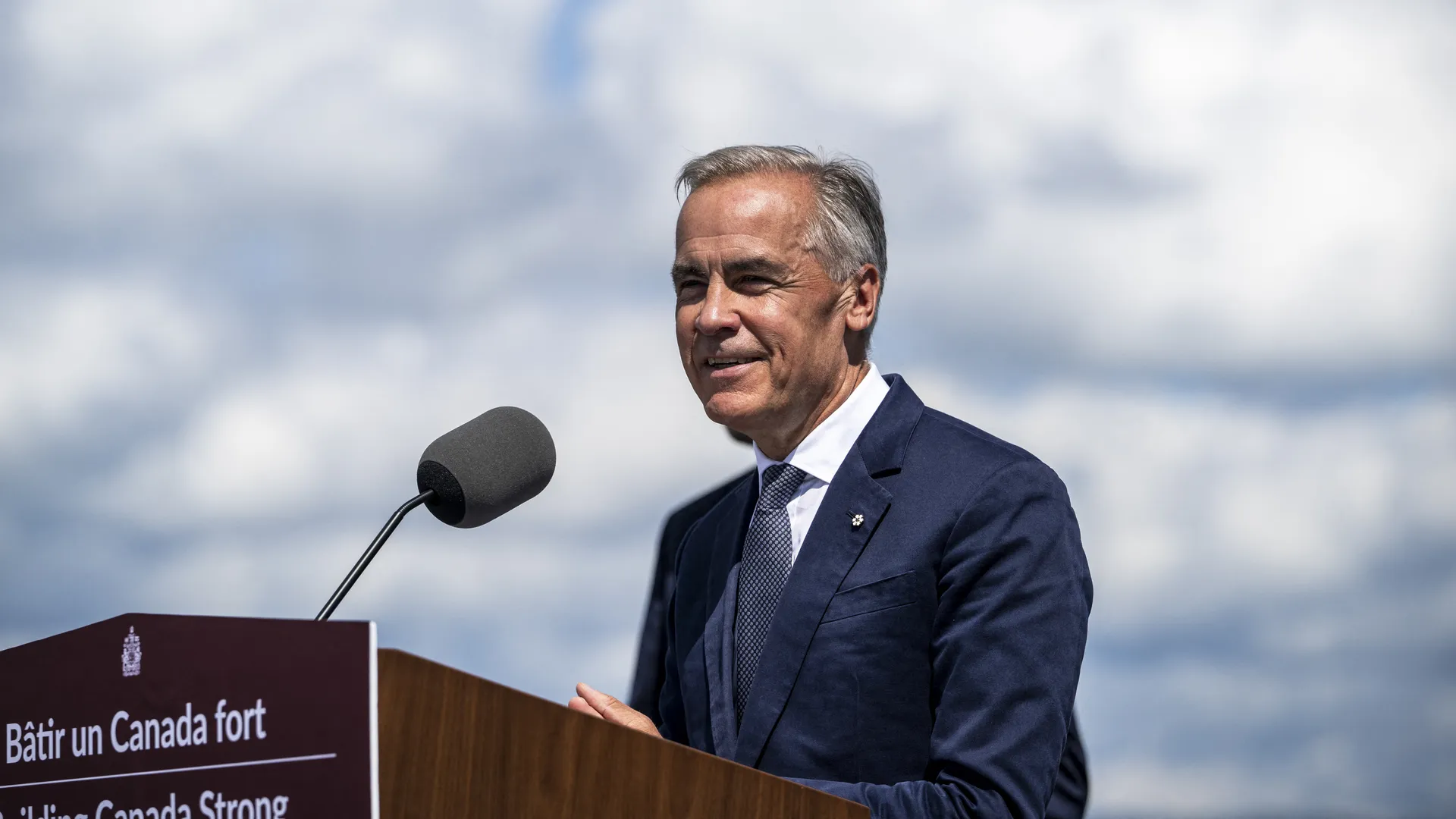
Mark Carney called for pro-trade democracies to resist great-power coercion together. Seven months later, he is largely fighting Trump alone.
In January at Davos, Mark Carney offered the most bracing account yet of what the end of the American-led trade order means for countries such as Canada. The old bargain, he said, is over. Economic integration is no longer simply a source of prosperity; it is becoming a source of coercion. Tariffs are leverage. Supply chains are vulnerabilities. Financial ties are weapons.
His conclusion was equally clear: middle powers must stop competing to be the most accommodating supplicant and start acting together. “If we’re not at the table, we’re on the menu,” he warned.
Seven months later, Canada is finding out what happens when a compelling geopolitical doctrine reaches its first test before its institutions exist.
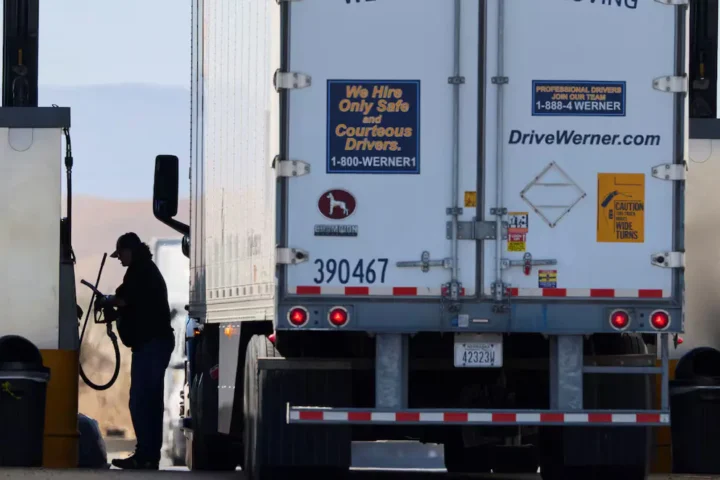
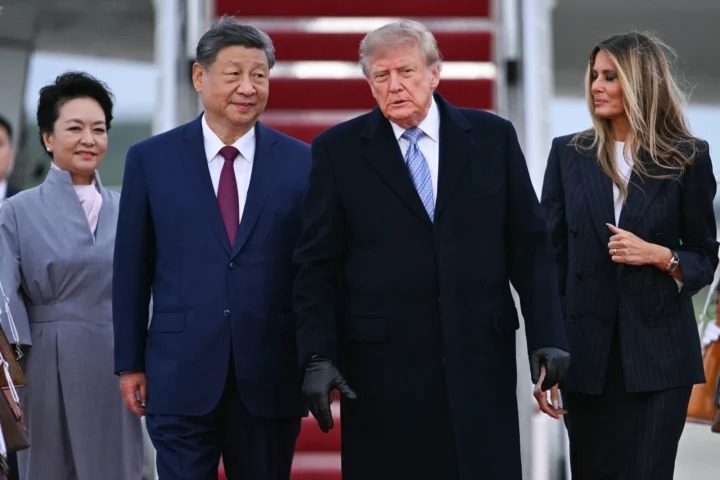
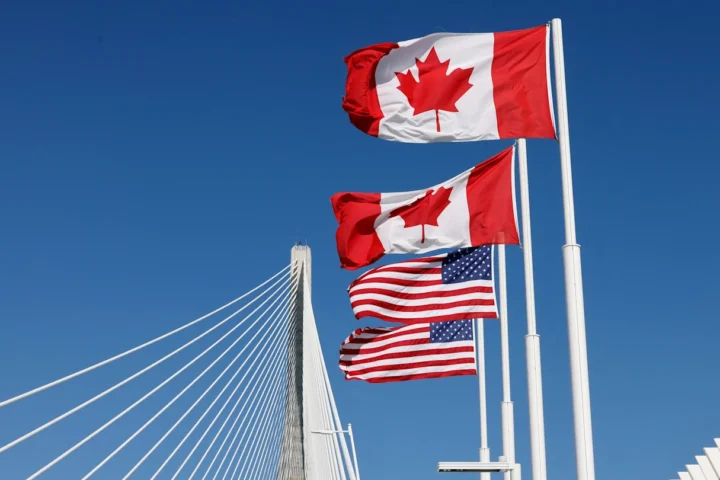
After trade negotiations with Washington collapsed, the United States imposed 50 percent tariffs on roughly $20 billion of Canadian goods. Ottawa has promised a dollar-for-dollar retaliation from Sept. 8, aimed at U.S. steel, dairy, appliances, agricultural equipment, pulp and paper, and electronics. The immediate conflict is a bilateral one. But its significance is global: it is the sharpest test to date of Carney’s argument that democracies dependent on trade can protect their sovereignty only by pooling their leverage.
So far, Canada is doing the pooling alone.
That does not mean Carney’s vision was naïve. It means that he was right about the direction of the world and late in building the vehicle for surviving it. A coalition of middle powers cannot be improvised after the tariff notice arrives. It needs commitments, market access, financing and political habits already in place. Canada has the beginnings of such a network. It does not yet have an alliance capable of imposing costs on economic coercion.
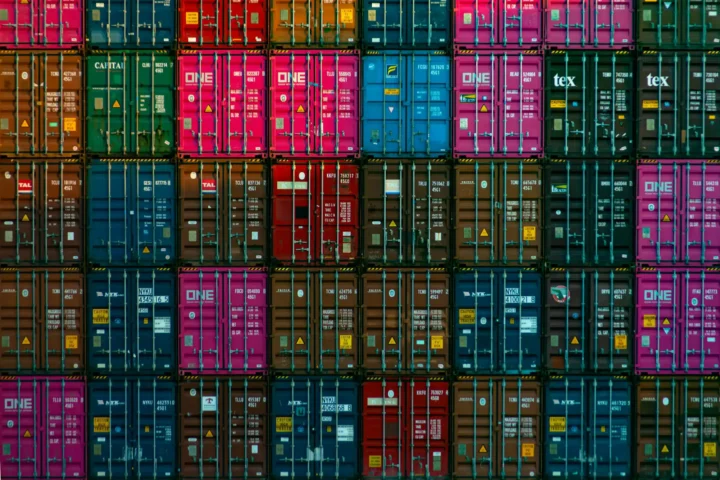
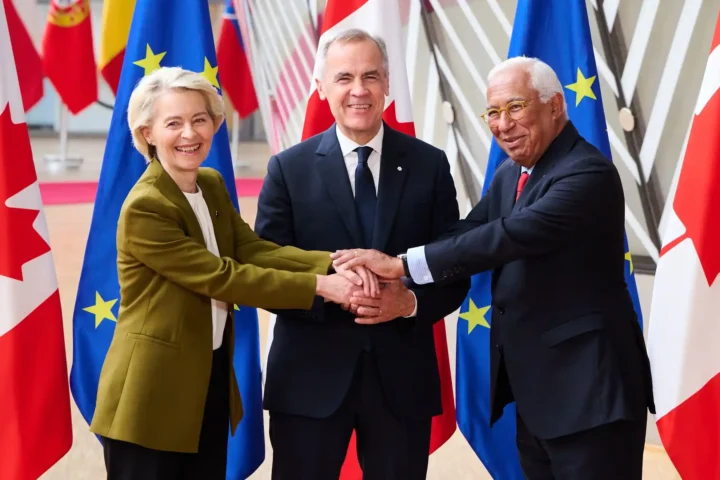
At Davos, Carney sketched an ambitious architecture: deeper links between the European Union and the Comprehensive and Progressive Agreement for Trans-Pacific Partnership, co-operation on critical minerals, common approaches to artificial intelligence, and flexible coalitions that could unite countries around particular interests. An EU-CPTPP bridge could link a market of about 1.5 billion people. It is an imaginative response to a world dividing not neatly into blocs, but into overlapping networks of power and dependence.
But a bridge is not a shield.
The EU-CPTPP project is still largely a project. Governments are discussing ways to align rules of origin, customs arrangements, digital-trade rules and investment protections. That is worthy work. It may ultimately create more resilient supply chains and lower barriers among reliable partners. Yet even its advocates concede that harmonising rules among nearly 40 diverse economies will be difficult and gradual. Such arrangements cannot, on their own, redirect industries, replace lost export markets or protect a country facing a sudden bilateral ultimatum from Washington.
That gap explains the lonely quality of Canada’s present stand.
Other U.S. partners have made their own bargains. Washington’s deals with the EU and Japan have capped tariffs on most of their exports at 15 percent. Britain secured a 10 percent base tariff, with more punitive treatment for some steel and auto exports. Those settlements may be imperfect, and they leave American protectionism entrenched. But they have also reduced the immediate incentive for those capitals to join Canada in a confrontation that could put their own fragile deals at risk.
This is the basic collective-action problem of the middle powers. Everyone can see that a system of transactional threats is dangerous. Each country also has a reason to seek an individual exemption from it. The rewards for accommodation are immediate; the gains from solidarity are distant and uncertain. A coalition with no agreed response to coercion is therefore vulnerable to being picked apart one bilateral negotiation at a time.
Canada is especially exposed. Nearly three-quarters of its goods exports go to the United States, whose economy is roughly 10 times larger. Carney is right to point out that interdependence runs both ways: Canada supplies the United States with 99 percent of its natural-gas imports, 85 percent of its electricity imports and 60 percent of its crude-oil imports. But asymmetry still matters. A country whose prosperity has been organised around privileged access to one neighbouring market cannot diversify on a ministerial timetable.
That is why Carney’s decision to reject the proposed deal deserves more respect than it will receive from those who regard any agreement as preferable to a trade war. According to his government, the United States kept adding terms that would compromise sovereignty, key industries and Canadian cultural protections, while calling into question whether any deal could be relied upon. A bargain that trades away the capacity to diversify in exchange for temporary tariff relief is not an escape from dependency. It is dependency written into contract.
Still, resistance is not a strategy by itself. Retaliatory tariffs may be politically necessary, but Carney has acknowledged that they will raise prices and reduce consumer choice in Canada. The real question is whether Ottawa can turn a necessary act of defiance into the catalyst for the coalition it says it wants.
That requires moving beyond speeches and exploratory trade talks.
First, Canada should seek an explicit anti-coercion compact among willing EU and CPTPP partners. It need not promise automatic tariff retaliation in every dispute. That would be politically impossible and economically clumsy. But it should establish clear consultation triggers when a member faces arbitrary economic pressure; a menu of collective responses; and commitments to avoid exploiting a partner’s distress for commercial advantage.
Second, the group should build emergency market-access mechanisms. When a member is cut off from a major market, its allies should be able to accelerate customs clearance, recognise standards, adjust quotas, provide trade finance and open procurement opportunities. Diversification works only when a Canadian producer can actually sell into a new market in months rather than after years of regulatory negotiation.
Third, the coalition should concentrate on sectors where its collective leverage is real: critical minerals, clean energy, advanced manufacturing, food security and digital infrastructure. Carney’s “buyer’s clubs” concept is more than a slogan if members use joint purchasing, long-term contracts and shared investment to reduce their exposure to coercive suppliers and buyers alike.
Finally, the alliance must not define itself merely as anti-Trump. That would make it an episode, not an order. Its affirmative purpose should be to demonstrate that open trade among democracies can still deliver reliability, reciprocity and resilience. The test is whether its members apply the same standards to allies and rivals—and whether they are willing to bear costs when those standards are breached.
Carney’s warning at Davos was that the world’s middle powers had a choice between accepting subordination and building a third path. Canada’s trade war shows that the choice is no longer theoretical.
The prime minister is not failing because his coalition has not ridden to the rescue. He is discovering that, in the age of economic coercion, a coalition cannot be a mood, a summit communiqué or a future trading bloc. It has to be a standing capacity to act.
Canada may be fighting Trump largely alone today. The task now is to make sure it is the last middle power forced to do so.