
For most of modern history, military power has been measured in visible things: armies, ships, aircraft, missiles and, eventually, nuclear weapons. But behind every weapon is a less visible architecture—capital, technology, minerals, factories, logistics networks, payment systems and suppliers. Long before a missile reaches a launcher, an economy has had to produce the materials, finance the factory, acquire the technology and move thousands of components through a supply chain.
That architecture is becoming one of the decisive arenas of great-power competition.
The United States is beginning to recognize this. The creation of an Economic Defense Unit intended to synchronize economic competition efforts, alongside new authorities associated with the Office of Strategic Capital, points toward an important evolution in American strategy. Washington is no longer thinking only about how to sanction an adversary after a crisis begins. It is increasingly asking how government can mobilize private capital, strengthen strategically important industries and make defense-related demand sufficiently predictable that private investors are willing to finance production.
That is a welcome change. But it needs a doctrine.
The central objective of American economic strategy should be straightforward: make it progressively easier for the United States and its allies to convert money, technology and resources into military capability—and progressively harder for potential adversaries to do the same.
That does not require turning the American economy into a command economy. Nor does it mean attempting to sever China from world trade, an objective that would be economically destructive and probably impossible. It means understanding that economic networks themselves distribute strategic power.
Three concepts can help Washington think about this competition more systematically: fungibility, elasticity and market-making. Underlying all three is a fourth requirement that is increasingly indispensable: verification.
Together, they offer the foundations of a modern doctrine of economic warfare.
The economy behind the battlefield
Economic warfare is hardly new. States have blockaded ports, seized merchant vessels, manipulated currencies, denied access to strategic commodities and financed allies for centuries.
What has changed is the complexity of the economic system being contested.
In the eighteenth century, William Pitt could combine British naval power, subsidies to continental allies and attacks on French colonial commerce to weaken France’s ability to sustain war. In the nineteenth century, Alfred Thayer Mahan understood command of the sea not simply as the ability to destroy enemy fleets but as the ability to control the commercial arteries upon which national power depended.
By the twentieth century, industrialization had made the relationship between economics and warfare impossible to ignore. World wars were contests not simply between armies but between industrial systems.
The same principle holds today, except the relevant industrial system is global.
A modern weapons platform may depend upon semiconductors fabricated in one country, minerals processed in another, machine tools manufactured somewhere else, software developed across several jurisdictions and financing moving through an international banking system.
Military power is therefore not simply something a country possesses. It is something an economic system converts.
Money becomes factories. Factories transform materials into components. Components become weapons. Logistics deliver those weapons. Technology improves them. Finance allows the process to expand.
Economic warfare targets this conversion mechanism.
That distinction matters. Conventional warfare seeks primarily to destroy an adversary’s deployed military capability. Economic warfare seeks to constrain the machinery capable of producing and regenerating that capability.
The problem is that Washington’s economic instruments remain surprisingly crude.
Modern militaries have spent decades improving targeting precision. Economic statecraft has not undergone an equivalent revolution.
Sanctions are often the area bombing of economic strategy. They can inflict substantial costs, but they frequently hit civilian commerce, allied firms and neutral intermediaries alongside their intended targets. Export restrictions can similarly generate unintended shortages or encourage companies to redesign supply chains around American controls.
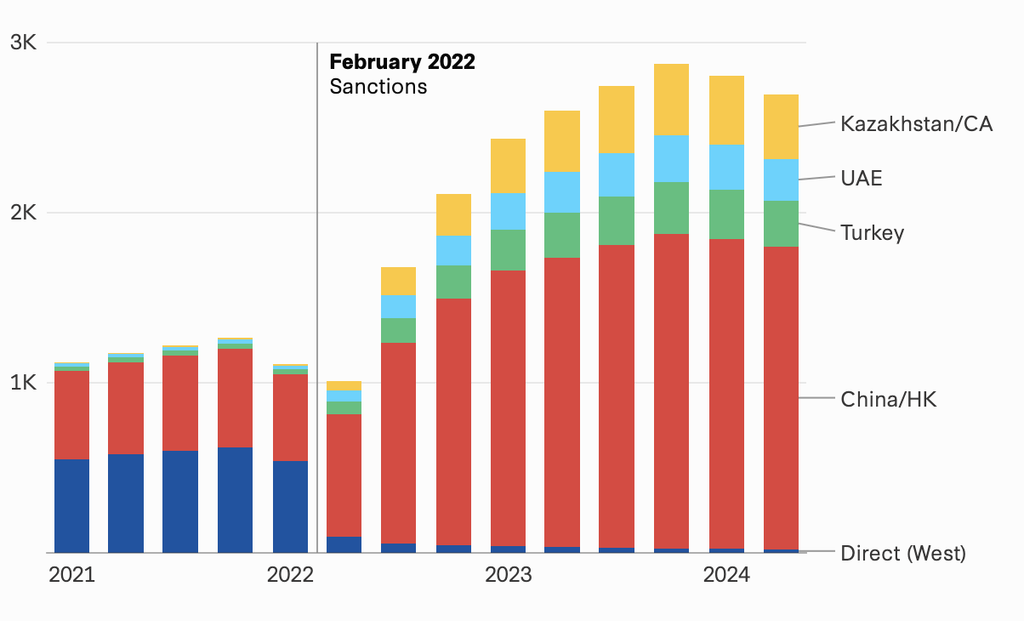
Russia’s adaptation following the sanctions imposed after its 2022 invasion of Ukraine illustrates the problem. Restricted technologies did not necessarily disappear from Russian supply chains. Trade patterns changed. Semiconductors and other dual-use products increasingly travelled through intermediaries and third countries. Energy changed routes. Shell companies appeared. Supply chains became longer and more opaque.
The lesson is not that economic pressure does not work.
It is that economic pressure without precision leaks.
And leakage is becoming the central operational challenge of economic warfare.
Fungibility: Find what cannot easily be replaced
The first question strategists should ask about any economic target is simple: How replaceable is it?
This is the problem of fungibility.
Restrict something that an adversary can easily buy elsewhere and the strategic effect will be modest. Restrict an input for which there are few substitutes, few producers or difficult technical alternatives and even a relatively narrow intervention can reverberate through an entire industrial system.
This is why semiconductor manufacturing equipment, specialized chemicals, critical minerals, advanced software and particular engineering capabilities matter disproportionately.
China has already demonstrated the strategic power created by controlling difficult-to-substitute inputs. Its extraordinary position in the processing and refining of several critical minerals gives Beijing leverage far greater than the nominal dollar value of those industries might suggest.
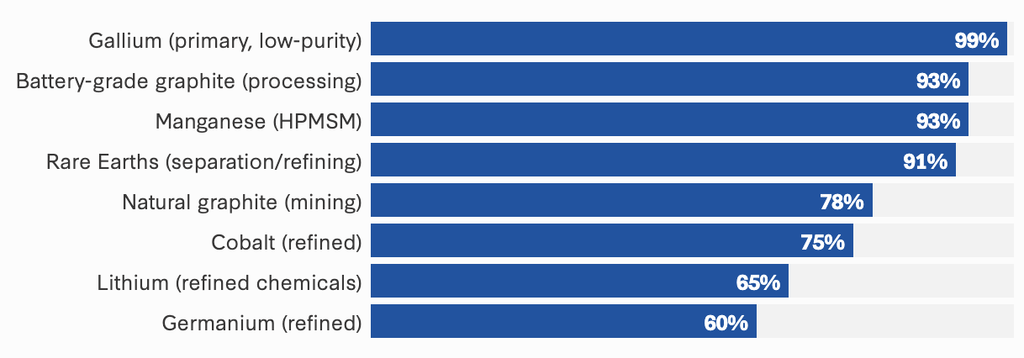
Rare-earth refining is particularly instructive. Western economies may possess enormous financial resources, sophisticated defense companies and advanced scientific institutions, but those strengths cannot instantly compensate for missing processing capacity.
A supply chain is ultimately constrained by its least replaceable node.
American economic strategy should therefore work in two directions simultaneously.
It should identify low-fungibility inputs inside adversary military-industrial systems and preserve leverage over them. At the same time, it should relentlessly eliminate low-fungibility dependencies inside American and allied supply chains.
This is more sophisticated than conventional ideas of economic “decoupling.” The goal should not be national self-sufficiency in everything. Autarky would sacrifice many of the efficiencies that make the American economy powerful.
The objective is selective resilience: redundancy where dependency creates strategic vulnerability, combined with continued openness where markets generate strength.
Elasticity: Pressure only matters if adaptation is difficult
Identifying a strategic dependency is only the beginning. The next question is: How quickly can the target adapt?
This is where elasticity becomes useful.
An adversary may initially depend heavily upon a restricted technology. But if it can substitute a domestic product, buy an alternative abroad or establish a third-country procurement network within six months, the coercive value of the restriction diminishes rapidly.
Economic warfare therefore operates against a clock.
The relevant measure is not simply whether substitution is possible. Given enough money and time, substitutes can often be found. The crucial question is whether substitution can occur before the adversary needs the capability.
That transforms economic intelligence into a strategic requirement.
Suppose a country requires a specialized component for missile production. A traditional sanctions approach might identify the component, prohibit its export and then audit compliance months later.
A more operational approach would map the entire conversion chain: manufacturer, distributor, freight forwarder, intermediary jurisdictions, payment institutions, likely shell companies, substitute components and production timelines.
The objective would be to detect adaptation while it is happening—not after the new supply chain has matured.
This is one of the most important lessons from Russia’s sanctions evasion. Individual transactions can move much faster than bureaucratic enforcement cycles.
Economic warfare conducted at quarterly-report speed will lose to procurement networks operating at commercial speed.
Washington therefore needs to think less like a regulator periodically inspecting compliance and more like an operational headquarters continuously observing a system.
Market-making: Make the American system difficult to leave
The third principle is potentially the most powerful because it reverses the usual logic of economic coercion.
Instead of asking only how America can deny access to markets, policymakers should ask how America can build markets that other countries do not want to leave.
The United States’ greatest economic weapon has never been isolation. It has been centrality.
Dollar clearing, deep capital markets, technology ecosystems, commodity exchanges, shipping infrastructure and international standards provide influence precisely because enormous numbers of countries and companies voluntarily use them.
Network effects magnify that advantage.
The more participants a financial or technological system attracts, the more useful it becomes. The more useful it becomes, the more expensive departure becomes. That creates strategic leverage without requiring constant coercion.
The objective should therefore be to make American and allied economic networks deeper, cheaper, faster and more reliable than competing systems.
This is where economic security policy can go badly wrong. If Washington overuses exclusion, sanctions and financial restrictions, it can unintentionally subsidize the development of alternatives.
China’s Cross-border Interbank Payment System is nowhere near replacing the dollar-centered global financial architecture. The scale difference remains enormous. But its growth should matter to strategists because network competition is path-dependent.
Once an alternative system develops sufficient liquidity, institutional familiarity and membership, switching becomes easier. Economic leverage consequently declines long before the alternative network achieves outright dominance.
Russia’s development of alternative payment infrastructure demonstrates the same principle on a smaller scale: when dependence becomes sufficiently costly, states invest in escape routes.
America therefore faces a delicate strategic problem. It must exploit its economic centrality without consuming it.
The strongest economic network is not necessarily the one that excludes the most adversaries. It is the one that allies, neutral states and commercial actors find indispensable—and whose rules adversaries must consequently take seriously.
Verification is the missing infrastructure
Fungibility, elasticity and market-making all encounter the same practical obstacle: How do you know what is actually happening?
Modern commerce still depends to a remarkable degree on claims.
A supplier declares where a product originated. A company certifies that a component complies with regulations. A shipping document describes what a container contains. A contractor attests that restricted materials are absent from its supply chain.
But attestation and verification are different things.
And the difference between them has become a strategic vulnerability.
A mineral may be mined in one jurisdiction, processed in another, incorporated into a component in a third and assembled into a weapons system in a fourth. By the time it reaches a prime contractor, even the company purchasing it may lack visibility several tiers down the supply chain.
The same opacity facilitates sanctions evasion.
Goods can be relabeled. Ownership can be concealed behind shell companies. Shipments can be rerouted. Components can be incorporated into larger products. Payments can pass through intermediaries.
This creates an uncomfortable reality: governments cannot effectively control economic activity they cannot see.
The next revolution in economic statecraft therefore needs to be a revolution in verification.
The United States and its allies need better systems for establishing provenance, beneficial ownership, transaction histories and chain of custody for strategically important goods. Compliance cannot remain a stack of documents reviewed long after a transaction occurs.
Where possible, it must become part of the transaction itself.
That would change the economics of enforcement.
Today, evasion can be attractive because verification is expensive while lying is cheap. The strategic objective should be to reverse that equation: make compliant transactions fast and inexpensive while making opaque transactions slower, costlier and more conspicuous.
This is where the government’s ability to work with private markets becomes particularly important.
Banks, insurers, logistics firms, commodity exchanges, technology platforms and institutional investors observe enormous amounts of economic activity. Government possesses authorities and intelligence that private firms do not. Neither side alone has a complete picture.
The economic defense architecture of the future must connect them without converting legitimate commerce into a permanently securitized bureaucracy.
Build more, prohibit more precisely
This leads to perhaps the most important change Washington should make.
American economic security policy should become more constructive and more discriminating at the same time.
For years, much of the debate has centered on restrictions: sanctions, tariffs, investment screening, export controls and entity lists. These instruments remain necessary. But prohibition alone cannot produce industrial capacity.
A country cannot sanction its way into more shipyards.
It cannot export-control its way into additional rare-earth processing.
It cannot tariff its way into faster weapons production.
Economic defense therefore needs a positive side.
Government contracts should become easier to finance. Long-term procurement commitments should help firms raise private capital. Strategic industries should have access to financing structures that allow production to expand before a crisis creates emergency demand.
This is why efforts associated with the Office of Strategic Capital matter. If predictable government demand can become a bankable asset, public procurement can mobilize considerably larger pools of private investment without requiring the government to finance every factory itself.
That plays directly to an American comparative advantage.
China can direct capital administratively. The United States possesses something different: the world’s deepest and most sophisticated private capital markets.
The objective should not be to imitate China’s economic model. It should be to make America’s own model strategically effective.
A pension fund, bank, insurer or private investor financing additional manufacturing capacity can contribute to national defense without becoming part of a centrally planned industrial system.
The state establishes strategic demand. Markets discover efficient ways to satisfy it.
That division of labor is essential because the United States’ economic strength ultimately comes from the dynamism that excessive economic control could destroy.
The new logic of deterrence
The most successful economic warfare strategy may ultimately be one that makes actual economic war less necessary.
Imagine two competing systems.
In one, strategically important manufacturers face uncertain orders, fragile supply chains, concentrated mineral dependencies and cumbersome financing. In the other, firms operate inside deep capital markets, redundant allied supply chains, predictable procurement systems and verified networks of suppliers.
The second system can mobilize faster.
That knowledge itself affects deterrence.
An adversary contemplating conflict must calculate not simply the forces deployed on the first day of war but the opponent’s ability to regenerate weapons, replace losses, finance expansion and sustain production over years.
Industrial resilience therefore becomes a form of latent military power.
This is why the distinction between economic policy and defense policy is becoming increasingly artificial. The factory, the clearinghouse, the semiconductor foundry, the port, the mine and the insurance market are all part of the strategic rear.
The United States should organize accordingly.
Its objective should not be indiscriminate economic confrontation with China or anyone else. Nor should economic warfare become a convenient label for protectionism.
The standard should be considerably stricter.
Where does an adversary’s military conversion system depend upon scarce inputs? How quickly can those inputs be substituted? Which networks provide visibility and leverage? Where are America’s own dangerous dependencies? And can pressure be applied without imposing greater costs on allies than on the intended target?
Those questions turn economic statecraft from political signaling into strategy.
The emerging Economic Defense Unit has an opportunity to institutionalize that approach. Its success should not be measured by the number of sanctions imposed or companies blacklisted, but by something more consequential: whether America’s economic system becomes better at producing strategic capability while adversary systems become worse at doing so.
That is ultimately the logic of the ledger.
America should seek a world in which its allies obtain capital, technology and strategic materials through markets that are deep, transparent and efficient, while adversaries attempting to acquire military-sensitive capabilities encounter progressively thinner, more expensive and more observable channels.
In other words: make allied production cheap, fast and scalable; make hostile military procurement expensive, slow and visible.
Economic warfare then ceases to be merely the economic punishment that accompanies geopolitical conflict. It becomes something more powerful: the deliberate shaping of the economic terrain on which future conflicts will either be deterred or fought.
The great powers of the twenty-first century will still need ships, missiles, aircraft and soldiers. But the decisive advantage may belong to the state that best understands the invisible machinery behind them.
The next arms race is already underway.
Much of it is happening in markets.