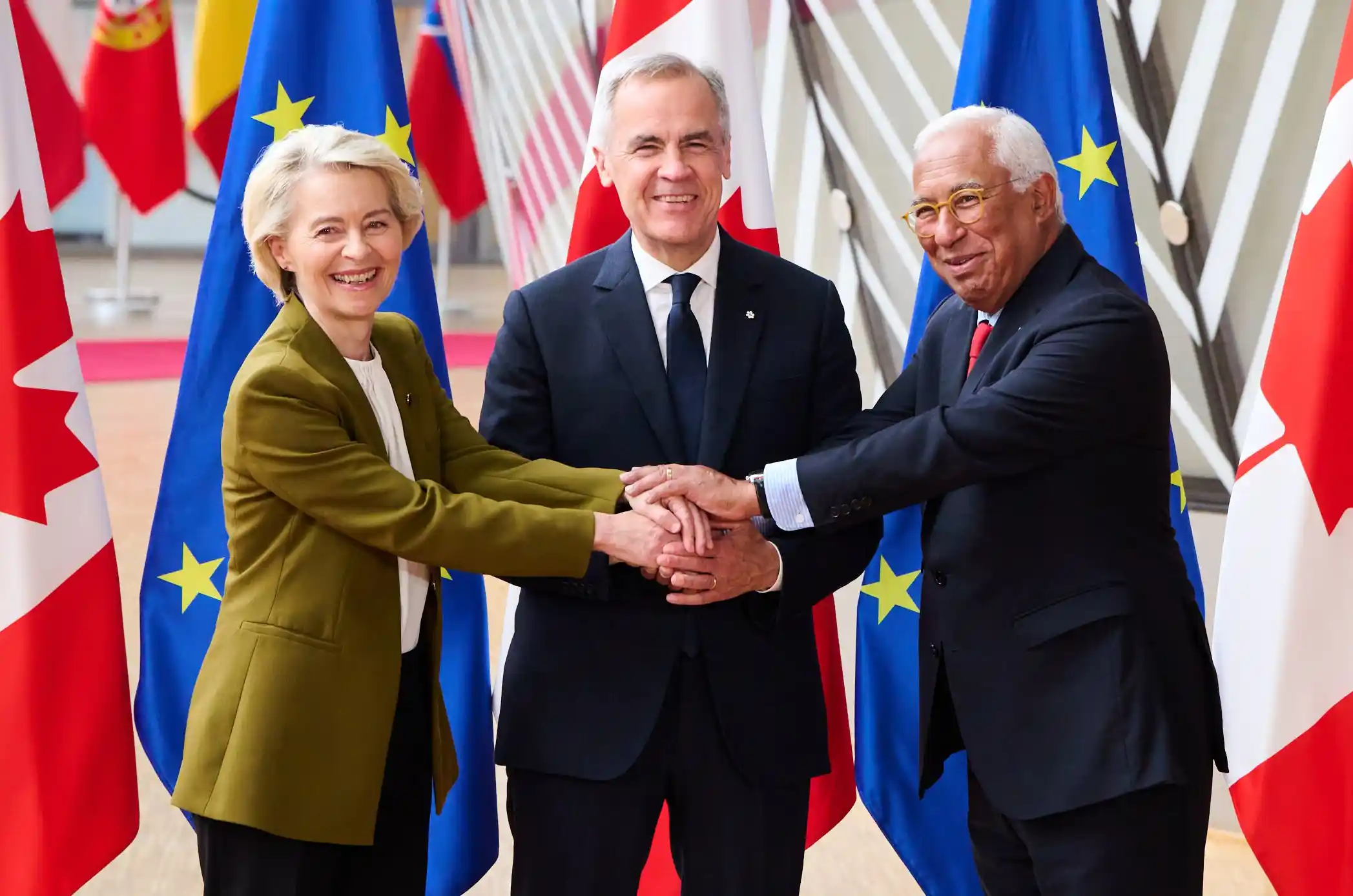
This week in Strasbourg, Canadian Prime Minister Mark Carney will sit in the gallery for Ursula von der Leyen’s State of the European Union address and then speak to the European Parliament. The choreography is unusual. A North American leader is being treated as something closer to family than a distant trading partner. The reason is not sentiment. It is the wreckage of Canada’s relationship with the United States and a quiet, high-stakes experiment: whether Ottawa and Brussels can invent a form of alliance that does not exist in any treaty.
The Wall Street Journal reported that Carney has explored an “associate member” status for Canada—a category the European Union has never created. Carney quickly clarified that Canada is not seeking full membership. What he wants, he said, is a “unique alliance” built on shared values, complementary strengths, and strategic necessity. That distinction matters.
Full membership is a legal and political impossibility. The EU’s founding treaties restrict membership to European states. Geography, the acquis communautaire, the Common Agricultural Policy, monetary union, and the transfer of sovereignty to Brussels would tear Canada’s federal-provincial compact apart and wreck its agricultural model. Associate status, or whatever name officials eventually choose, is an attempt to capture the benefits of closeness without the suicide of accession.
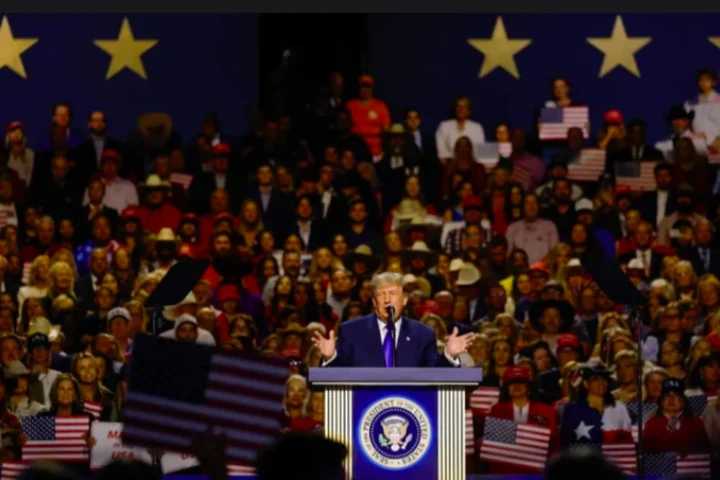
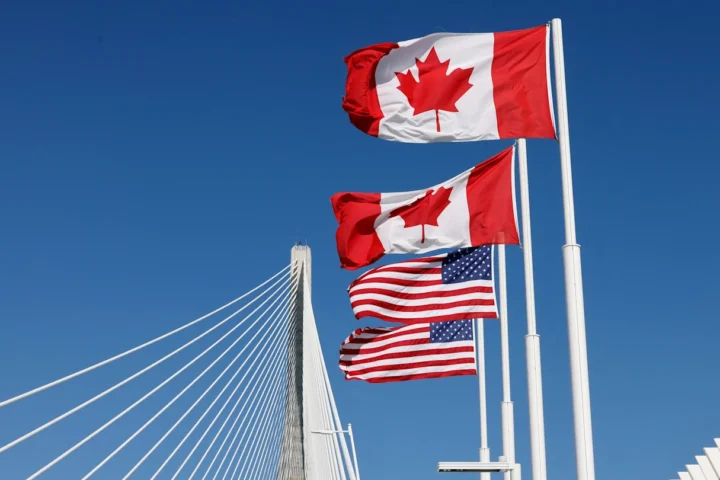
The driver is Washington. Roughly 72 percent of Canadian merchandise exports still go to the United States. After the collapse of trade talks this summer, tariffs now sit on tens of billions of dollars of cross-border commerce. President Trump has called Canada “the worst country to deal with,” threatened new auto tariffs, and revived the 51st-state taunt. Ottawa’s response has been diversification with unusual speed. The EU is the obvious partner: already Canada’s second-largest trading partner, already bound by the provisionally applied Comprehensive Economic and Trade Agreement (CETA), already linked by a 2025 Security and Defence Partnership and by Canada’s unprecedented entry into the EU’s €150 billion SAFE defence-procurement fund.
What would follow is not a single treaty so much as a thickening of the relationship across several tracks at once.
Trade and the single market, without the single market
CETA already eliminated tariffs on more than 99 percent of tariff lines and has lifted two-way goods-and-services trade to more than €130 billion. Yet ten EU member states—including France and Italy—have still not ratified the deal nearly a decade after it was signed. A new political push from both sides could finally complete ratification and add a digital-trade agreement that officials hope to have ready by the October 29–30 summit in Montreal. More ambitious still is the idea of letting Canadian goods, services, and workers in strategic sectors—energy, artificial intelligence, defence, and critical minerals—move more freely, “effectively shifting the EU border.” That is not membership in the single market. It is a sectoral, high-trust corridor. Canadian firms would gain privileged access to a 450-million-person market and, under proposals circulating in Brussels, to EU public procurement under the Industrial Accelerator Act. Europe would gain a reliable supplier of copper, nickel, lithium, cobalt, rare earths, aluminum, and fertilizer that can be shipped through Arctic routes.
The economic reorientation would be the largest Canada has attempted in decades. It would not replace the United States. Geography and integrated auto, energy, and supply chains make that impossible. It would, however, give Ottawa an insurance policy and give European industry an alternative to Chinese minerals and residual Russian energy.
Energy, cables, and the Arctic
Europe still needs to finish the job of replacing Russian gas. Canada has the molecules; what it lacks is the infrastructure to deliver them at scale across the Atlantic. Talks include pipelines, LNG, and Arctic fertilizer corridors. Joint projects under discussion go further: undersea data cables, shared data centres and cloud capacity, new satellite networks. These are not romantic add-ons. They are the physical architecture of digital and energy sovereignty at a moment when both sides worry about subsea-cable sabotage and great-power competition in the High North. Canada already sits inside the EU’s rewritten Arctic thinking. A deeper partnership would give Brussels a North American partner that can tell Washington, as one European parliamentarian put it, that the Arctic is not an American lake.
People, skills, and research
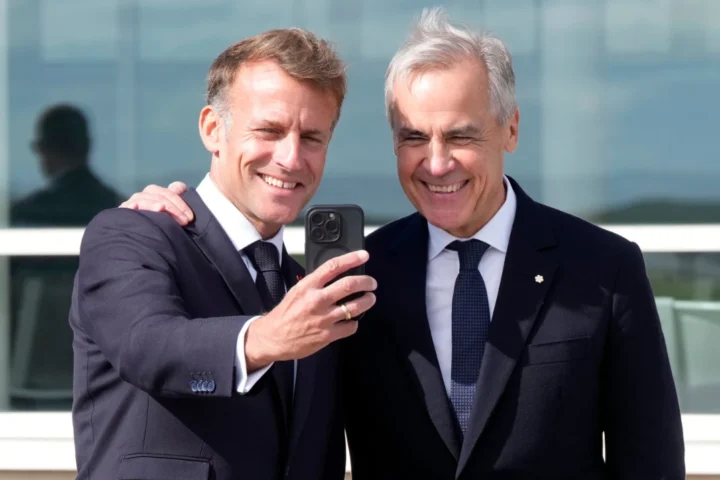
The most politically explosive idea is mobility. Carney has discussed visa-free living and working rights for Canadians in the EU with Emmanuel Macron and others. Officials also want Canada fully inside Erasmus+, mutual recognition of professional qualifications beyond architects, and easier artist visas. For a country whose young people have long treated London, Paris, and Berlin as finishing schools, this would be a generational opening. For Europe, it would be a targeted inflow of English-speaking, highly educated labour in sectors where shortages are chronic. Academic and research collaboration would follow the same logic: Canada as a trusted node in European science rather than a distant associate.
Defence without a common army
Canada is already the first non-European participant in SAFE. German shipyards are building Canadian submarines. Canadian firms are selling tactical radios to Polish cyber command. A unique alliance would lock in industrial cooperation, intelligence sharing, and Arctic domain awareness without requiring Canada to join a European army or accept qualified-majority voting on foreign policy. For an EU that is racing to rearm and still short of industrial depth, Canadian capacity is useful. For Canada, it is a way to keep a sophisticated defence industrial base alive as the old North American auto-and-defence complex comes under tariff pressure.
What (probably) would not follow
Sovereignty is the red line Ottawa has drawn. Canada will not become Norway: bound by EU rules without a vote. It will not adopt the euro, the Common Agricultural Policy, or the full acquis. Canadian agriculture—built on genetically modified crops, different pesticide regimes, and different animal-welfare rules—cannot survive wholesale European regulation. Provincial jurisdiction over resources, labour, and education makes deep regulatory alignment a constitutional minefield. Any labour-mobility deal will have to be carefully designed so that it does not become a one-way valve or a political gift to opponents who will call it an elite project.
Europe has its own constraints. Agricultural lobbies in France and elsewhere still treat CETA as unfinished business. Creating a new legal category for a non-European country sets a precedent that some member states will resist and that others—perhaps a post-Brexit United Kingdom—will immediately demand. Distance is real. A container from Halifax to Rotterdam is not a truck from Windsor to Detroit. Utilization of CETA preferences remains incomplete; rules of origin and sanitary standards still trip Canadian exporters.
The United States will notice. A Canada that can sell energy and minerals to Europe and move talent across the Atlantic is a Canada less easy to coerce. Washington can respond with further tariffs, with pressure on shared defence projects, or with indifference. The political risk for Carney is that the alliance looks like a substitute for the American relationship rather than a complement. Conservative critics have already called the idea out of touch. Public opinion, however, is surprisingly open: multiple 2026 polls show roughly half of Canadians willing to consider even full EU membership, and much larger majorities favour deeper economic and security ties. That support is highest in Ontario and Quebec and among Liberal voters; it is not a western-Canadian consensus.
What comes next
The calendar is compressed. Von der Leyen’s speech this week, Carney’s address to the Parliament, a meeting with Macron on Saint-Pierre-et-Miquelon, and the Montreal summit in late October will test whether “unique alliance” is a slogan or a work programme. The deliverables that matter are concrete: a digital-trade text, a mobility pilot, a critical-minerals investment package, CETA ratification by at least some of the holdouts, and a joint Arctic statement that does not provoke an unnecessary fight with Washington.
If it works, the West will have invented a new geometry. Not a replacement for NATO or for North American integration, but a second pillar that democracies can stand on when the first one buckles. Canada would remain a North American country with a European option. The European Union would remain a European project with a transatlantic insurance policy and a reliable source of the materials and energy its green and digital transitions require. That is less romantic than flags and anthems. It is more useful. In a world where great powers treat trade as a weapon and geography as destiny, usefulness is the point.