As Alberta prepares for a historic vote on its future, a potent blend of Western alienation and American-style populism is raising a wild question: Could Canada’s energy heartland really become the 51st U.S. state?
In Western Canada, a political storm is gathering that threatens to redraw the map of North America.
On October 19, 2026, voters in Alberta will head to the polls to answer a question that once belonged strictly to the fringes of Canadian politics: Should Alberta take the legal steps required to hold a binding referendum on separating from Canada?
While Quebec’s historical independence bids were rooted in francophone culture, language, and distinct nationhood, Alberta’s surge in secessionist fervor is driven by something entirely different: oil, fiscal grievances, deep distrust of Ottawa, and an unmistakable, ideological love affair with Donald Trump’s brand of American populism.
As the vote nears, the specter of “Wexit” has evolved from a quiet grumble into an organized political movement. And at its outer edge sits a jaw-dropping proposition that was once unthinkable in peaceable Canada: joining the United States as the 51st state.
The Resurgence of Western Alienation
Western alienation is not new. For over a century, Albertans have harbored a deep-seated suspicion that Eastern Canada—specifically the political centers of Toronto, Montreal, and Ottawa—treats the West as a colonial hinterland: good for pumping crude oil and paying federal taxes, but secondary when it comes to political representation.
The modern wave of bitterness traces back to the 1980 National Energy Program under Pierre Trudeau, which artificially suppressed domestic oil prices to benefit Eastern manufacturing at Alberta’s expense. Decades later, under successive federal administrations, that resentment flared again over climate regulations, carbon pricing, pipeline delays, and Canada’s federal equalization system—a mechanism that redistributes tax dollars from wealthier “have” provinces like Alberta to “have-not” regions.
Yet, the contemporary movement led by grassroots organizations like the Alberta Prosperity Project and sanctioned by Premier Danielle Smith’s United Conservative Party (UCP) government represents a fundamentally new phase. It is no longer just about getting a better deal inside Confederation; for a vocal minority, it is about breaking Confederation altogether.
Evolution of Western Alienation
Phase 1 (1980s): Economic Grievance
└─ Reaction to the National Energy Program (NEP) & wealth transfer.
Phase 2 (1990s): Political Integration
└─ “The West Wants In” — Channeled through the federal Reform Party.
Phase 3 (2020s–Present): Ideological Secessionism
└─ Cross-border MAGA alignment, anti-regulation, 2026 referendum.
The MAGA North Connection
What makes today’s Alberta separatist movement unique is its eager absorption of U.S. conservative culture war tropes and MAGA style.
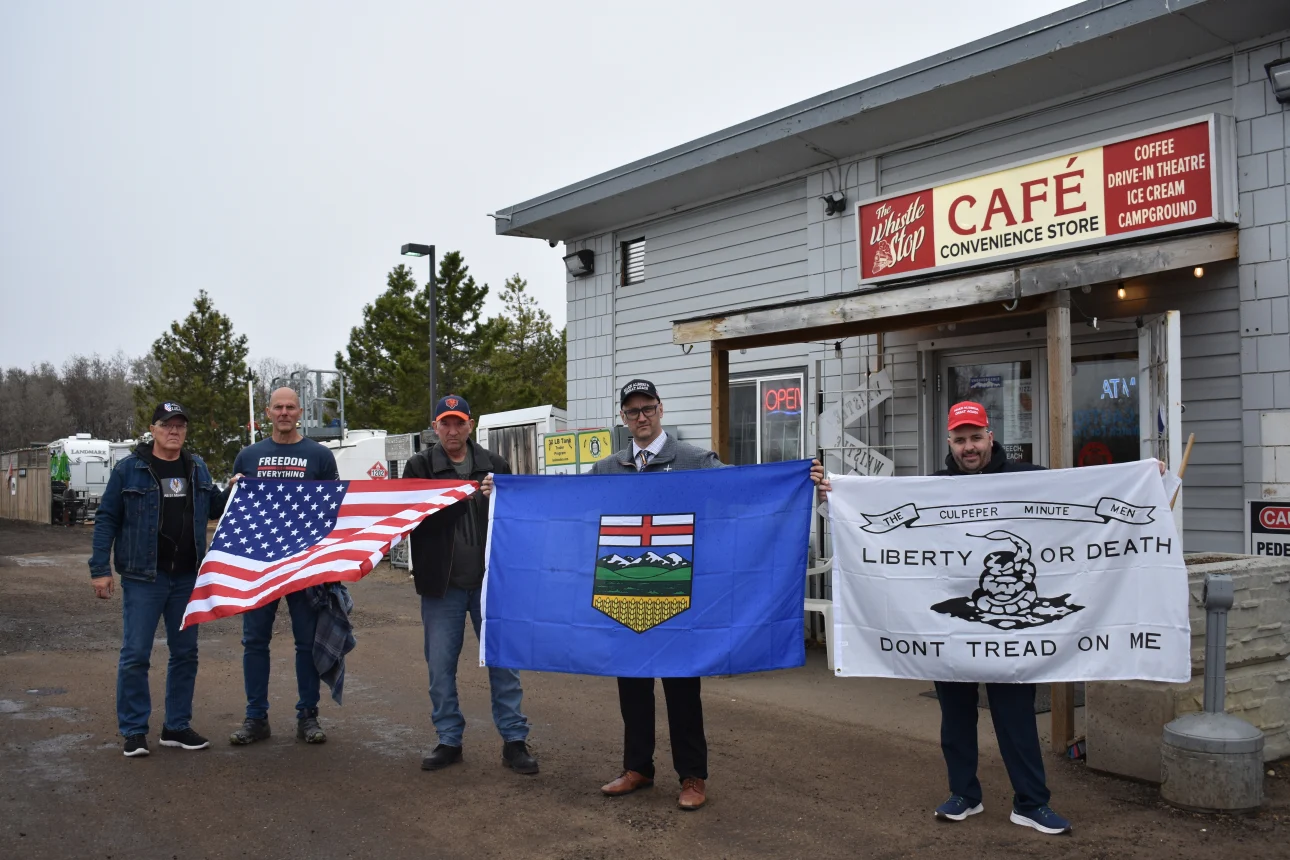
Walk through a sovereignty rally in rural Red Deer or Medicine Hat, and the iconography is unmissable: yellow “Don’t Tread on Me” flags, red “Make Alberta Great Again” hats, and open veneration for Donald Trump. During the 2022 Freedom Convoy protests—which shut down the border crossing at Coutts, Alberta—truckers flew Canadian red ensigns alongside American flags and Trump banners, signaling a ideological alliance that transcends international borders.
To the Canadian secessionist who loves Trump, the 47th U.S. President represents everything the Ottawa political establishment is not:
- Unapologetic Energy Nationalism: A commitment to “drill, baby, drill” versus Ottawa’s net-zero mandates and emissions caps.
- Institutional Skepticism: Deep disdain for globalist bodies, public health mandates, and federal regulations.
- Cultural Alignment: A defense of traditional rural values against what they view as aggressive progressive social policy.
It is no coincidence that separatist leaders have reportedly sought out conversations with conservative thinkers and political operatives in Washington. For Albertans who view the Canadian federal government as an overreaching, green-obsessed bureaucracy, Trump’s America looks less like a foreign power and more like a ideological promised land.
Is the “51st State” Real or a Fantasy?
When Donald Trump mused publicly in late 2024 about Canada becoming a 51st state during trade friction, most Canadians reacted with outrage or mockery. But among hardline Alberta separatists, the idea was greeted with a quiet, approving nod.
The logic put forward by “Annexationists”—represented by fringe parties like the Republican Party of Alberta—is simple:
| Dimension | Independence / Separation | Annexation as 51st U.S. State |
| Market Access | Landlocked nation with potential transit disputes through Canada. | Direct access to U.S. refining hubs, gulf coast ports, and interstate pipelines. |
| Regulatory Climate | Subject to federal Canadian carbon tariffs and environmental reviews. | Alignment with U.S. energy deregulation and lower corporate tax models. |
| Defense & Sovereignty | Responsible for building a standalone military from scratch. | Protected under the U.S. military umbrella and NORAD integration. |
| Political Alignment | Small, isolated parliamentary republic surrounded by Canada. | A guaranteed red state adding two Conservative U.S. Senators and Representatives to Congress. |
However, the path from an October 2026 provincial referendum to a 51st star on the American flag is blocked by colossal legal, political, and constitutional mountains:
1. The Legal Hurdles Inside Canada
Under Canada’s Clarity Act and the landmark 1998 Supreme Court Secession Reference, a province cannot simply declare independence unilaterally. Separation requires a clear majority vote on a clear question, followed by complex constitutional negotiations involving Ottawa, all ten provinces, and Indigenous nations.
2. The Treaty Rights of First Nations
Nearly the entirety of Alberta sits on Treaties 6, 7, and 8—historic agreements made between First Nations and the British Crown, long before the province of Alberta was created in 1905. Indigenous leaders have repeatedly made clear that their treaties are with the federal Crown, not the Alberta provincial government. In May 2026, an Alberta court struck down an earlier separatist petition specifically because proponents failed to consult First Nations, whose constitutional rights would be directly threatened by secession.
3. U.S. Congressional Approval
Even if Alberta somehow extracted itself from Canada, joining the United States requires an Act of Congress under Article IV of the U.S. Constitution. While American Republicans might welcome a high-income, oil-rich red state that locks in conservative Senate control, Democrats in Washington would fight tooth and nail against an admission that tilts the Electoral College rightward without an offsetting blue state like Puerto Rico or Washington, D.C.
4. Public Support at Home
Most importantly, despite all the noise, the vast majority of Albertans do not actually want to leave Canada, let alone join the United States. Recent polling ahead of the October vote shows that while Albertans overwhelmingly favor standing up to Ottawa, over 70% of residents oppose separation.
A High-Stakes Political Game
If the numbers are so stacked against actual independence or American statehood, why is Premier Danielle Smith allowing this referendum train to roll forward?
Because in Canadian political history, the threat of separation has often been the ultimate leverage tool.
Just as Quebec used the threat of independence in 1980 and 1995 to extract massive autonomy, tax carve-outs, and cultural protections from Ottawa, Alberta’s political leadership is using the sovereignty movement as a battering ram. The upcoming vote—phrased deliberately as a mandate to open constitutional negotiations rather than an immediate declaration of independence—is designed to force Prime Minister Mark Carney and the federal government into major concessions on energy development, carbon policies, and fiscal transfers.
Canadian leaders have warned that playing with secession is a “dangerous bluff”. Once a political movement unlocks the forces of populist grievance and nationalist sentiment, it rarely stays neatly inside the lines drawn by political strategists.
The Broader Warning for North America
The phenomenon of Canadian secessionists who embrace Trump reveals a deeper truth about modern democracy: border lines no longer bound ideological identity.
For decades, Canada defined itself in contrast to the United States—substituting the American “life, liberty, and the pursuit of happiness” with “peace, order, and good government.” But social media, polarising media ecosystems, and shared economic frustrations have created a transnational conservative movement that feels a stronger affinity for cross-border political allies than for their own fellow citizens in Ottawa or Toronto.
When Albertans vote on October 19, 2026, they will not just be deciding a technical question of constitutional law. They will be reflecting a profound friction point inside Western democracy: whether shared national identity can hold together when political cultures pull in opposite directions.
Alberta will almost certainly remain a Canadian province when the dust settles. But the fact that millions of Canadians are looking south to Donald Trump’s America with longing—wishing their oil patch was a U.S. state rather than a Canadian province—is a warning sign that Confederation is deeply fractured.