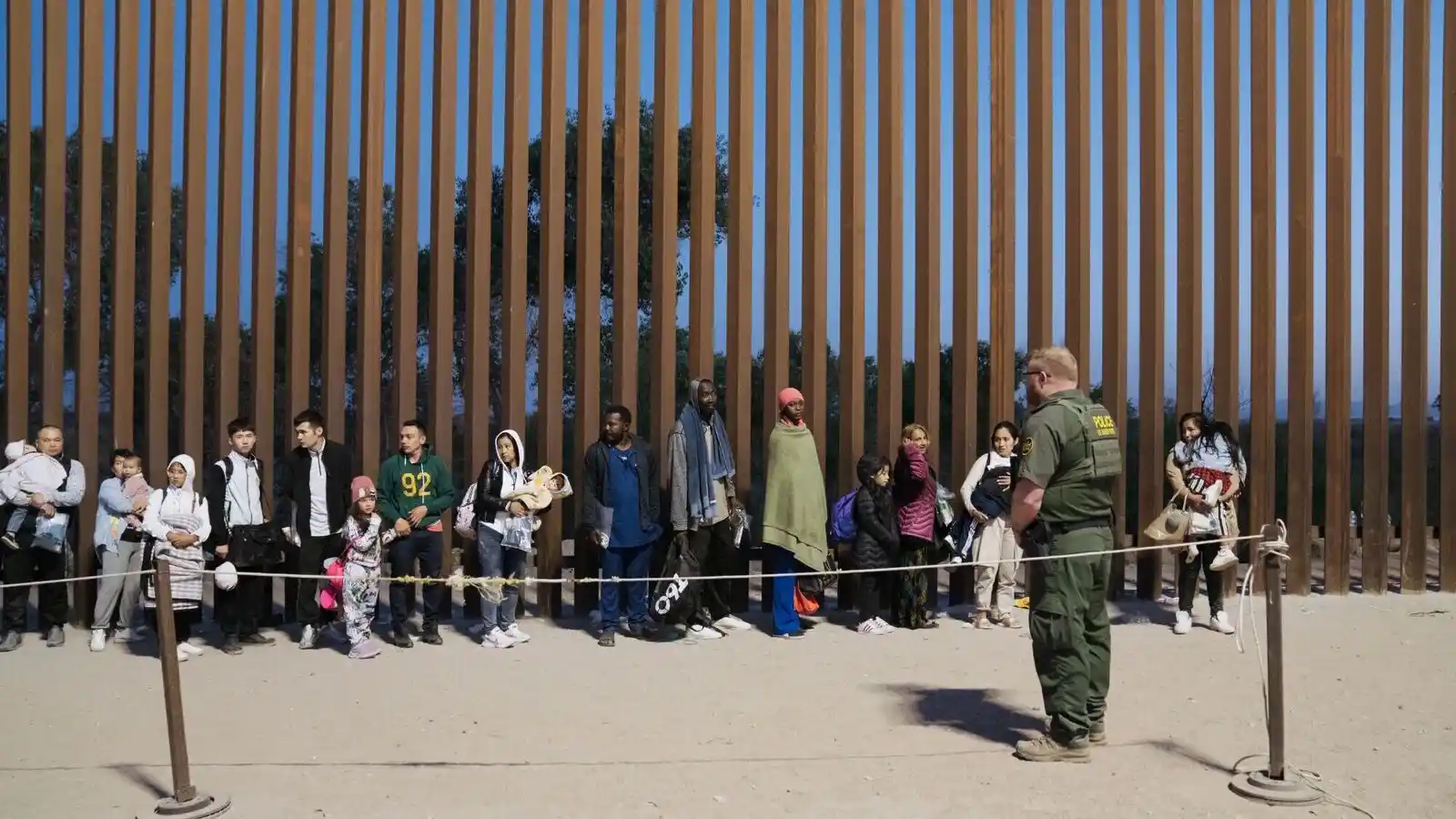
Debate over the Trump administration’s immigration agenda has fixated on the southwest border, where images of quiet crossings have become a political talking point. But the biggest reductions in the number of foreign nationals arriving in the United States have not come from the border at all. They have come from the legal system: immigrant visas, student visas, work visas, refugee admissions, and the lawful processing of asylum seekers at ports of entry.
Data through February 2026, the latest month for which the State Department has published figures, show that monthly legal entries in the major categories have fallen about 2.7 times as much as illegal entries. The drop in legal entries is roughly 144,569 people per month, against a drop of roughly 53,128 in illegal entries. Legal channels account for 73 percent of the combined reduction.
The Trump administration has cut more legal immigration than illegal immigration
Number of immigrant visas issued, monthly, Jan. 2024–Feb. 2026
Sources: State Department, “Admissions & Arrivals,” WrapsNet, 2026; State Department, “Monthly Immigrant Visa Issuances,” 2026; State Department, “Annual Report, FY 2017”; Customs and Border Protection, Nationwide Encounters, 2026; for gotaways see below.
Note: Illegal=Gotaways+Border Patrol arrests; “Parole (asylum)” is credible fear parole at ports of entry; Legal categories sum all categories below.
An earlier projection of this pattern, published in the spring, leaned on estimates for several categories because the administration was slow to release data. The fuller record shows those estimates somewhat understated the decline in legal immigration. The comparison here uses monthly flows: legal categories are measured against a pre-policy baseline month, and illegal entries are measured by Border Patrol arrests at the southwest border. Three findings stand out:
- Illegal crossings had already fallen by more than 80 percent before the president took office, so most of the border decline predates his second term.
- Every major legal category has fallen sharply, from roughly 40 percent for student visas to 99.9 percent for asylum seekers presenting at ports of entry.
- The policies behind the legal declines (country-wide visa bans, new fees, suspended programs) are aimed at immigration as a whole, not at unlawful entry in particular.
Illegal Crossings Were Already Collapsing
Monthly Border Patrol arrests at the southwest border fell 81 percent between December 2024 and August 2026. That figure sounds like a verdict on the current administration until the baseline is considered. By December 2024, arrests had already dropped 81 percent from their peak a year earlier, in December 2023. Compounding the two declines, arrests are now down about 96 percent from the peak, and 84 percent of that total decline had already occurred under President Biden.
The release data tell a similar story, with an even larger share of the decline predating the transition. Border Patrol releases into the United States had fallen 96 percent from their peak by the time Trump took office. They have fallen further since, but in absolute terms the drop in releases was overwhelmingly a pre-2025 event: 96 percent of the decline from the peak happened before Inauguration Day.
Recorded evasions of the Border Patrol, the so-called gotaways, follow the same shape. They fell about 80 percent from December 2024 to September 2025. But by December 2024 they were already 83 percent below their peak in November 2022. The 2026 figures are spotty and have surfaced mainly through media leaks rather than direct agency publication, yet the direction is clear: the current administration has continued a downward trend that was well established.
The administration credits an executive order directing Border Patrol to disregard asylum law and immediately return anyone who crosses. Several observations cut against that explanation. The first is timing: crossings were falling long before the order existed. The second is the experience of the one group exempt from it. Arrests of unaccompanied children, who are not subject to immediate return, fell just as far and just as quickly as arrests of other migrants. If the order were the driver, the exempt group should look different.
More plausible explanations are broader. Prospective migrants are frightened by the administration’s posture, and economic conditions for lower-skilled workers in the United States have worsened, reducing the payoff from making the trip. Either way, the border numbers are a continuation of a trend, not a rupture.
Immigrant Visas Fell by About Half
The State Department has not published immigrant visa issuance numbers since September 2025, but the policy changes since then leave little doubt about the direction. Effective January 1, 2026, the president banned all immigrant visas for nationals of 40 countries, including the Palestinian Territories. That ban alone touched about one in five immigrant visa applicants. On December 23, 2025, the State Department suspended the Diversity Visa Lottery. Then, on January 21, 2026, in a press release of just three sentences, it suspended immigrant visa issuance for nationals of 75 countries, bringing the total number of banned countries to 92.
Based on 2024 processing data, these bans reach half of all legal immigrants arriving from abroad, including half of the spouses and minor children of US citizens. These are not marginal categories; they are among the most settled and sympathetic paths to permanent residence. For a citizen whose spouse lives in a banned country, the effect is concrete: the legal route to bringing that spouse home is closed for as long as the suspension lasts.
An earlier estimate of the effect of these bans, built from the list of banned countries, understated the impact. It assumed that consular processing would shift toward nationals of countries that were not banned, keeping total numbers closer to normal. That did not happen. The purpose of the policy was to reduce legal immigration overall, not to reallocate it, and the State Department made no visible preparation to redirect capacity. The result is a decline of about half in immigrant visas for prospective permanent residents.
K Visas for Fiancé(e)s and Spouses Fell by More Than Half
Visas for fiancé(e)s and spouses of US citizens, the K category, were down 61 percent between February 2024 and February 2026. The 40-country ban that began in January 2026 reaches this category, excluding roughly 3,000 visas a year. The broader 75-country suspension does not. That creates an incentive for some couples to change course: spouses blocked from immigrant visas can try instead to enter on K-1 visas, which let a citizen’s fiancé(e) come to the United States to marry and then apply for permanent residence.
That shift appears to be happening, and it explains why earlier projections slightly overstated the February 2026 decline in K visas. Even so, a partial shift is a workaround, not a recovery. The category remains down by well over half.
International Student Visas Fell by Nearly Half
As of February 2026, student visa issuance was still 42 percent below its February 2024 level. The decline has been driven by a stream of policies aimed at international students specifically:
- January 2025: an executive order led to the cancellation of F-1 status and the revocation of between 1,700 and 4,500 student visas by April. The administration also arrested and detained several students over their political speech.
- May 2025: the administration tried to bar Harvard from enrolling international students at all. The courts blocked the attempt.
- May to June 2025: the State Department suspended all student visa issuance for three weeks at the height of the season.
- June 2025: a presidential order banned student visas from 19 countries, affecting about 10,188 students a year. In December it was widened to 40 countries, affecting about 23,000 students annually.
The summer peak shows the effect most clearly. Comparing the months when students typically obtain visas, issuance had already fallen 40 percent between the summer of 2024 and the summer of 2025.
Earlier projections for February 2026 understated the decline. The likely reasons are that more students are simply afraid to come, or that consulates are denying more applications. No denial data exist, so that cannot be tested, but it would be rational for prospective students to be less enthusiastic about a country whose government is arresting and expelling their peers.
Newer measures are likely to deepen the effect. The administration recently announced a $70,000 fee on work authorization for international graduates of US universities who apply to work under the Optional Practical Training program, a route many students rely on to recoup the cost of their degrees. DHS has also finalized a rule limiting international students’ stay to generally four years, which a judge has temporarily blocked.
H-1B Visas Fell by 78 Percent
Even before the major policy change, the average monthly count of H-1B visa issuances in 2025 was below that of 2024. The decisive move came in September 2025, when the president signed an executive order requiring a $100,000 fee to petition for a newly hired H-1B worker located outside the United States. DHS has reported that the fee reduced filings by 91 percent for the workers it targets.
Despite exempting renewals, Trump’s original $100,000 fee cut H-1B visas by 78%
Number of H-1B, H-1B1, and H-4 visas issued by month, Calendar Years 2024, 2025, and 2026
Sources: State Department, “Monthly Nonimmigrant Visa Issuances,” 2026.
The fee’s reach was limited by design, because renewals were exempt. In FY 2024 there were 65,000 new H-1B approvals for workers abroad, while 219,659 H-1B visas were issued abroad in total, renewals included. That implies roughly 30 percent of issuances were for workers the fee targeted. On that basis, an earlier projection put the fee’s effect at about a quarter of issuances last year.
The actual decline has been far larger. H-1B visas, together with H-4 visas for spouses and children, were 78 percent below their February 2024 level, so something beyond the fee itself is at work. Legal and regulatory uncertainty is the likeliest candidate. Over the summer, a district court struck down the $100,000 fee as an unconstitutional tax, but it is not yet clear how the administration has implemented that ruling. In September 2026 the president issued a fresh proclamation imposing a $100,000 fee, and DHS has proposed a $103,000 fee through regulation, though that is not yet in effect. DHS has also suspended several major companies, including Microsoft, Adobe and Infosys, from sponsoring H-1B workers for green cards.
With rules shifting this quickly, many current H-1B workers may be wary of traveling abroad to renew their visas, given the risk of being unable to return.
Refugee Admissions Fell by About 90 Percent
Refugees enter legally and receive full protection because they have a well-founded fear of persecution. Their numbers have fallen by nearly 90 percent, from 12,518 in December 2024 to 1,341 in March 2026. The administration first suspended the refugee program entirely, then restarted it to admit exclusively white South African refugees, so the composition of the program has changed along with its size.
The refugee cap for FY 2026 is just 7,500, which implies an average of about 500 admissions a month over the remainder of the year. Most of the refugees the administration has blocked were persecuted Christians.
Asylum Seekers at Ports of Entry Fell 99.9 Percent
Every earlier administration allowed some asylum seekers to enter legally at the southwest ports of entry. Even the first Trump administration initially encouraged the practice, before terminating entries in 2020 during the pandemic. The second administration closed the door again in January 2025 by eliminating the CBP One scheduling app and banning asylum.
The change is nearly total. Monthly legal entries by asylum seekers at the southwest border dropped 99.9 percent, from almost 40,000 in December 2024 to just 26 in February 2026. The most recent figure, for August 2026, is 31. In June 2026 the Supreme Court upheld the government’s authority to block all legal entries by asylum seekers at ports of entry.
The president has shared a version of the underlying chart on social media, declaring Democrats’ border policy a disaster. Yet the lawful pathway that has vanished here is one that existed under every prior administration, including his own at the outset.
The Full Picture: 144,569 Versus 53,128
Combining the categories gives the clearest view. Across the major legal categories, monthly entries are down about 144,569. Illegal entries, measured by Border Patrol arrests, are down about 53,128. That is a ratio of roughly 2.7 to 1, and legal entries make up 73 percent of the total reduction.
Trump’s cuts to legal entries are 2.7 times his cuts to illegal entries
Number of entries, visas issued, in a month, December 2024 versus current 2026
Source: State Department, Customs and Border Protection; Gotaways are estimated based on number of arrests and news reports
The comparison, if anything, flatters the border side of the ledger. Most people caught by Border Patrol were not being released into the United States by December 2024, so counting every arrest overstates how many illegal entries have actually been prevented, including people who are expelled immediately. The legal side is understated in two ways. The totals cover only the major visa categories, and including every category would make the cuts look more severe. They also leave out people already living in the United States who are now barred from receiving legal status or converting from temporary to permanent status.
| Category | Period compared | Decline |
|---|---|---|
| Border Patrol arrests, southwest border | Dec 2024 to Aug 2026 | 81% (96% from Dec 2023 peak) |
| Asylum seekers at ports of entry | Dec 2024 to Feb 2026 | 99.9% |
| Refugee admissions | Dec 2024 to Mar 2026 | About 89% |
| H-1B and H-4 visas | Feb 2024 to Feb 2026 | 78% |
| K visas | Feb 2024 to Feb 2026 | 61% |
| Student visas | Feb 2024 to Feb 2026 | 42% |
| Immigrant visas | 2024 processing data | Bans cover about half |
Conclusion
The cuts to legal immigration have real costs. They fall on US citizens seeking to reunite with spouses, fiancés, children and other relatives. They also undermine US prosperity by shutting out students, skilled workers and other newcomers who contribute to the economy, and they increase the federal deficit.
They also expose the central misconception about the administration’s immigration agenda. It is not, in practice, a campaign against illegal immigration. Illegal crossings were already falling steeply when it began, and the largest new reductions have come in legal channels that had operated under both parties for decades. The agenda is a broader assault on all types of immigration. As Americans debate the path forward, that is the reality worth understanding.
Data notes. The State Department has not published immigrant visa issuance since September 2025, so that category rests on policy coverage rather than issuance counts. Border data for 2026 come partly from media leaks rather than direct agency publication. Comparison periods differ by category, as shown in the table above.