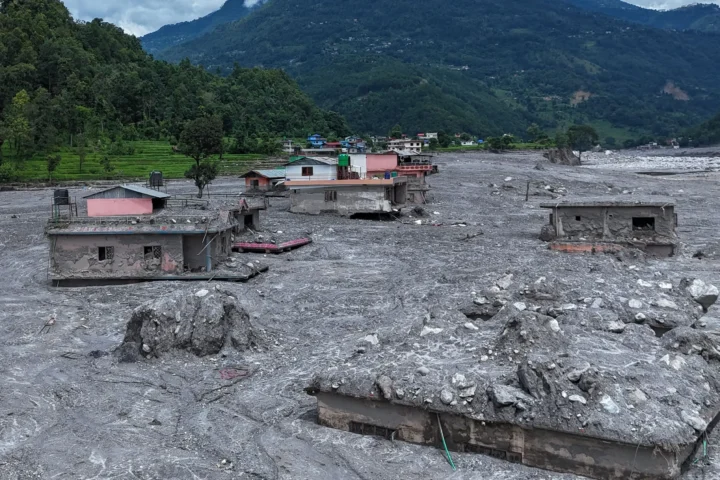
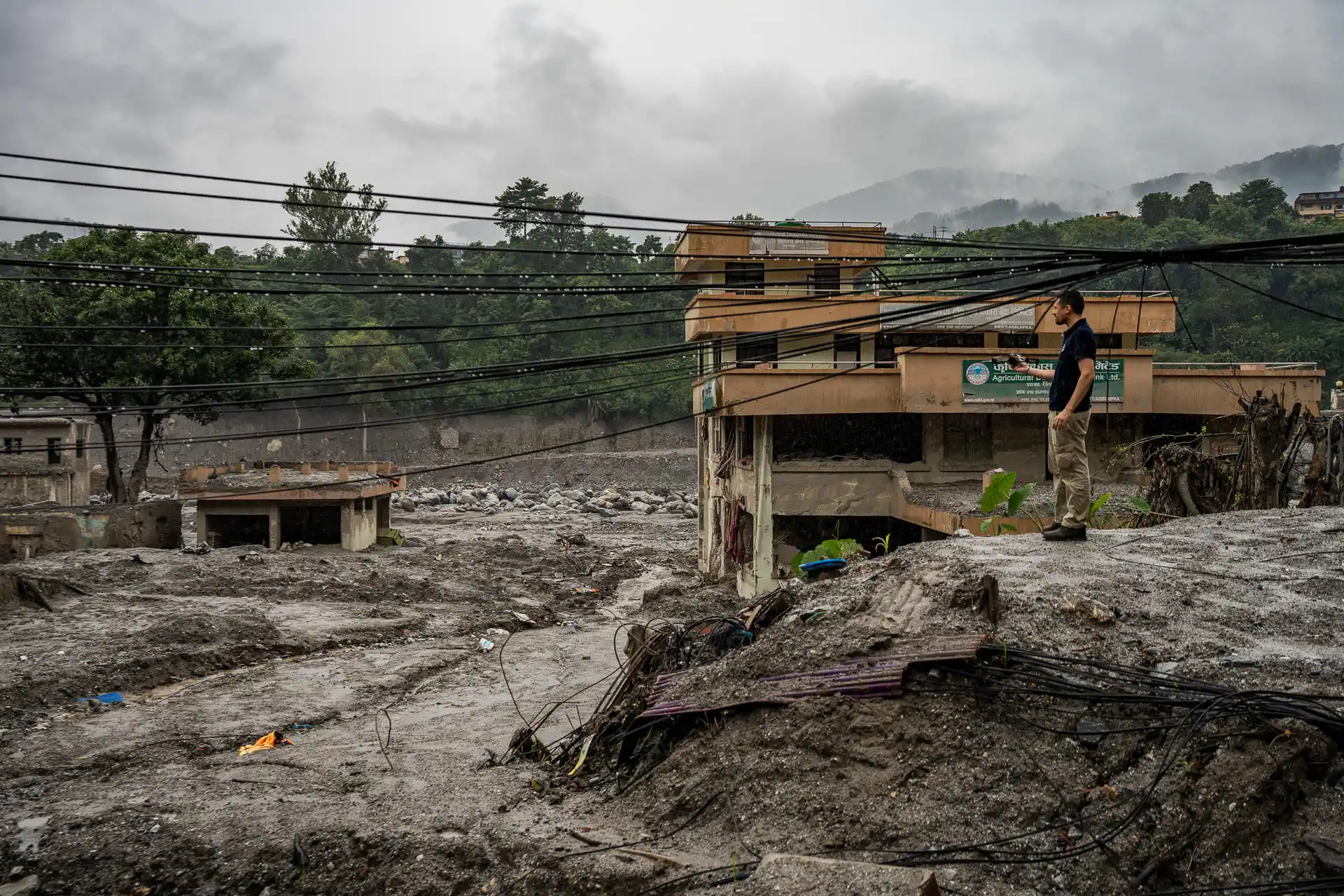
On the morning of Aug. 26, under a clear sky, a slab of ice and rock broke away from the north face of Langtang Lirung, a peak in northern Nepal, and plunged roughly 1,200 meters into the valley below. Within seven minutes, a surge of meltwater and debris had flattened the Gyirong border crossing into Tibet. Then it turned south, tearing down some 70 kilometers of the Trishuli River, through villages, bazaars and hydropower sites. More than 1,400 people are dead in Nepal and thousands remain missing, many of them workers inside flooded hydropower tunnels. Bodies were recovered as far downstream as India.
It was the second catastrophe on the same corridor in barely a year. In July 2025, the sudden drainage of a glacial lake in Tibet sent a flood down the same river system, killing at least nine people and destroying the Friendship Bridge between Nepal and China. The road being rebuilt after that flood was wrecked again. And in the past week, fresh floods and landslides killed at least a dozen more people in Nepal while survivors of August were still digging their homes out of the silt.
It is tempting to file events like this under “natural disasters,” a phrase that quietly assigns the blame to the weather. That framing is increasingly false. The mounting toll of floods, landslides, heat waves, storms and glacial collapses is the product of three forces colliding: a warming climate, reckless development and weak governance. Climate change loads the dice. Our decisions about where to build, what to approve and whom to warn determine how many people are standing in the way when the dice are thrown.
Call it a risk multiplier. A hotter atmosphere delivers more extreme conditions; roads, hotels, dams, factories and cities placed in harm’s way convert those conditions into catastrophe. The world has grown adept at announcing climate commitments. It has been far less adept at the unglamorous work that actually saves lives: changing where infrastructure goes, how money flows, how neighbors share danger and how officials answer for harm they could have foreseen.
Asia is the early warning
No region makes the case more plainly than Asia. The World Meteorological Organization reports that the continent is warming nearly twice as fast as the global average. In 2024, its average temperature ran about 1.04 degrees Celsius above the 1991–2020 baseline, and 23 of the 24 High Mountain Asia glaciers under observation lost mass. That same year, catastrophic floods struck Central Asia, Nepal, India, China and Southeast Asia.
Precision matters here. Not every flood can be pinned on climate change; rivers have always overflowed. The deeper problem is that warming raises the odds of intense rainfall, destabilizes glaciers, lifts sea levels and hollows out the “once-in-a-century” benchmarks that engineers and planners still rely on. The historical record is no longer a reliable guide to the future, yet it remains the basis for most of what we build.
Nepal: a flood that ignores borders
Nepal sits between the rapidly changing Tibetan Plateau and the crowded plains of South Asia, which makes it a laboratory for a new geography of disaster. August’s flood showed that the danger runs in every direction. The collapse began on the Nepali side of the border, destroyed a Chinese port within minutes and then spent hours wrecking Nepali towns downstream. Early claims on social media that Chinese dams or construction were to blame proved unfounded; satellite imagery and seismic records pointed to the glacier collapse as the source.
This was not a monsoon flood. Scientists describe a multi-hazard cascade: ice and bedrock failing, avalanches and debris flows, temporary dams forming and bursting, and finally a flood. Glacier collapses are rarer in the Himalaya than glacial lake outbursts, but more destructive. Researchers link them to warming that is weakening permafrost, the frozen glue that holds high slopes together, though some caution against pinning any single event on climate change alone.
What is most damning is that the mountain gave notice. A Virginia Tech geophysicist analyzing radar satellite data found the glacier-and-rock mass creeping downhill and accelerating in the weeks before it failed. A rapid assessment by an international scientific group, HiRISK, likewise found pre-event signs in satellite imagery, including changes in the glacier’s surface. No one was watching in a way that could turn that signal into an evacuation.
The warning systems that did exist were built for a different threat. A China-Nepal flash-flood network, credited with preventing casualties in the past, relied on water-level monitors tuned for monsoon floods, and upstream stations were swept away before they could send alerts. Downstream, Nepal’s official text alerts reportedly arrived late, only in Nepali and without location-specific instructions. Many of the lives saved came from informal networks. A head teacher in Nuwakot evacuated some 900 children ten minutes before the water hit, after warnings reached him from several sources, including a town just upstream.
Development multiplied the toll. Thirteen hydropower projects were damaged, knocking about 431 megawatts off the grid, and more than 900 people working at hydropower sites were reported missing, hundreds of them believed trapped in tunnels. Scientists who studied the event have said early warning for construction workers was very weak and that risk assessment must extend beyond a project’s own boundaries. Nepal needs roads and electricity; development itself is not the villain. The villain is building in steep, unstable valleys without a publicly auditable assessment of cumulative risk. The test for a tunnel or a bridge cannot be whether it would have survived the last big flood. It must be whether it will stay safe under a changed climate and the full range of cascading hazards: debris flows, lake outbursts, ice avalanches, earthquakes and rivers that no longer behave as they once did.
Information is the other failure. The Hindu Kush Himalaya holds thousands of glacial lakes and unstable ice faces across China, Nepal, India, Bhutan and Pakistan, yet the data about them remains largely national. China’s tight control of information in Tibet, including the censorship of flood footage, has made even the toll on the Chinese side hard to verify. Nepal needs real-time discharge data, satellite and ground monitoring of glaciers and slopes, sensors on dangerous lakes, automated alerts that reach local officials in local languages, shared evacuation protocols and public access to the hazard data behind all of it.
Nepal’s finance minister has warned that rebuilding could cost as much as $5 billion. How that money is spent will decide whether this is recovery or rehearsal. Rebuilding the same road, the same power station and the same tunnel portals in the same exposed places, with cosmetic upgrades, is not recovery. It is the pre-financing of the next disaster, as the twice-wrecked Rasuwa border corridor already shows.
Uttarakhand: when demand outruns the mountain
Across the border in India, Uttarakhand shows how an economy can manufacture its own vulnerability. The state’s geography is inherently perilous: steep slopes, young and seismically active geology, narrow river valleys and intense monsoons. Climate change adds erratic rainfall, rapid changes in snow and ice, heat stress and heightened landslide risk.
Onto this terrain, the state has layered a high-volume tourism and pilgrimage economy. Reports indicate that more than 80 million tourists visited in 2024, while hotels, resorts and roads have pushed into eco-sensitive zones, including riverbanks. Academic research has tied unchecked visitor inflows, unplanned construction, poor waste management and unregulated urbanization to environmental degradation and greater disaster risk.
The 2013 Kedarnath disaster should have been the turning point. Extreme rain triggered floods and landslides, but encroachment, road cutting, weak drainage and poor preparedness magnified the destruction. The lesson was never that pilgrimage must end. It was that the carrying capacity of a mountain ecosystem must set the terms for tourism, not the other way around.
Instead, the pattern has deepened: wider roads carved into unstable slopes, buildings crowding rivers, parking lots paving over drainage channels, tunnels and hydropower projects reshaping fragile ground, and towns expanding without adequate sewage or waste systems.
A different model is possible, and it is not a ban on development. Each valley and pilgrimage route should have a scientifically determined carrying capacity, with visitor permits tied to water, waste, transport and emergency capacity. Construction should be barred in floodplains, active landslide zones and unstable slopes, and building codes enforced independently of political pressure. New roads should be judged by cumulative impact rather than one project at a time. Tourism revenue should pay for watershed restoration and emergency services, and local communities should share in both the income and the planning. Seasonal closures should be understood as safety policy, not administrative failure.
Visitor counts are the wrong scoreboard. If each additional tourist brings revenue but also raises the odds of a road collapse, a water shortage or a flood, the gain is an illusion. The measure that matters is prosperity adjusted for resilience.
Thailand: the illusion of control
Thailand demonstrates that relative wealth offers no immunity when growth ignores hydrology. Bangkok sits in the low-lying Chao Phraya delta, with much of the metropolitan area only one to two meters above sea level. Land subsidence from groundwater extraction, urban sprawl, tidal influence and heavier rainfall are converging on the same ground.
The 2011 floods revealed how a disaster travels through an economy. Water swamped industrial estates, crippled electronics supply chains and disrupted transport, farming and exports; the concentration of industry in flood-prone zones turned a regional hazard into a systemic shock. The World Bank projects that the number of people affected by floods in 2035–2044 could be 2.5 times the 2010 figure, puts the odds of a 2011-scale flood before 2050 at roughly even, and warns that climate impacts could cost Thailand 7 to 14 percent of GDP by mid-century if resilience is not strengthened. More recent flooding in the southern provinces tells the same story: intense rain meeting drainage and land-use plans designed for an older climate.
Thailand needs to treat water as a landscape-wide system rather than something to be pushed downstream. That means restoring wetlands and retention areas, redesigning urban drainage, curbing construction in high-risk zones, improving river-basin management and making industrial estates responsible for their own resilience. It also needs a harder conversation. Not every low-lying district can be defended forever with embankments and pumps. Some areas will need elevated infrastructure and flood-compatible buildings. In others, the cheapest long-term option is to stop building and gradually relocate the most exposed communities and public facilities.
Vulnerability is manufactured
None of this is uniquely Asian. Hurricane Katrina’s storm surge in 2005 was a natural event; its human toll was shaped by inadequate flood protection, segregation, poverty, weak evacuation capacity and institutional failure. Pakistan’s 2022 floods exposed how extreme rain interacts with poverty, flimsy housing and thin public finances. Floods in Germany and Belgium in 2021, Australia in 2022 and Libya in 2023 showed that wealthy and middle-income societies suffer catastrophic losses too when warning systems, infrastructure and governance fail.
The same storm does not produce the same outcome everywhere. The consequences hinge on whether wetlands survived, whether houses were built safely, whether roads drain, whether evacuation routes function, whether warnings arrive in time and whether institutions trust their scientists. That is why counting disasters tells us less than examining who and what we have placed in harm’s way. A warming planet is dangerous. A warming planet combined with poor planning is lethal.
Promises without delivery
Governments have pledged adaptation money for years. The numbers tell a different story. The U.N. Environment Programme estimates that international public adaptation finance for developing countries rose from $22 billion in 2021 to $28 billion in 2022, against an annual adaptation finance gap of $187 billion to $359 billion. Even meeting the Glasgow pledge to double adaptation finance would close only about 5 percent of that gap. Too much of what does flow arrives late and as loans. A country recovering from a flood should not have to borrow to protect itself from a crisis driven largely by other nations’ historical emissions.
Closing the distance between promise and delivery requires six shifts.
First, make adaptation finance predictable. Developed countries and multilateral development banks should open a dedicated window of grants or highly concessional finance, allocated by exposure and vulnerability rather than by a government’s skill at drafting sophisticated proposals. Every major international infrastructure loan should carry a public climate-risk assessment, a maintenance budget and a binding resilience plan.
Second, treat early warning as a public utility. The W.M.O.’s Early Warnings for All initiative has widened coverage, but in 2024 only about half of African countries and 40 percent of countries in the Americas and the Caribbean reported having multi-hazard systems. And a warning is not a system. A text message sent ten minutes before a flash flood accomplishes little if roads are blocked, shelters are absent and local officials lack the authority to order an evacuation.
Third, regulate development, not just emissions. A country can cut its carbon output and still build disaster risk into its landscape. Lenders should make climate-risk disclosure mandatory for major projects and weigh cumulative impacts, not just one dam’s or one hotel’s footprint. The public should be able to see hazard maps, safety assumptions, evacuation plans, inspection reports and who bears liability.
Fourth, build transboundary institutions with political insulation. A permanent Himalayan body including China, Nepal, India, Bhutan and Pakistan should share data on glacier movement, lake levels, river discharge, landslides, avalanches and hydropower operations automatically and in advance of any crisis. Life-saving information cannot be treated as a diplomatic favor or a state secret.
Fifth, make polluters and builders accountable. High-emitting companies, infrastructure developers and insurers should disclose physical climate risks and contribute to resilience funds where their activities raise exposure. Officials who approve construction on known floodplains or unstable slopes should face professional and legal consequences when foreseeable harm follows. Disaster inquiries must name decision-makers, not merely tally rainfall.
Sixth, put communities at the center. Residents know their rivers, slopes and safe routes, and they are almost always the first responders. Resilience funding should reach municipalities, village institutions and local disaster committees directly, with a real voice for women, Indigenous groups, farmers, tourism workers and informal settlements. A technically excellent plan that local people do not trust will fail in the emergency it was written for.
The moral test
Real action will look far less dramatic than a summit speech, and far more consequential: cancelling unsafe projects, capping tourist numbers, moving buildings off floodplains, sharing sensitive data across borders, funding drainage and early-warning systems, restoring wetlands, rewriting insurance rules and holding officials to account. It will also require admitting that some places cannot be made fully safe, and that adaptation sometimes means retreat, relocation and a deliberate decision not to repeat the past.
The test is simple. When the next flood arrives, will any government be able to say it had no warning? In Nepal, in Uttarakhand, in Thailand and in countless other places, the honest answer is increasingly no. The science exists. The technology exists. What is missing is the political will to let evidence override short-term profit, construction pressure and national rivalry.
Natural hazards may be unavoidable. Disasters on this scale are a choice.