A painting does not bleed. A sculpture does not cry out when a shell lands nearby. An icon cannot flee an occupied city.
Yet in Ukraine, works of art have become casualties, hostages and refugees of war.
Since Russia launched its full-scale invasion in February 2022, museums, archives and cultural collections across Ukraine have faced bombardment, theft, occupation and deliberate destruction. Against this campaign, an extraordinary rescue network has emerged. Ukrainian curators have packed collections in basements, driven through active combat zones and made life-or-death decisions about what could be saved. Beyond Ukraine’s borders, Lithuanian museum directors, restorers and conservators have helped turn Vilnius into a sanctuary for endangered art.
Their work deserves to be understood not as humanitarian decoration on the margins of war, but as part of the defence of Ukraine itself.
Russia’s assault on Ukrainian culture is not accidental collateral damage. It belongs to the same political project as the invasion: the denial of Ukraine as a sovereign nation with its own history, memory and cultural identity. When museums are looted, archives destroyed and artworks removed to Russia, the aim is not merely material gain. It is to weaken a people’s claim to their own past.
That is why saving a painting matters.
By September 2025, more than 670,000 museum objects had reportedly been evacuated from frontline areas in Ukraine, including nearly 100,000 during 2025 alone. These figures are staggering, but they can obscure the human reality behind them. Every evacuation depends upon someone deciding which collection to move, how to package it, where to find transport and whether the road ahead is survivable.
Often, those decisions are made without electricity, secure communication or any guarantee that the destination will remain safe.
Ukraine has attempted to formalise this work. A February 2026 resolution required museum collections within 50 kilometres of the front to be relocated at least 75 kilometres away. It also gave museum leaders greater authority to act independently in emergencies, bypassing the bureaucratic delays that can be fatal in wartime.
But legislation cannot conjure trucks, climate-controlled storage or trained personnel. More than 3.5 million objects reportedly remain in museums in frontline regions, while private collections, school archives and university holdings may fall outside the official evacuation system altogether.
This is where Lithuania’s intervention has become so important.
Lithuanian cultural institutions began helping almost immediately after the invasion, initially sending packaging materials, generators, fire extinguishers and conservation equipment. That practical assistance soon developed into something more ambitious: the evacuation, restoration and exhibition of Ukrainian works in Lithuania.
By late 2022, the Lithuanian National Museum of Art had helped transport dozens of significant works from Kyiv, Odesa and Lviv to Vilnius. Among the first arrivals were 66 paintings, icons and decorative objects valued at more than €20 million.
Their financial value, however, is almost beside the point.
A nation’s heritage cannot be reduced to insurance estimates. These works carry historical memory, religious meaning, regional identity and artistic continuity. They belong not only to museums, but to the cultural imagination of Ukraine.
At the centre of Lithuania’s effort is the Pranas Gudynas Conservation Centre in Vilnius. Since 2022, its specialists have inspected, stabilised or restored more than 1,500 Ukrainian artworks, including paintings by Maria Prymachenko and centuries-old European works evacuated from the Borys Voznytskyi National Art Gallery in Lviv.
The conservation process has been exacting. Lithuanian restorers travelled to western Ukraine to determine which pieces could survive transportation. Around 100 works by Prymachenko were eventually brought to Vilnius, while some of the most fragile remained on conservation tables for months as specialists treated mould, water damage and structural deterioration.
It would be easy to describe this as technical work. It is also political work.
Every restored canvas contradicts Russia’s attempt to reduce Ukrainian culture to rubble. Every exhibition insists that Ukrainian art is not merely surviving in storage, but continuing to speak publicly. Conservation, in this context, becomes resistance by other means.
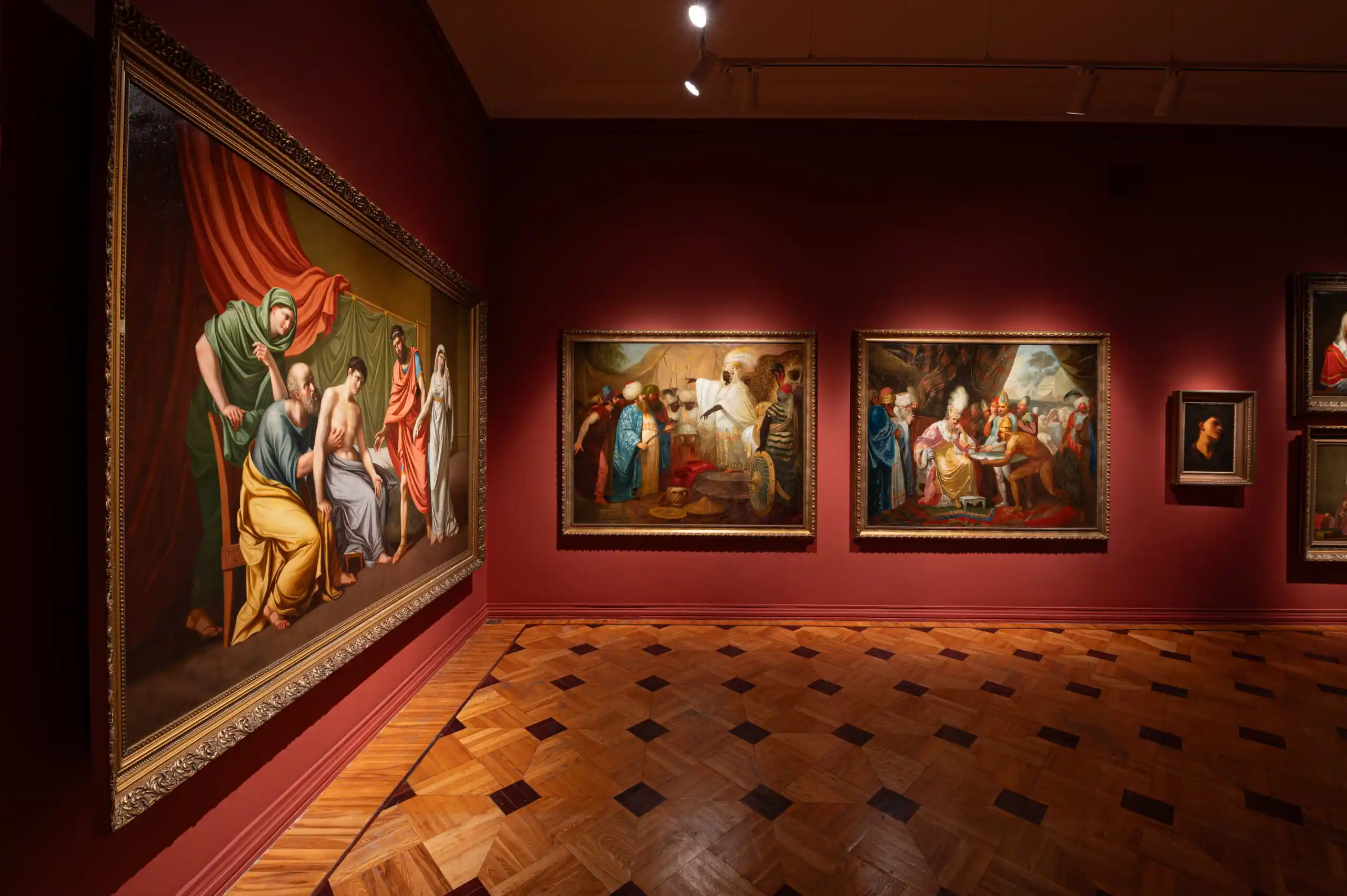
Lithuania has understood this clearly. Exhibitions such as Magnificent Refugees of War and I Gift You Sunlit Art have presented evacuated Ukrainian works not as relics awaiting a peaceful future, but as active witnesses to the present.
The title Magnificent Refugees of War was especially powerful. It acknowledged that artworks, like people, can be displaced by violence. Removed from their homes, placed in temporary shelter and dependent upon the protection of strangers, these paintings and icons have acquired a new wartime biography.
Exhibiting them is therefore not simply a curatorial choice. It is an act of cultural diplomacy.
The public sees what is at stake. Visitors encounter Ukraine not only through images of ruins and military maps, but through colour, faith, imagination, craft and historical depth. The exhibitions demonstrate precisely what Russia’s war threatens to destroy.
The arrival in Vilnius of a painting attributed to Caravaggio, The Taking of Christ, brought wider attention to this effort. Transported from Ukraine under armed protection, the painting’s journey required extraordinary security and institutional trust. Lithuanian National Museum of Art director Arūnas Gelūnas described its protection as more than an exhibition project: it was symbolic and moral support for Ukrainian colleagues working under wartime conditions.
That symbolism matters, but it should not distract from the people assuming the greatest risks.
The true frontline of cultural protection remains inside Ukraine.
Kyiv-based historian Leonid Marushchak has become emblematic of this work, leading evacuations from museums in cities including Kharkiv and Bakhmut. His teams have rescued medieval stone sculptures, icons, paintings and other objects while travelling through areas under attack.
During one operation in 2023, his vehicle was reportedly struck while he was evacuating a centuries-old stone lion from Bakhmut shortly before the city fell.
Such stories should force us to reconsider what a curator is.
In peacetime, curators research, interpret and preserve collections. In Ukraine, many have become emergency workers, logisticians, drivers and guardians. They operate with the knowledge that delay may mean destruction and that evacuation itself may cost them their lives.
Lithuanian curators are candid about the division of risk. The works arriving in Vilnius were generally not pulled directly from burning museums. Ukrainian colleagues had already moved them to temporary storage in western Ukraine before they could be transferred abroad. The most dangerous part of the journey had often already been completed.
Lithuania’s role is nevertheless indispensable. Sanctuary is not less meaningful because someone else carried the refugee to the border.
Nor has this assistance come without strain. Lithuanian institutions have taken on restoration and storage work alongside their existing obligations, often without proportional increases in staffing or funding. Their effort has been sustained by professional solidarity and moral urgency.
That commitment should not be taken for granted. Nor should it remain exceptional.
Other European nations should treat the Lithuanian-Ukrainian partnership as a model. Cultural rescue requires transport agreements, secure storage, conservation expertise, insurance arrangements, emergency financing and trust built before disaster reaches the museum doors. These systems cannot be improvised only after collections have come under fire.
Lithuania can protect only a fraction of Ukraine’s endangered heritage. The approximately 1,500 works treated or sheltered there represent a tiny share of the millions of objects still held in exposed regions. The scale of the threat demands a broader international network of cultural safe havens.
That network must also plan for the future.
Most of the evacuated works will eventually be expected to return to Ukraine. Current Ukrainian rules envision repatriation after martial law ends, but the end of fighting will not instantly make every museum safe. Buildings will need to be rebuilt. Storage systems will need to be restored. Security conditions will remain uneven. Some objects may stay abroad longer than anyone currently intends.
This should not become an excuse for cultural dispossession. Temporary protection must remain grounded in Ukrainian ownership, Ukrainian authority and transparent agreements for return.
The history of war is filled with artworks that left endangered countries “temporarily” and never came home. Any international rescue effort must therefore protect not only the physical object, but the rights of the culture to which it belongs.
The greater moral point, however, is unmistakable.
Culture is not a luxury to be rescued after lives, territory and infrastructure have been secured. It is part of what people are defending when they defend a country.
A museum collection embodies the continuity between generations. An icon carries faith across centuries. A folk painting preserves a visual language that no occupying power can manufacture. An archive proves that a people existed, governed, created, worshipped and remembered in their own name.
That is why authoritarian powers attack culture. And that is why democracies must protect it.
The paintings now held in Vilnius are not merely valuable objects stored beyond missile range. They are fragments of a national memory placed in temporary exile. Their survival has depended upon Ukrainian curators willing to enter danger and Lithuanian colleagues willing to accept responsibility once the works crossed into safety.
This quiet alliance may lack the visibility of military aid or diplomatic summits, but its purpose is no less consequential.
It says that Ukraine will not be allowed to disappear.
It says that destruction will not have the final word.
And it says that when the paintings eventually return home, they will carry with them evidence not only of what war tried to erase, but of the people who refused to let it happen.