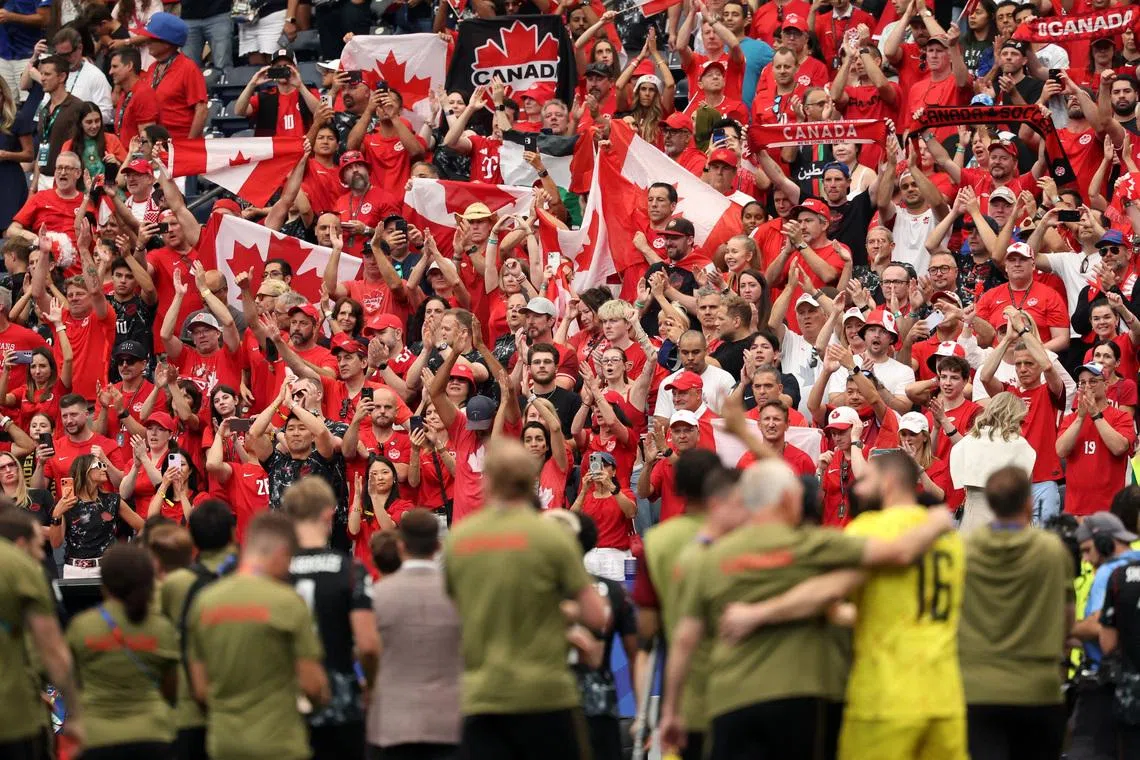
There is something happening on Canadian soccer fields this summer that hockey rinks and baseball diamonds have never quite managed to produce: a national team that looks like the country actually filling its stands.
The Men’s World Cup being co-hosted on Canadian soil is a landmark on its own terms. Soccer has overtaken hockey as the sport most played by Canadian kids, and hosting the tournament is a once-in-a-generation civic moment. But the deeper story isn’t really about the tournament’s scale. It’s about who is wearing the Canadian jersey, and what journeys brought them there. The men’s national team has a chance to offer Canadians a version of national identity that diverges sharply from the one hockey has spent a century building — and to do it at a moment when that alternative feels unusually necessary.
The Old Symbol
For generations, hockey has functioned as Canada’s default symbol of athletic greatness and the emotional shorthand for what it means to belong to this country. It is also, inescapably, an expensive sport — equipment, ice time, travel leagues — that has long carried a demographic profile skewed toward white, European-descended families. The NHL’s own workforce numbers bear this out: roughly 84 per cent white among players and staff. Canada’s Olympic roster at the Milan Cortina Games this past February reflected that same pattern. The silver-medal team that lost the gold-medal game to the United States was, by and large, a team drawn from one narrow slice of the country.
None of this makes hockey any less beloved, or any less a genuine part of Canadian culture. But it does mean hockey has never been well positioned to reflect a country where roughly a quarter of residents were born somewhere else.
The Jays Problem
Baseball offered a tempting alternative last October, when the Toronto Blue Jays’ run to the World Series became the closest thing English Canada had felt to a unifying sports moment since the back-to-back championships of 1992 and 1993. Ownership leaned hard into the maple-leaf branding, and the country obliged, adopting the Jays as “Canada’s team” almost overnight.
But look at the roster and the story gets complicated. The Blue Jays’ World Series lineup carried exactly one Canadian-born player — Vladimir Guerrero Jr., born in Montréal to a father who once played for the Expos — surrounded by a largely American cast. It’s worth asking honestly what Canadians were actually cheering for. Some of it was baseball. A good deal of it, plausibly, was the satisfaction of rooting against American teams during a stretch of unusually tense cross-border politics. What it wasn’t, in any deep sense, was a roster that mirrored the lived experience of the people cheering it on.
A Different Kind of Roster
Canada’s men’s soccer team tells a different story, and it starts with the armband. Captain Alphonso Davies was born in the Buduburam refugee camp in Ghana, to Liberian parents who had fled a civil war. He came to Edmonton at five years old through Canada’s refugee resettlement system. He is now a Champions League winner and a UNHCR Goodwill Ambassador — a biography that would have been unthinkable for a Team Canada hockey captain of any previous generation.
Davies isn’t an outlier on this roster; he’s representative of a deliberate strategy. Since taking over from John Herdman in 2024, head coach Jesse Marsch has made pursuing dual nationals and diaspora talent a stated priority rather than an incidental byproduct. The results show up throughout the squad: Tani Oluwaseyi, eligible to play for Nigeria, chose Canada instead. Niko Sigur came up through Croatia’s youth system before switching allegiances. Marcelo Flores represented Mexico at various youth levels. Alfie Jones, born in England, reportedly learned “O Canada” from a teammate before taking his citizenship oath at a training camp.
This is a team assembled, in large part, from players who were courted — who had other national teams available to them and chose Canada, or who arrived here as children carrying another country’s early chapters with them. That is a fundamentally different foundation than a roster built on inherited eligibility alone. It’s also a pointed historical reversal: Canadian immigration policy once explicitly privileged white European arrivals, a preference that official multiculturalism was built to counteract. A soccer roster this diverse, this international in its personal histories, would have been structurally impossible under the old rules. It exists because the country’s approach to who belongs here changed.
Why the Timing Matters
Sport has always done more than entertain when it comes to nation-building. It gives people a low-stakes, high-emotion way to feel personally implicated in a collective story — to see a version of themselves represented on a stage the whole country is watching. That function only works, though, if the people on the field plausibly resemble the people in the stands.
This World Cup lands at a particularly loaded moment for that idea. The United States, co-hosting alongside Mexico, has floated using immigration enforcement as part of tournament security — a proposal that has cast a long shadow over a tournament already entangled in arguments about who gets to belong where. Against that backdrop, a Canadian squad built substantially by immigrants, refugees, and players who actively chose this country over others isn’t just a nice story. It’s a rebuttal, on the field, to a narrative currently circulating just across the border.
What This Offers Canadians
For the enormous number of Canadians who arrived here themselves, or whose family history is defined by that arrival, this team offers something the Olympic hockey squad and the Blue Jays’ borrowed roster never quite could: a chance to watch players whose paths to the Canadian jersey resemble their own family’s path to a Canadian passport. That’s not a minor emotional detail. It’s arguably the whole point of what international sport is supposed to do for a country — give people a mirror, not just a spectacle.
Canada doesn’t need to abandon hockey, and nobody should expect the Blue Jays to stop being adopted as an honorary national team every October they’re good enough to deserve it. But if this World Cup run gives Canadians a new answer to the question of what a “Canadian team” looks like, it will have done something no recent tournament, Olympic run, or World Series chase has managed: shown the country a version of itself that’s actually representative of who’s here.