Two very different maritime wars are rewriting some of the oldest assumptions about naval power.
In the Black Sea, Ukraine has demonstrated that a country with virtually no conventional fleet can impose extraordinary costs on a major naval power. In the Red Sea, meanwhile, the Houthis have shown that a non-state force equipped with comparatively inexpensive missiles and drones can disrupt one of the arteries of global commerce and compel the world’s most sophisticated navy to expend expensive weapons defending it.
The tactical circumstances are different. The strategic message is remarkably similar.
For more than a century, naval power has largely been measured in capital ships: battleships first, aircraft carriers later, supported by cruisers, destroyers, submarines and increasingly sophisticated aircraft. The emerging maritime battlefield does not make those platforms obsolete. But it does challenge the assumption that expensive ships will necessarily dominate cheaper, distributed adversaries.
The central question for the US Navy is therefore no longer simply how many ships it possesses. It is how economically, quickly and sustainably those ships can find, defeat and survive thousands of inexpensive threats.
Ukraine has provided the most dramatic demonstration.
The sinking of the Russian cruiser Moskva in April 2022 was initially easy to regard as an extraordinary event: a major warship lost to Ukrainian Neptune anti-ship missiles. What followed made that interpretation impossible.
Ukraine subsequently combined cruise missiles, intelligence, aerial reconnaissance and explosive unmanned surface vessels to attack Russian ships and naval facilities repeatedly. By March 2024, the Ukrainian Navy claimed that roughly one-third of Russia’s Black Sea warships had been destroyed or disabled. More important than the precise tally was the operational consequence: Russia increasingly moved valuable vessels away from occupied Crimea, reducing the freedom with which its surface fleet could operate in the western Black Sea.
The campaign has continued to evolve. In September 2026, Ukrainian forces struck Russian naval assets at Novorossiysk — the very base whose importance had increased as Russian vessels were displaced from Sevastopol — demonstrating that moving ships farther from Ukraine did not necessarily place them beyond Ukraine’s expanding strike architecture.
That points toward a deeper lesson.
Ukraine has not replaced a conventional navy with a “drone navy.” It has disaggregated some of the functions traditionally concentrated inside a navy.
Reconnaissance can come from satellites and unmanned aircraft. Targeting information can be distributed digitally. The weapon can be a cruise missile or an explosive speedboat rather than another warship. Special forces can operate from small craft. Commercial technologies can supplement military sensors.
Put these elements together and a country does not necessarily require a destroyer to threaten a destroyer.
The result is a kind of maritime guerrilla warfare conducted through networks of sensors, software and expendable machines.
And its strategic effect has gone far beyond the ships Ukraine has damaged.
Sea power ultimately matters because of what it permits — or prevents — on land and in commerce. Moscow sought to constrain Ukraine’s access to the Black Sea and thereby its ability to export agricultural commodities. Yet after the collapse of the UN-backed grain arrangement in 2023, Ukraine established its own maritime corridor. By mid-2024, Reuters reported that military gains in the Black Sea had helped Ukraine sharply increase grain shipments despite continued Russian attacks on ports.
Ukraine therefore achieved something strategically remarkable: without building a conventional fleet capable of defeating Russia ship-for-ship, it created enough maritime denial to reopen economic access to the sea.
That distinction — between sea control and sea denial — should command attention in Washington.
It has obvious implications for a potential Western Pacific conflict. Smaller American partners do not need miniature versions of the US Navy to complicate the calculations of a much larger opponent. Distributed sensors, mobile anti-ship missiles, unmanned vessels, drones, mines and external intelligence could potentially create formidable coastal denial networks.
The Philippines, for example, need not match China’s navy ton-for-ton for geography around an island chain to become dangerous.
But Ukraine is only half the lesson.
The Red Sea presents the inverse problem: the United States is the sophisticated naval power attempting to defend ships against relatively inexpensive weapons.
The Houthis have employed anti-ship ballistic missiles, cruise missiles, unmanned aircraft, explosive surface vessels and small boats. CENTCOM said in 2025 that the group had conducted more than 300 attacks against US naval and international merchant shipping following October 2023. The threat has not disappeared: the International Maritime Organization recorded renewed attacks in 2026, including a deadly August strike on a cargo vessel.
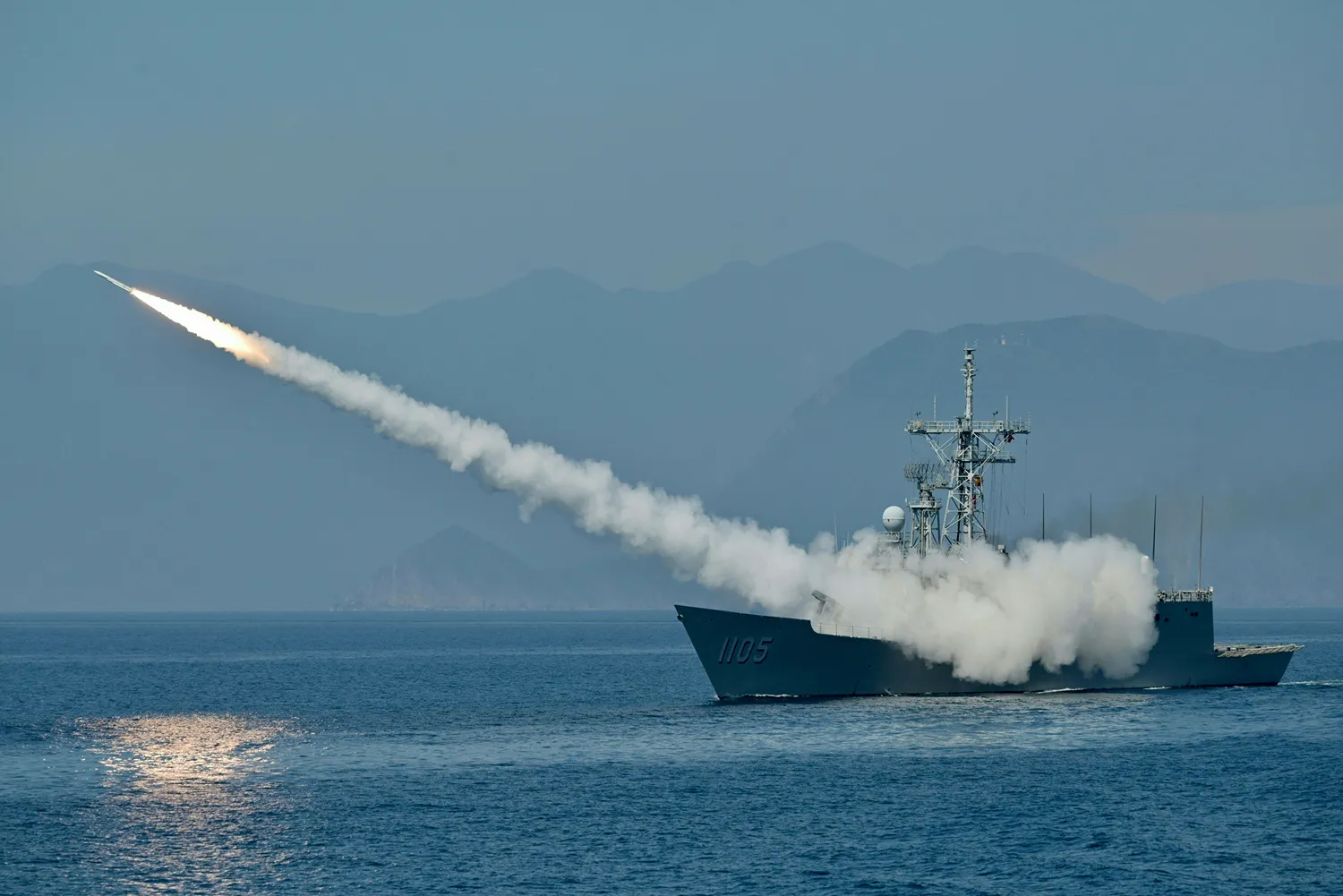
American destroyers have repeatedly demonstrated that modern naval air defence works. In one November-December 2024 engagement, two US destroyers escorting merchant vessels defeated three anti-ship ballistic missiles, three one-way attack drones and a cruise missile without damage to the vessels they were protecting.
But tactical success exposes an uncomfortable economic problem.
A navy cannot indefinitely solve a cheap-threat problem exclusively with expensive interceptors.
The relevant calculation is not merely whether an incoming drone can be destroyed. Of course it can. The question is what it costs to destroy it, how many interceptors a ship can carry and how quickly those magazines can be replenished.
This is the new mathematics of naval warfare.
A $2 million interceptor destroying a far cheaper drone may constitute a tactical victory while contributing to a strategic problem. An adversary does not necessarily have to sink the destroyer. It can force the destroyer to exhaust scarce ammunition, retreat for replenishment or consume weapons required for a more demanding conflict.
The Navy consequently needs a layered defensive architecture in which the cheapest effective weapon is matched to each threat.
That means combining long-range interceptors with electronic warfare, rapid-firing guns, cheaper missiles, directed-energy systems and eventually lasers capable of engaging suitable targets at dramatically lower marginal cost. It also means accepting that the most efficient interception may occur before launch.
CENTCOM has already demonstrated this principle by striking Houthi missiles, UAVs and unmanned surface vessels while they were being prepared for attacks.
The old maxim is to kill the archer rather than endlessly shooting down arrows.
Yet there is another lesson that technology cannot solve.
Ships will eventually be hit.
The extraordinary effectiveness of modern American air defence can create its own psychological danger: the expectation of interception. Against a sufficiently dense salvo, deception campaign or unexpected weapon, some threats will penetrate.
Damage control therefore becomes strategic capability.
Crew training, redundancy, compartmentalisation, firefighting, distributed communications and the ability to continue fighting after taking a hit matter as much in the drone age as radar and missiles. Survivability cannot simply mean preventing impact. It must mean absorbing one.
Commercial shipping presents another challenge. Naval forces cannot permanently station an advanced destroyer beside every merchant vessel crossing a threatened waterway. Convoys, escorted transit windows and coordinated routing may consequently regain relevance — old solutions returning because new technology has recreated an old problem.
The broader lesson from both seas is that naval warfare is becoming simultaneously more technologically sophisticated and more accessible.
Precision navigation, commercial satellite imagery, artificial intelligence, cheap electronics and autonomous systems are diffusing capabilities once available only to major militaries. The result is not the end of the aircraft carrier or destroyer. Large warships retain enormous advantages in mobility, aviation, sensors, command-and-control and sustained firepower.
But their environment is becoming less forgiving.
The decisive naval competition of the coming decades may therefore not be between one fleet of exquisite platforms and another. It may be between different architectures: concentrated versus distributed, expensive versus expendable, crewed versus autonomous, and closed military networks versus systems capable of rapidly incorporating commercial technology.
The Black Sea shows what happens when a smaller force learns to impose asymmetric costs on a larger navy.
The Red Sea shows what happens when the larger navy finds itself on the other side of precisely that equation.
Taken together, they offer Washington a warning. The future fleet cannot merely be powerful. It must be difficult to find, difficult to overwhelm, inexpensive enough to sustain, capable of absorbing losses and surrounded by large numbers of systems commanders are willing to risk.
For centuries, naval strategy revolved around the question of who possessed the stronger fleet.
The emerging era adds another question: who can make the enemy spend more to remain at sea than it costs to drive him from it?
The answer to that question may determine who controls the oceans in the twenty-first century.