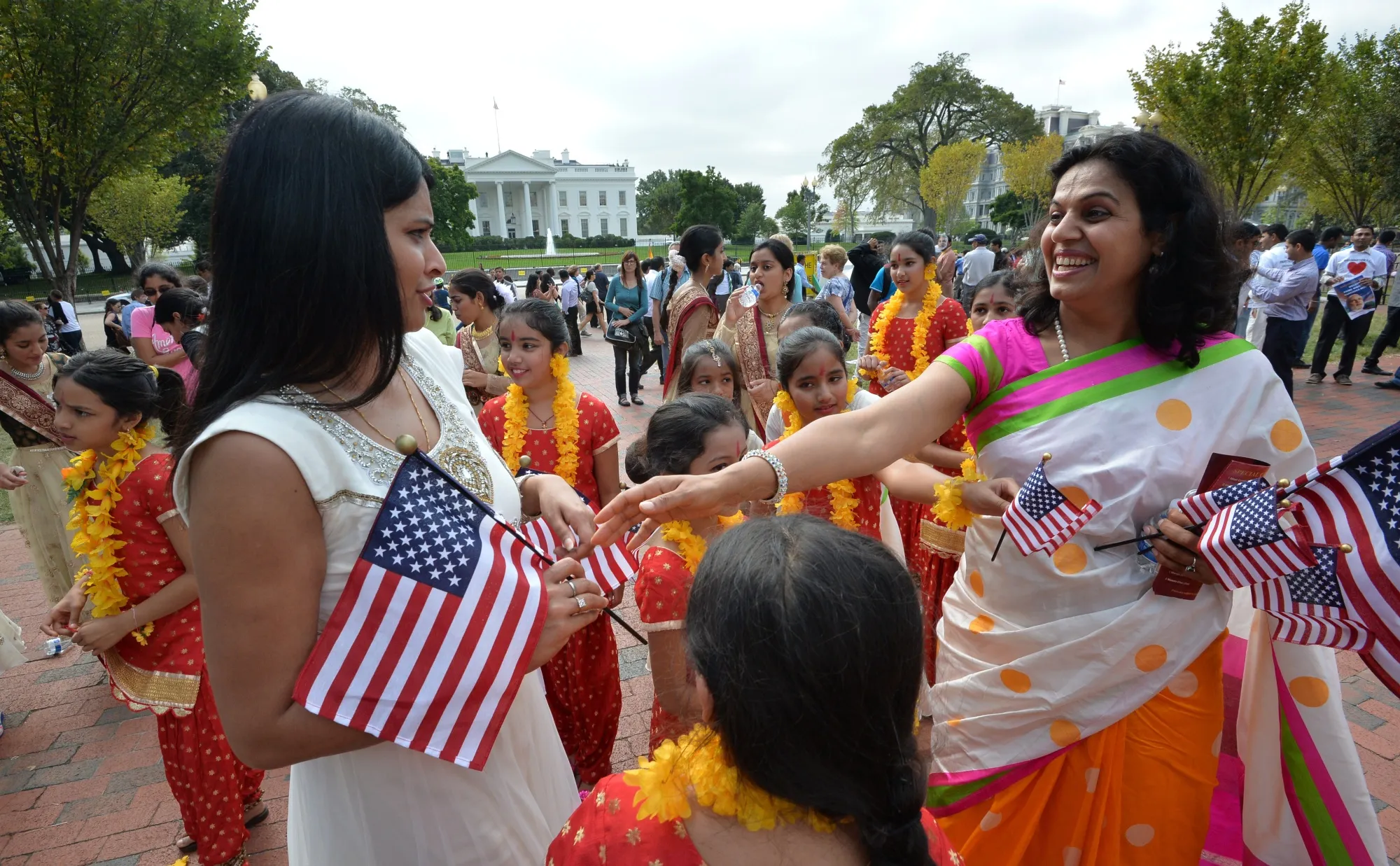
In a season of sharpened rhetoric about immigration, trade, and foreign influence, a curious silence has settled over one of the most successful immigrant stories in modern American history. While headlines track visa restrictions, online slurs, and debates over H-1B visas, the data on people of Indian origin in the United States tell a different story: a community that has become foundational to the country’s technological edge, medical infrastructure, tax base, and entrepreneurial engine. Numbering roughly 5.2 million—about 1.5 percent of the population—they are not a marginal presence. They are over-represented, by large margins, in the sectors that determine whether America remains competitive.
Indian-Origin Population in the United States, 2000–2023
Total population (bars) has more than doubled since 2000 while the U.S.-born share (line) has steadily risen.
Source: Pew Research Center analysis of the 2000 Census and 2008–10, 2017–19, and 2021–23 American Community Surveys (IPUMS). Population includes those identifying as Indian alone or in combination. U.S.-born share: ~26% (2000), ~30% (2010), ~32% (2019), ~34% (2023).
This is not a sentimental claim. It is an empirical one. Indian American households report a median income of approximately $151,200, well above the national median and higher than most other major ethnic groups.
Median Household Income (2023)
Indian-headed households lead major groups in the United States.
Source: Pew Research Center analysis of 2021–23 American Community Survey; U.S. Census Bureau.
Roughly three-quarters of Indian American adults aged 25 and older hold a bachelor’s degree or higher, compared with a national average near 38 percent; nearly half possess graduate or professional degrees. Their poverty rate sits around 6 percent. Analyses associated with the Indiaspora/BCG Impact Report estimate that this population, despite its small share, accounts for roughly 5 to 6 percent of U.S. income-tax revenues—on the order of $250–300 billion. These are not the markers of a group extracting more than it contributes. They are the markers of a group that has, within a generation or two, become net producers of high-value economic activity.
The pattern is most visible in technology and the broader innovation economy. Indian-origin executives currently lead a substantial share of America’s largest companies. The 2024 Indiaspora Impact Report documented that CEOs of Indian origin headed 16 Fortune 500 firms, which collectively employed about 2.7 million people and generated nearly $1 trillion in revenue. The roster is familiar for a reason: Sundar Pichai at Alphabet/Google, Satya Nadella at Microsoft, Arvind Krishna at IBM, Shantanu Narayen at Adobe, Nikesh Arora at Palo Alto Networks, Raj Subramaniam at FedEx, Sanjay Mehrotra at Micron Technology, Reshma Kewalramani at Vertex Pharmaceuticals, and others across cybersecurity, semiconductors, logistics, and consumer goods. These are not ceremonial appointments. Nadella’s tenure coincided with Microsoft’s transformation into a cloud and AI leader; Pichai has steered Alphabet through successive platform shifts; Krishna has reoriented IBM toward hybrid cloud and enterprise AI. Their companies shape the infrastructure on which American businesses and government agencies increasingly rely.
The startup layer is equally striking. A June 2026 National Foundation for American Policy analysis found that immigrants had founded or co-founded 455 of 775 U.S. unicorn companies—privately held startups valued at $1 billion or more—accounting for 59 percent of the total and a collective valuation near $5 trillion. Indian-born founders accounted for 96 of those companies, more than any other nationality, ahead of Israel, the United Kingdom, and China. Serial founders such as Mohit Aron (Nutanix, Cohesity), Jyoti Bansal (AppDynamics, Harness), and Arvind Jain (Rubrik, Glean) appear repeatedly in the data.
Immigrant Founders of U.S. Unicorn Companies
India is the leading country of origin among immigrant founders of U.S. billion-dollar startups (April 2026).
Source: National Foundation for American Policy (NFAP) analysis of CB Insights data, April 2026. Immigrants founded or co-founded 455 of 775 U.S. unicorns (59%).
Companies such as Perplexity AI, co-founded by Aravind Srinivas, illustrate the pattern in real time. Roughly 70 percent of H-1B visas for high-skilled workers have gone to Indian nationals in recent years; many of those recipients later become permanent residents, founders, or senior technical leaders. Patent data reinforce the trend: the share of U.S. patents held by Indian-origin innovators rose from roughly 2 percent in the mid-1970s to about 10 percent by the late 2010s. In practical terms, a community that is 1.5 percent of the population is generating a disproportionate share of the companies, intellectual property, and technical talent that sustain U.S. advantages in software, semiconductors, artificial intelligence, and enterprise technology.
Healthcare shows a parallel over-representation that is more immediately felt by ordinary Americans. India is the leading country of origin for immigrant physicians and surgeons. American Immigration Council analysis of 2024 American Community Survey data places the number of India-born physicians and surgeons at approximately 62,800—about 21 percent of all immigrant physicians and roughly 6 percent of the total U.S. physician workforce. Broader estimates that include second-generation Indian Americans and longer-settled practitioners often place the overall share of physicians of Indian origin near or above 10 percent; the American Association of Physicians of Indian Origin has cited figures in the range of 100,000 physicians serving a substantial fraction of the patient population. Asian American physicians as a group comprise roughly one-fifth of the U.S. physician workforce; within that group, Indian Americans have consistently been the largest subgroup. These physicians are not concentrated solely in coastal research hospitals. They staff rural clinics, inner-city hospitals, and primary-care practices where shortages are chronic. International medical graduates, of whom Indians form the largest single national contingent, have long filled residency slots that domestic graduates leave vacant in less desirable specialties and geographies.
Top Countries of Birth for Immigrant Physicians & Surgeons
India is the largest source country for immigrant physicians and surgeons in the United States (2024).
Source: American Immigration Council analysis of the 2024 American Community Survey. Indian-born physicians represent 21% of immigrant physicians and 6% of all U.S. physicians.
The contributions extend beyond bedside care into research and leadership. Indian-origin scientists have accounted for a notable share of National Institutes of Health grants and scientific publications in recent years. Biotech and pharmaceutical executives of Indian origin have led companies developing therapies for rare diseases, oncology, and infectious disease. Figures such as Atul Gawande have influenced global surgical safety standards; Vivek Murthy has shaped public-health messaging on loneliness and pandemic response. When U.S. hospitals faced staffing crises during COVID-19, the presence of Indian American physicians and nurses was not incidental—it was structural. Claims that the community is somehow peripheral to American medicine do not survive contact with workforce data.
The economic footprint is broader still. Indian Americans have long dominated segments of the hospitality industry; multiple reports place their ownership of U.S. hotels and motels in the range of 40 to 60 percent, depending on the metric and year. Small businesses in retail, convenience stores, and professional services generate additional employment and local tax revenue. The Indiaspora report and related analyses note that Indian American professional and entrepreneurial activity indirectly supports millions of jobs beyond the Fortune 500 and unicorn counts. Philanthropic giving to American universities and civic causes is substantial; international students from India remain one of the largest groups in U.S. higher education, contributing tuition revenue and, in many cases, remaining to work and found companies.
America’s postwar advantage rested in part on its capacity to attract and retain talent that other societies educated but could not fully employ or reward. Indian Americans are a contemporary illustration of that mechanism. Many arrived as students or on temporary skilled visas, invested in American institutions, and produced returns—companies, patents, medical care, tax revenue—that accrue primarily in the United States. Their children, now a growing share of the community, continue the pattern in medicine, engineering, finance, and public service. Treating this population as an undifferentiated source of grievance, rather than as a high-return component of the American human-capital stock, is a policy choice with measurable costs. Restricting the inflow or signaling hostility does not automatically produce more domestic physicians in rural counties or more founders of the next generation of software and biotech firms. It simply reduces the supply of people who have demonstrated, repeatedly, that they will do those jobs at scale.
The American way of life has never been static. It has expanded its productive capacity by absorbing people who bring skills, work ethic, and a willingness to operate inside U.S. institutions and markets. Indian Americans have done so with unusual clarity of outcome. In technology they help set the trajectory of the platforms and tools that define modern economic activity. In medicine they keep hospitals open and research pipelines moving. In taxes and entrepreneurship they enlarge the resources available for public goods and private investment. These are not abstractions. They are the daily operations of companies that employ millions, clinics that treat patients, and startups that commercialize research. In an era when national competitiveness depends on human capital as much as on natural resources or military hardware, the record of this community is not an inconvenience to be managed. It is an asset that has already been realized—and one that further policy can either reinforce or diminish.