For most of this year, Beijing’s economic managers have offered a familiar reassurance: growth is cooling, but it’s cooling in a controlled, deliberate way — the natural byproduct of a planned shift away from real estate and toward higher-value manufacturing. July’s data make that story much harder to believe.
China’s GDP grew 4.3% year-on-year in the second quarter, down from 5% in the first and the weakest quarterly pace since the depths of the Covid era. That alone might have been dismissed as a temporary dip. But the first hard numbers from the second half of the year — industrial output, retail sales, purchasing manager surveys, prices, employment — all point the same direction. This is not a soft patch. It is a slowdown that is broadening and, if anything, accelerating.
The month that was supposed to stabilize things didn’t
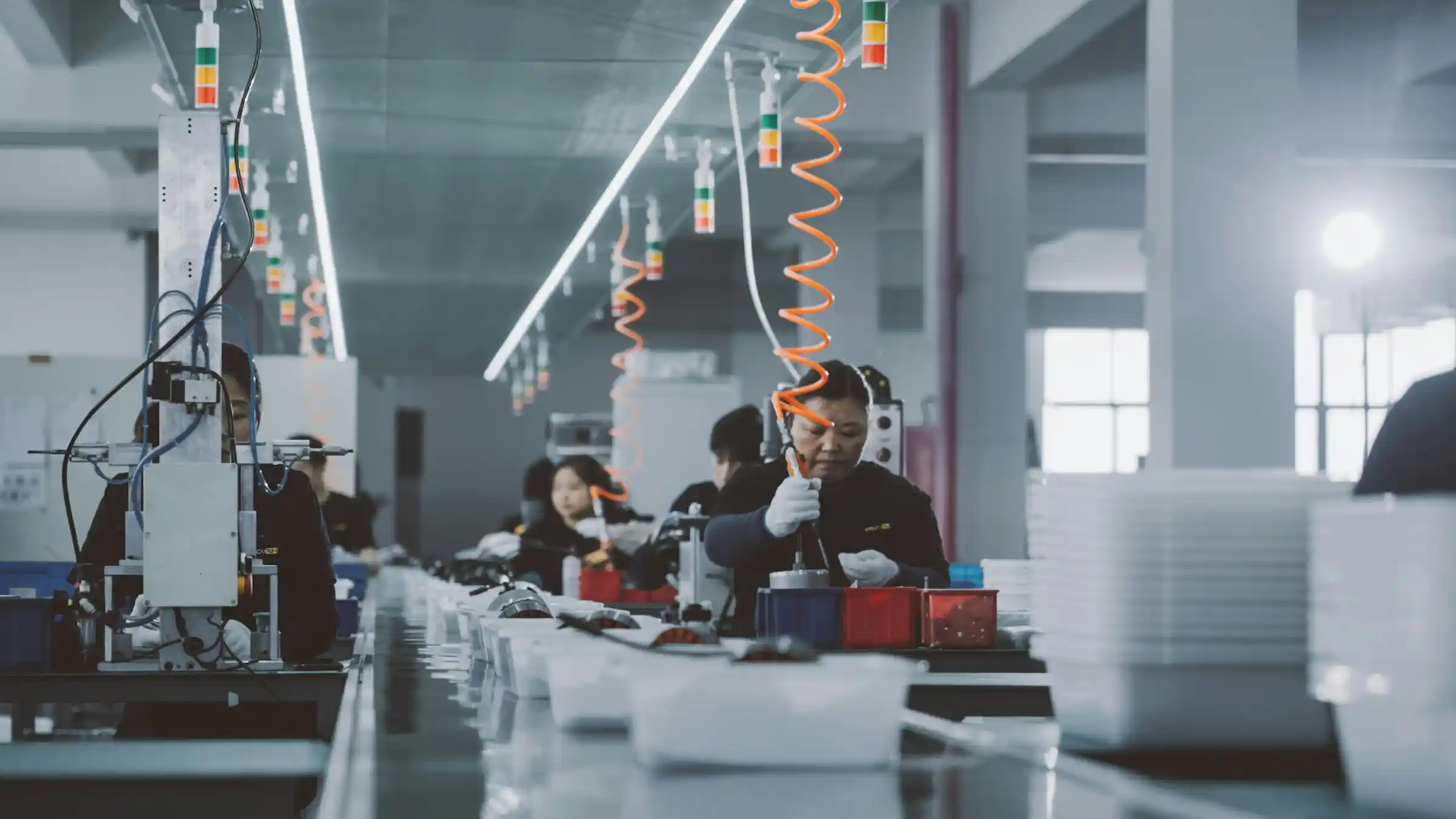
Factory output grew just 4.5% in July, down from 5.3% in June and below what economists had expected. Retail sales rose a mere 0.6%, decelerating from an already-weak 1% the month before. Coming after a June that looked like the beginning of a plateau, July’s reversal is the more troubling signal: it suggests that whatever stabilization analysts thought they were seeing was an illusion, propped up by fading stimulus and seasonal noise rather than genuine momentum.
The purchasing managers’ indices confirm it. The official manufacturing PMI slid back below the 50-point expansion threshold, and the new-orders sub-index hit its lowest level in more than three years. Construction activity, gauged by its own PMI, fell to a record low. Services, too, weakened to levels not seen since the early pandemic. When factories, building sites and service businesses all soften in the same month, it’s no longer possible to blame one sector’s troubles — this is an economy losing altitude across the board.
Three pillars, still crumbling
China’s growth model has long rested on three legs: investment, exports and, increasingly promised but rarely delivered, consumption. Each is now showing serious strain.
Fixed-asset investment contracted more than 6% in the first seven months of the year, with property investment down roughly 18% — the steepest such decline in decades. Home prices fell for the seventh consecutive month, with gains recorded in only a handful of the 70 cities Beijing tracks. Given how much household wealth in China is tied up in real estate, this isn’t merely a sectoral problem; it’s a direct hit to the confidence and spending power of hundreds of millions of families.
Exports, especially in electric vehicles and the electronics feeding the global AI buildout, have been the one bright spot, helping industrial output outperform domestic demand for much of the year. But that strength looks increasingly fragile. Some of it reflects front-loading ahead of tariff deadlines rather than durable demand, and shipments to the United States reportedly fell outright in July for the first time in months. Leaning on exports also invites the kind of trade friction China is already contending with, as partners grow louder about industrial overcapacity.
That leaves consumption — the leg Beijing has spent years promising to strengthen — as the weakest of all. Retail sales growth in the first half of 2026 ran at barely a quarter of the pace seen a year earlier. Consumer-goods “trade-in” subsidies gave spending a temporary lift, but as those programs fade, the underlying caution of Chinese households is reasserting itself.
Why households are holding back
That caution isn’t irrational. Urban unemployment climbed to 5.2% in July, reversing months of gradual improvement, while youth unemployment remains stuck near 15% — even after methodology changes designed to present a more flattering picture. Falling home values have eroded the wealth of homeowners. And consumer inflation, at just 0.5% year-on-year and negative on a monthly basis, is the clearest possible sign that demand across the economy is too soft to support even modest price growth.
Producers, meanwhile, are squeezed from the other direction. Producer prices are still elevated year-on-year, largely because of an earlier energy-cost shock, but are falling month-on-month, and prices for consumer goods specifically remain in negative territory. Firms can’t pass rising costs on to consumers who won’t pay them, which compresses margins, discourages hiring and investment, and feeds straight back into the weak labor market and cautious spending that caused the problem in the first place. It is, in short, a self-reinforcing loop — and one that low inflation alone should have made obvious months ago.
None of this is happening in an information vacuum. Chinese policymakers know the numbers, and expectations are building for additional support out of upcoming Politburo and economic-planning meetings: more consumption incentives, further property-market easing, looser monetary policy. What’s less likely is the kind of massive, credit-fueled stimulus that pulled China out of previous downturns. Local-government debt is already elevated, the property sector is still working through a multi-year deleveraging, and Beijing has been visibly reluctant to reinflate the kind of speculative bubble it spent the better part of a decade trying to deflate.
That reluctance is understandable, but it leaves policymakers threading a genuinely difficult needle: enough support to arrest the slide without enough to reignite the imbalances that caused it. The trade-in subsidies and targeted property relaxations tried so far have not been sufficient to change the trajectory — July’s data are the proof. Something larger will likely need to be attempted, but “larger” and “sustainable” are increasingly in tension.
A structural problem, not a seasonal one
Chinese officials have pointed to typhoons and heavy summer rainfall as disruptive factors in July, and there’s no doubt bad weather played some role in denting factory and construction activity. But weather doesn’t explain a three-year low in new manufacturing orders, a record-low construction PMI, or a youth unemployment rate stuck near 15%. Private research, including surveys showing weak hiring intentions and falling restaurant and travel spending, points to the same underlying diagnosis as the official data: demand is soft because households and firms don’t have confidence that it will get better, and that lack of confidence is becoming self-fulfilling.
That is the real story behind July’s numbers. China’s economy has not merely hit a rough patch after a strong first quarter; it has entered a period where its traditional growth levers — property-driven investment and export-led manufacturing — are each running into limits at the same time that consumption, the one lever that could offset them, remains too weak to compensate. Absent a meaningful and durable shift toward stronger household spending, more sustainable investment, and a genuine repair of the labor market, the slowdown that began in the second quarter looks less like an aberration and more like the new baseline. The question facing Beijing now isn’t whether to respond, but whether it is willing to accept the trade-offs that a response big enough to matter would require.