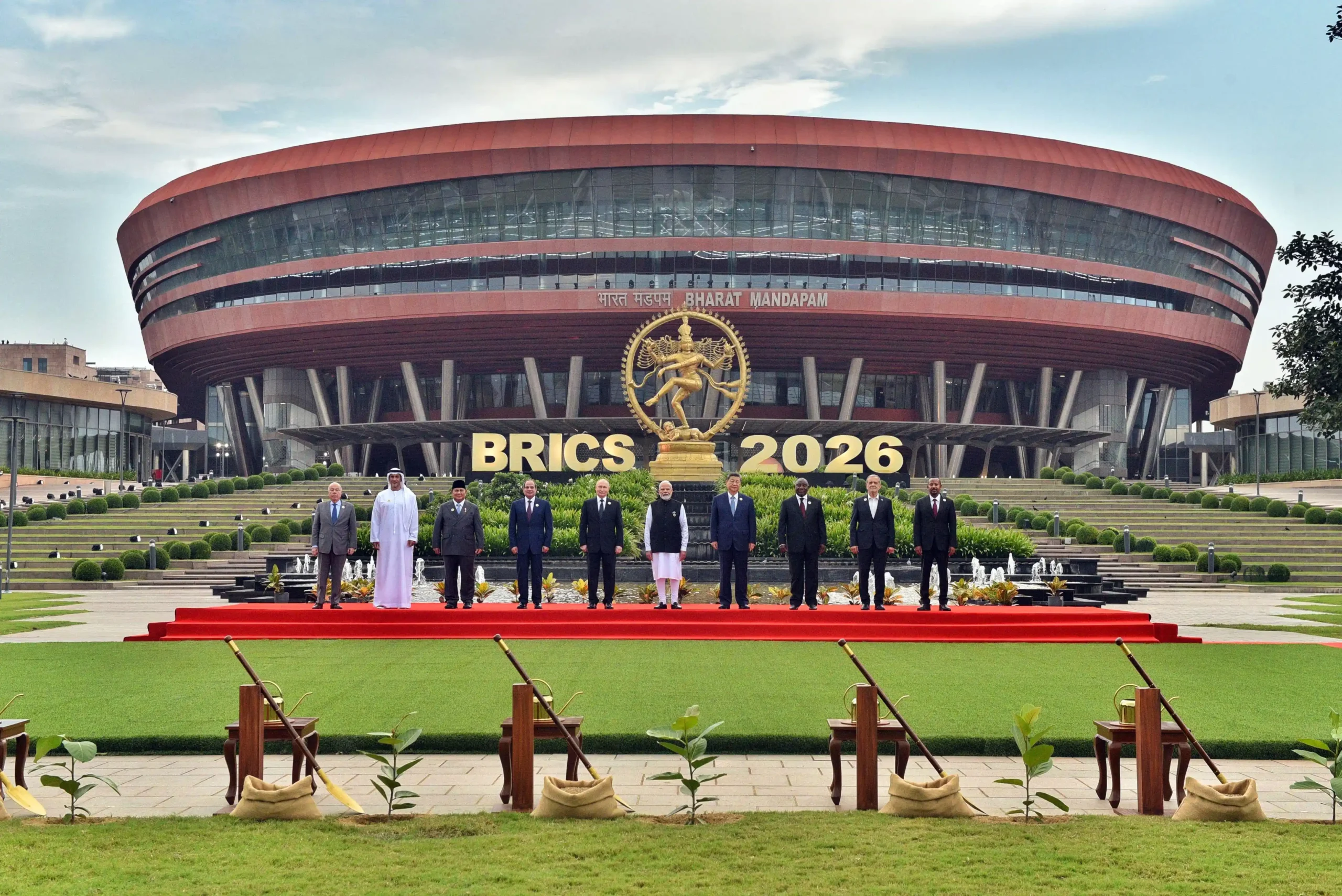
In our fractured world, the 18th BRICS summit in New Delhi, India, produced something that has become rare in high politics: a long, negotiated text that every member accepted. The New Delhi Declaration, adopted unanimously on Sept. 12, runs to 140 points. It does not resolve the wars that shadow the grouping. It does not invent a new world order. What it does is record, in careful language, that countries with clashing alignments can still agree on restraint, on the need to reform institutions that no longer match the distribution of economic weight, and on a set of practical tasks in payments, development finance and technology. That is not a small achievement. It is one the rest of the world should take seriously.
BRICS is no longer the five-country club of 2009. It now includes Egypt, Ethiopia, Iran, the United Arab Emirates and Indonesia alongside the original members. The expanded table contains a U.S. security partner and a state under American and Israeli military pressure; a permanent member of the U.N. Security Council at war in Europe and another that is not; energy exporters and energy importers; democracies and autocracies. Foreign ministers had already failed to issue a joint statement in May because of differences over West Asia. However, overnight talks in New Delhi produced a unanimous statement. The text instead expressed “deep concern” over escalation, called for “maximum restraint,” and urged a multilateral approach that respects national viewpoints. It also restated long-standing positions on Palestine: opposition to forced displacement, support for a two-state solution on 1967 lines with East Jerusalem as capital, backing for UNRWA, and full U.N. membership for Palestine. The wording is not perfect, but it is evidence that consensus, however thin, remains possible.
That possibility matters because the grouping now represents a large share of the planet’s people and output. Member governments and IMF-based estimates put the bloc at roughly half the world’s population and about 40 percent of global GDP on a purchasing-power-parity basis — a share that has risen sharply since the early 1990s, even after accounting for new members. Nominal GDP is smaller, around $32 trillion, and still trails the G7 in market-exchange terms. Growth, however, has run well ahead of the advanced-economy average for years. Intra-bloc merchandise trade has expanded more than thirteenfold since 2003 and exceeded $1.17 trillion in 2024. The New Development Bank, the group’s most concrete institutional product, had approved about $43 billion for 139 projects by the end of 2025, with an active portfolio of some $35.6 billion. Local-currency lending has risen, though the dollar still dominates the book. These are not abstract talking points. They describe a set of economies that already shape commodity markets, manufacturing supply chains and the demand for infrastructure finance.
The declaration’s most consequential political paragraphs concern the architecture of global governance. Members restated support for comprehensive U.N. reform, including the Security Council, so that it better reflects Africa, Asia and Latin America. China and Russia again endorsed a greater role for Brazil and India in the U.N. system, including the Council — language that founding members have sought for two decades. The text also pressed for quota and voice reforms at the IMF and World Bank so that emerging and developing economies are not permanently underweighted relative to their share of world output. None of this is new. What is new is that an enlarged, more heterogeneous BRICS still put the demand in a consensus document after expansion had made agreement harder, not easier.
Trade language is equally revealing. The declaration voiced “serious concerns” about unilateral tariff and non-tariff measures that distort commerce and sit uneasily with WTO rules. It called for restoration of a functioning two-tier WTO dispute-settlement system, including the Appellate Body. It supported accession bids by Ethiopia and Iran. It did not pretend that members practice free trade among themselves. China remains the hub of intra-BRICS commerce; several members run large deficits with Beijing; Brazil, like others, still sells mostly commodities into the bloc and buys more sophisticated goods. The point of the text is not that these imbalances have vanished. It is that members preferred a shared critique of fragmentation to a public split over who is to blame. In an era of carbon-border adjustments, secondary sanctions and tit-for-tat duties, that preference is itself a policy signal.
On finance, the document is incremental rather than revolutionary. There is no BRICS currency. There is a Payment Task Force charged with studying faster, cheaper cross-border settlement and local-currency trade, with an explicit caveat that there is no one-size-fits-all model. That caveat is honest. Most intra-bloc trade is still invoiced in dollars. Central banks still hold large dollar reserves. What members can do — and what the declaration encourages — is reduce friction at the margin: interoperability of payment systems, more local-currency lending by the New Development Bank, and settlement options that do not run exclusively through a single correspondent-banking network. For commodity exporters and importers who have watched shipping lanes and payment rails become political instruments, even modest redundancy is valuable.
The same pragmatism appears in technology and development. Leaders committed to implement an earlier statement on global governance of artificial intelligence, stressing access for the Global South, energy efficiency of AI systems, and safeguards against misuse. They established a Task Force on Growth and Development. They endorsed continuity mechanisms so that initiatives do not die when the chair rotates — a quiet recognition that a grouping without a permanent secretariat needs memory. India, as chair, also convened hundreds of meetings across dozens of cities over the year. Process is not strategy. But process is how a consensus club avoids becoming a photo opportunity.
Multilateralism is not only the Security Council or the G7. It is also the capacity of states that will never form an alliance to keep talking, to produce a text, and to assign follow-up work. The G20 has often struggled to issue communiqués when members are at odds. The U.N. system is gridlocked on the conflicts that matter most. In that environment, a forum that includes nearly half of humanity and can still adopt 140 paragraphs on the first day of a summit is performing a function that other tables are failing to perform: keeping a channel open when interests diverge.
For the members themselves the value is more concrete. Expansion without a common document would have advertised incoherence. A document that condemns terrorism — including the April 2025 attack in Pahalgam — while calling for dialogue in West Asia allows governments to tell domestic audiences that they were not isolated. Support for Brazil and India at the U.N. keeps a long campaign alive. Local-currency experiments and NDB projects give finance ministries something to point to besides communiqués. Brazil’s own recent NDB operations, including a $500 million program channeled through regional development funds for energy and connectivity in the North, Northeast and Center-West, illustrate how the bank can sit alongside, rather than replace, traditional lenders. That is the right scale of ambition.
The world beyond the grouping has a stake as well. Supply chains and energy routes that run through the Strait of Hormuz, the Red Sea and the South Atlantic are not BRICS property. When members call for the protection of seafarers and the uninterrupted flow of trade and energy “in accordance with applicable international law,” they are describing a public good. When they warn against protectionism dressed as climate policy, they are speaking for many developing economies that fear new barriers more than they fear sermons about emissions. When they insist that AI rules not be written solely in a handful of capitals, they are stating a fact about where the next billion users live.
Appreciation does not require romance. BRICS will not substitute for the IMF, the WTO or the U.N. It will not dissolve the dollar. It will not end wars by declaration. What it demonstrated in New Delhi is more modest and, in 2026, more useful: that an expanded coalition of states with real disagreements can still choose language over rupture. Diplomacy of that kind is unfashionable. It is also how large, diverse systems avoid becoming permanently ungovernable. The declaration should be read as a test of whether that habit can survive the next crisis, not as a claim that the crisis is over. The test is worth watching. The alternative — a world in which even the minimum of shared text becomes impossible — is already visible elsewhere.