The Democratic sweep of the 2026 midterms has altered America’s political landscape, exposing vulnerabilities in the Republican coalition and reviving Democratic ambitions. But with economic uncertainty, shifting voter loyalties and ideological divisions shaping the electoral battlefield, the race for the White House in 2028 remains far from settled.
The race for the White House in 2028 has effectively begun, and the political landscape looks markedly different from the one that delivered Donald Trump’s presidential victory in 2024.
The Democratic Party’s sweeping success in the November 2026 midterm elections has fundamentally altered the balance of power in Washington. Democrats have regained control of both chambers of Congress, penetrated traditionally Republican strongholds and recovered support among demographic groups that had increasingly gravitated towards Trump.
Yet the election has also exposed a deeper uncertainty in American politics: whether voters are embracing a new Democratic political direction or merely expressing frustration with the incumbent Republican administration.
That distinction could determine the outcome of the next presidential election.
The 2026 Verdict: A Warning for Republicans
The scale of the Republican setback provides the first indication of the challenges confronting the party ahead of 2028.
By November 12, Democrats had flipped eight Republican-held Senate seats and 44 House seats, according to CQ Roll Call.
The victories extended well beyond traditional Democratic territories.
In Texas, Democrat James Talarico defeated Republican Ken Paxton in a Senate race that challenged decades of Republican dominance. Georgia elected Keisha Lance Bottoms as governor, while Democrats made significant congressional gains across the Midwest and Southeast.
According to the Cook Political Report, Democrats were positioned to win almost every congressional district Trump carried by fewer than ten percentage points in 2024.
At least 53 Democrats were set to represent districts that voted for Trump in the previous presidential election.
These results suggest that the Republican coalition responsible for Trump’s return to power may be considerably less secure without his name directly on the ballot.
However, the historical distinction between midterm and presidential electorates remains important. Presidential elections generally attract substantially higher turnout, including voters who rarely participate in congressional contests.
Republicans could therefore recover ground in 2028 even without dramatically changing their policy positions.
The Economy Will Define the 2028 Battlefield
Economic performance is likely to remain the most consequential variable in the next presidential contest.
Trump’s 2024 victory was partly built on dissatisfaction with inflation and living costs under the previous Democratic administration.
Two years later, similar grievances have turned against Republicans.
The US Bureau of Labor Statistics reported that consumer prices increased 0.4% in October 2026 after rising 0.6% in September. Food prices increased 0.5% during October, while shelter costs climbed 0.3%.
Meanwhile, unemployment remained relatively contained at 4.1%, with the economy adding 165,000 jobs during October.
Nevertheless, 4.8 million Americans were employed part-time for economic reasons, indicating that stable headline employment figures do not necessarily reflect household financial security.
An October NBC News survey found that 70% of registered voters believed the country was heading in the wrong direction, while 60% disapproved of Trump’s job performance.
Inflation and living costs appeared among the two most important concerns for 47% of respondents.
For the Republican presidential nominee in 2028, restoring confidence in economic management will therefore be critical.
For Democrats, the challenge will be equally demanding: demonstrating that their economic proposals can meaningfully improve affordability rather than simply capitalising on Republican shortcomings.
If living standards improve substantially before 2028, the political environment could shift again.
The Hispanic Vote: America’s Emerging Electoral Battleground
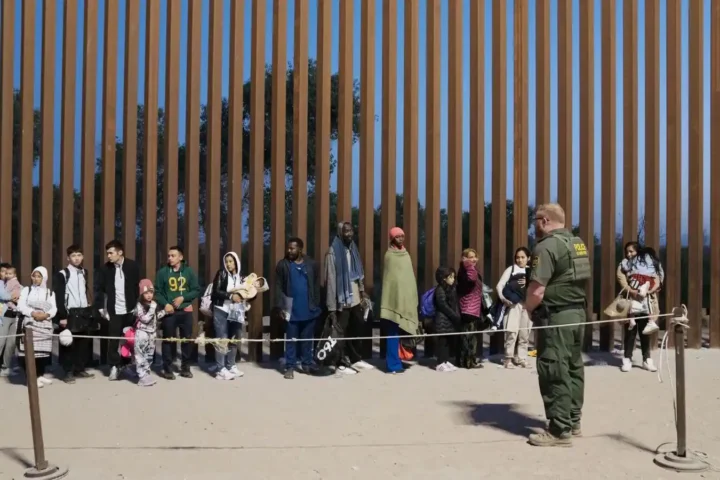
One of the most consequential questions for 2028 concerns Hispanic voters.
According to Pew Research Center, Trump received 48% of Hispanic votes in 2024, compared with 36% in 2020.
That improvement helped Republicans strengthen their position among working-class and minority voters.
The 2026 midterms, however, revealed significant erosion.
The Associated Press Voter Poll found that approximately six in ten Hispanic voters supported Democratic House candidates, while only around one-third backed Republicans.
In Texas, approximately 60% of Hispanic voters supported Democratic Senate candidate James Talarico.
These developments challenge the assumption that Hispanic voters are undergoing a permanent conservative realignment.
Instead, they suggest an electorate increasingly influenced by immediate economic conditions, immigration policies and perceptions of governmental competence.
For 2028, Hispanic communities could prove decisive in competitive states such as Arizona, Nevada and Pennsylvania, while also influencing Republican prospects in Texas and Florida.
Neither party can safely regard their support as guaranteed.
Young Voters Could Reshape the Presidential Contest
The political preferences of younger Americans present another major uncertainty.
In 2024, Trump significantly improved his standing among younger voters compared with earlier Republican presidential performances.
However, the 2026 midterms produced a sharp reversal.
According to the Associated Press Voter Poll, approximately 70% of voters under 30 supported Democratic congressional candidates, compared with roughly 30% backing Republicans.
About six in ten younger voters identified opposition to Trump as a reason for their congressional vote.
Nevertheless, voters under 30 accounted for only approximately one-tenth of the midterm electorate.
This creates an important strategic distinction for 2028.
Democrats must convert favourable attitudes among younger Americans into sustained political participation. Republicans, meanwhile, must determine whether their 2024 gains represented genuine ideological movement or temporary dissatisfaction with the Democratic leadership.
Housing affordability, employment opportunities, student debt, artificial intelligence and economic mobility are likely to influence this demographic.
The party that presents a credible vision of future prosperity may enjoy an important advantage.
The Republican Succession Problem
The 2028 election will also test whether the Republican Party can sustain Trump’s political coalition without Trump himself as its presidential candidate.
His influence has reshaped Republican positions on immigration, international trade, foreign policy and America’s relationship with traditional allies.
But maintaining this coalition requires more than inheriting its ideological framework.
Trump’s political appeal has often depended on personal loyalty, unconventional communication and an ability to mobilise voters who previously participated inconsistently in elections.
A successor may struggle to replicate these characteristics.
Vice President JD Vance is among the prominent Republican figures positioned for the post-Trump political era, although the party’s eventual nominee and ideological direction remain uncertain.
The midterms have made the succession challenge more complicated.
A Republican candidate in 2028 must defend aspects of the administration’s record while persuading voters dissatisfied with economic performance and governance.
Whether the party chooses continuity, recalibration or a broader ideological repositioning will shape its electoral prospects.
Democrats Face Their Own Leadership Dilemma
Despite their midterm success, Democrats have not resolved the question of what kind of political leadership can deliver a presidential victory.
The party’s 2026 electoral coalition included both progressive candidates and moderates who succeeded in traditionally conservative states.
This ideological diversity offers electoral flexibility but complicates the formation of a unified national platform.
Democratic governors such as Pennsylvania’s Josh Shapiro, Illinois’ JB Pritzker and Maryland’s Wes Moore have attracted attention as potential presidential contenders.
Former Vice President Kamala Harris also remains an influential figure within the party.
However, the 2026 results do not automatically identify the strongest candidate for 2028.
Progressives may argue that economic populism and ambitious social policies are essential for mobilising younger voters.
Moderates may contend that winning suburban constituencies and Republican-leaning states requires ideological restraint and broader bipartisan appeal.
The challenge will be combining voter enthusiasm with geographical competitiveness.
Ultimately, the party’s presidential nominee must demonstrate an ability to win beyond reliable Democratic strongholds.
Turnout Could Decide the Next Election
Voter participation may be as consequential as ideological preference.
Preliminary estimates indicate that approximately 123.5 million Americans voted in the 2026 midterms, representing around 49.1% of the voting-eligible population, according to the Council on Foreign Relations.
This placed turnout among the highest recorded for a US midterm election in more than a century.
The results suggest that Democratic enthusiasm was particularly strong.
An October Associated Press-NORC survey found that approximately three-quarters of Democratic registered voters considered participating in the election extremely important, compared with roughly six in ten Republicans.
Yet presidential contests attract millions of additional voters.
The re-entry of irregular Republican voters in 2028 could significantly alter the electoral balance.
For Democrats, sustaining the enthusiasm generated by opposition to Trump may become difficult if voters expect tangible policy achievements from their newly elected congressional representatives.
Foreign Policy and the Changing Electoral Equation
International developments could also influence the presidential race.
The Trump administration’s military confrontation with Iran, tariff policies and approach towards traditional alliances became sources of controversy during the midterm campaign.
For an electorate primarily concerned with living costs, foreign policy may matter most through its domestic economic consequences.
Energy prices, supply-chain disruptions, trade uncertainty and military expenditure can directly affect household finances.
The next presidential contest could therefore become a referendum not only on America’s domestic economy but also on the economic consequences of its international strategic choices.
Both parties will face pressure to reconcile national security priorities with demands for economic stability.
2028: An Election Without a Settled Political Majority
The most important conclusion from the 2026 midterms is that neither major American political party possesses a secure national majority.
The Republican coalition that appeared ascendant in 2024 has demonstrated considerable vulnerabilities.
At the same time, the Democratic resurgence has been driven partly by dissatisfaction with the incumbent administration rather than overwhelming enthusiasm for the opposition.
The Associated Press Voter Poll found that only about half of voters viewed the Democratic Party favourably, despite its electoral victory.
This suggests that American politics is entering a period of heightened electoral volatility, in which economic conditions, candidate credibility and voter mobilisation can rapidly reshape political loyalties.
The next two years will determine whether Democrats can translate their congressional triumph into a persuasive national governing vision, and whether Republicans can reconstruct their electoral coalition around a post-Trump leadership.
The road to 2028 is therefore not simply a contest between two political parties.
It is a struggle to define the next phase of American politics, the future of its economic model and the direction of its global leadership.
The 2026 midterms have transformed the political battlefield. But the contest for America’s future remains wide open.