In the immediate aftermath of the November 3, 2026 U.S. midterm elections—a sweeping Democratic “Blue Tsunami” that flipped both chambers of Congress—a convenient narrative quickly took hold across Washington. According to this postmortem, the second Trump administration’s domestic economic agenda was working as intended until February 2026, when joint U.S.–Israeli military strikes against Iran triggered a Middle Eastern energy shock that ignited pump prices and alienated affordability-minded voters.
Empirical evidence from the twenty-one months preceding the election refutes that diagnosis. Nearly a full year before hostilities erupted in the Persian Gulf, the administration’s sweeping tariff regime had already imposed a measurable drag on U.S. industrial employment, capital construction, household purchasing power, and North American supply chains. The Iran conflict did not create America’s affordability crisis; rather, it layered an acute energy and maritime freight shock atop an economy already strained by the highest U.S. import barriers in nearly a century.
Whether the incoming 120th Congress can unwind that pre-existing trade drag when it convenes in January 2027 is the defining macroeconomic question for the final two years of President Donald Trump’s second term. While the Democratic takeover of the House and Senate establishes meaningful institutional guardrails—including appropriations leverage, subpoena oversight, and confirmation power—constitutional veto arithmetic, executive statutory agility following the Supreme Court’s February 2026 tariff ruling, and bipartisan hawkishness toward China sharply constrain rapid tariff relief. Post-midterm politics will reshape the instruments and volatility of American protectionism, yet they are unlikely to restore pre-2025 trade openness.
1. The Pre-Iran Baseline: Anatomy of the 2025–2026 Tariff Shock
To separate the economic effects of trade policy from Middle Eastern geopolitics, one must examine the trajectory of the U.S. economy between January 2025 and January 2026. Within weeks of returning to office, the administration invoked the International Emergency Economic Powers Act (IEEPA) to impose 25% duties on most Canadian and Mexican imports and 10% (subsequently doubled to 20%) tariffs on Chinese goods, citing border and fentanyl emergencies. On April 2, 2025, the White House escalated further with its “Liberation Day” proclamation, establishing a 10% baseline “reciprocal” tariff across nearly all trading partners alongside elevated country-specific surcharges. During the peak of bilateral escalation in spring 2025, average U.S. tariffs on Chinese imports surged to approximately 164% (with total effective duties on targeted categories reaching 145%), met by Chinese retaliatory tariffs averaging 146%, before the October 2025 Busan truce dialed average bilateral rates back to roughly 49% and 31%, respectively.
The fiscal and distributional scale of this policy shift was historic. According to calculations by the Yale Budget Lab, the 2025 tariff waves extracted an estimated $214.7 billion in inflation-adjusted customs revenue above the 2022–2024 baseline by February 2026. Traditional allies absorbed unprecedented duties: U.S. Census Bureau trade data show that in 2025, Washington levied tariffs on roughly 15% of all U.S. imports from Canada by value (approximately $56 billion in goods), generating $10 billion in calculated duties compared with just $0.4 billion in 2024. Even after judicial interventions and bilateral exemptions in 2026, the Yale Budget Lab estimates that the average U.S. statutory tariff rate stood at 11.2% in November 2026—and is scheduled to reach 11.4% in December 2026—imposing an ongoing burden of roughly $900 per household annually, raising consumer price levels by 0.6%, and extracting $1.7 trillion over a ten-year window ($1.6 trillion on a dynamic basis after accounting for reduced GDP growth).
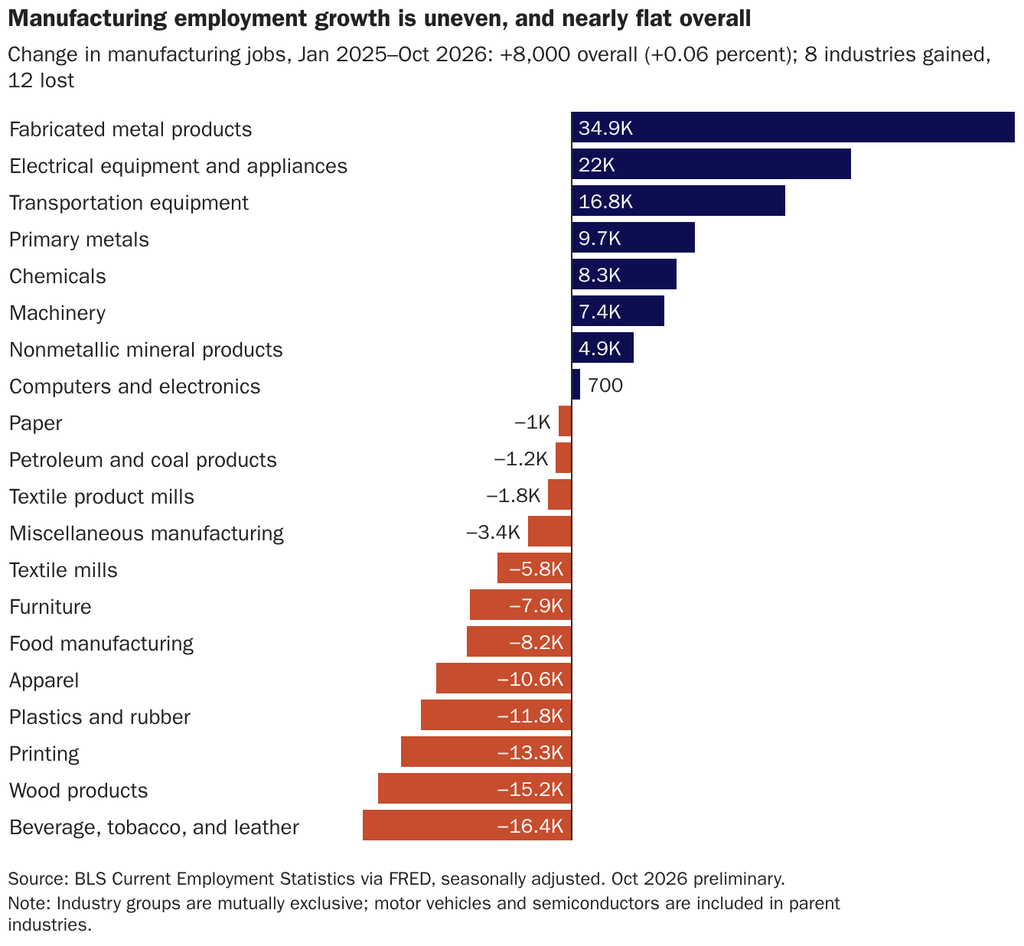
Crucially, the macroeconomic payoff promised by protectionist theory—a broad-based manufacturing hiring and investment boom—failed to materialize before or after the Iran shock. Bureau of Labor Statistics (BLS) payroll data analyzed by Cato Institute economist Kyle Handley reveal that between January 2025 and October 2026, total U.S. manufacturing employment grew by a negligible 8,000 jobs, or 0.06%, leaving the industrial workforce virtually unchanged over twenty-one months.
| Economic / Trade Indicator | Pre-Tariff Baseline (2024 / Jan 2025) | Pre-Iran Tariff Era (2025 – Jan 2026) | Post-Iran & Late-2026 Status (Feb – Nov 2026) | Net Shift / Analytical Significance |
| Average U.S. Statutory Tariff Rate | ~2.4% (2024 MFN baseline) | Peaked >20% mid-2025; ~164% peak on China | 11.2% (Nov 2026); 11.4% (Dec 2026) | Highest sustained U.S. tariff wall since the 1930s |
| Incremental Customs Revenue | $0.4B collected on Canadian imports (2024) | $214.7B above 2022–24 baseline (by Feb 2026) | ~$189.4B IEEPA receipts ($81B refunded by July 2026) | Massive tax transfer from U.S. importers/households |
| U.S. Manufacturing Payrolls | Baseline (Jan 2025) | Stagnant net growth throughout 2025 | +8,000 jobs (+0.06%) Jan 2025–Oct 2026 | 8 subsectors gained; 12 subsectors contracted |
| Manufacturing Construction Spend | Peak industrial buildout (Jan 2025) | Steady deceleration as input costs rose | Down 32% (Jan 2025 to Sept 2026) | Tariff uncertainty chilled greenfield factory CapEx |
| U.S. Regular Retail Gasoline | ~$3.10–$3.30/gal (2024 avg) | $2.78/gal (Jan 12, 2026 low) | Peaked $4.50/gal (May 11, 2026); >$4.00 (Oct 2026) | +61.9% spring surge amplified tariff inflation |
| ISM Manufacturing Prices Index | ~52–55 (neutral expansion) | Elevated throughout second half of 2025 | 77.9 (Sept 2026); 75.2 (Oct 2026) | Severe input cost pressure across metals, fuel, parts |
Beneath the flat headline payroll figure lies acute sectoral distortion. Across twenty major manufacturing industries tracked by the BLS, eight gained workers while twelve lost jobs. Protected upstream metal producers and capital-goods segments saw modest expansion—most notably fabricated metal products (+34,900 jobs) and transportation equipment (+22,000 jobs). Conversely, downstream manufacturers reliant on imported intermediates, packaging, and global export markets suffered sustained contraction: beverage, tobacco, and leather manufacturing lost 16,400 jobs; wood products shed 15,200 jobs; and electrical equipment and appliances lost 13,300 jobs.
Capital expenditure and trade-balance data reinforce this picture of pre-Iran friction. Far from catalyzing a domestic factory construction wave, U.S. manufacturing construction spending fell 32% between January 2025 and September 2026 as firms deferred long-horizon commitments amid unpredictable input duties. Meanwhile, the U.S. manufactured goods trade deficit across the first three quarters of 2026 remained larger than during the pre-tariff period of 2024, as supply chains rerouted away from direct Chinese shipments toward higher-cost third-country assemblers in Southeast Asia and Latin America rather than reshoring to the United States. Although headline ISM Manufacturing PMI readings improved in mid-to-late 2026—reaching 55.5 in October 2026—purchasing managers consistently reported that output expansion was narrowly anchored by artificial intelligence data-center and semiconductor infrastructure spending, while broader industrial sentiment remained weighed down by input inflation and tariff compliance friction.
2. Compounding Shocks: How the Iran War Layered Energy Inflation onto Trade Friction
When joint U.S.–Israeli military operations against Iran began in February 2026—building upon earlier strikes in June 2025—they struck an economy with almost no price buffer remaining. Corporate balance sheets that had spent 2025 absorbing or passing through steel, aluminum, component, and retail import tariffs were suddenly confronted with a severe global energy supply disruption.
Tehran’s asymmetric retaliation targeted the maritime chokepoints of global energy commerce. By laying mines, attacking commercial tankers in the Strait of Hormuz, disrupting shipping lanes near the Bab-el-Mandeb Strait, and striking refining infrastructure across Persian Gulf states, Iranian forces choked a corridor that carried approximately 25% of the world’s seaborne oil trade and 19% of global liquefied natural gas (LNG) in 2025. Combined with a U.S. naval blockade and reduced global refining capacity from the ongoing Russia–Ukraine conflict, maritime transit collapsed and crude benchmarks surged.
For American households and manufacturers, the transmission from the Persian Gulf to domestic prices was immediate:
- Retail Fuel Surge: According to the U.S. Energy Information Administration (EIA), average U.S. regular retail gasoline prices stood at a multi-year low of $2.78 per gallon on January 12, 2026, one month before the war began. By May 11, 2026, pump prices had surged 61.9% to $4.50 per gallon, remaining above $4.00 per gallon through October 2026.
- Industrial Input Pincer: In the September 2026 Institute for Supply Management (ISM) manufacturing survey, negative executive commentary outnumbered positive remarks, with 60% of respondents reporting deteriorating business conditions. Among those citing headwinds, 46% pointed to pricing volatility, 34% explicitly cited tariffs, and 30% cited the Iran war. Supply managers highlighted simultaneous price spikes across tariffed metals (aluminum, steel, copper, brass) and war-affected energy derivatives (diesel fuel, freight, plastics, and packaging materials), driving the ISM Prices Index to 77.9 in September and 75.2 in October.
- Electoral Fusion of Grievances: Voters did not view trade policy and Middle Eastern conflict as separate issues; they experienced both as a single cost-of-living squeeze. An August 2026 public opinion survey found that 75% of Americans worried about affording groceries and household goods, and 83% of that group attributed price increases directly to tariffs. By November 3, an NBC News exit poll across 45 states revealed that 66% of voters believed the administration’s tariffs had hurt the national economy, while Reuters/Ipsos polling showed just 34% public approval for the strikes on Iran alongside 54% who judged the war not worth fighting.
“The Iran war was layered on top of an already difficult business environment. Managers respond by raising prices, absorbing costs, or delaying hiring and investment. These aren’t hypothetical effects—the trade war began nearly a year before the Iran war, giving us clear evidence of its costs.” — Kyle Handley, Cato Institute (November 2026)
3. The Judicial Detour: Learning Resources, Inc. v. Trump and Statutory Adaptation
Any assessment of whether Congress can dismantle the tariff regime must account for a pivotal constitutional intervention that occurred nine months before the midterms. On February 20, 2026—the very month the Iran conflict escalated—the U.S. Supreme Court issued its landmark decision in Learning Resources, Inc. v. Trump (607 U.S. 229, consolidated with Trump v. V.O.S. Selections, Inc.). Writing for the Court, Chief Justice John Roberts held that the International Emergency Economic Powers Act—a 1977 economic sanctions statute—does not authorize the president to unilaterally impose tariffs. The majority ruled that Congress’s grant of authority to “regulate importation” during a declared national emergency cannot be construed as an unbounded delegation of Article I taxing power to levy duties of unlimited rate, scope, and duration on any nation.
In theory, Learning Resources invalidated the legal foundation of the 2025 fentanyl tariffs on Canada, Mexico, and China as well as the global “Liberation Day” reciprocal tariffs—prompting U.S. Customs and Border Protection to establish a phased refund process that had returned $81 billion to importers by July 2026 out of an estimated $189.4 billion collected under IEEPA. In practice, however, the ruling triggered an immediate executive statutory pivot rather than trade liberalization:
- Section 122 of the Trade Act of 1974: On the exact day of the Supreme Court’s ruling (February 20, 2026), the White House issued a proclamation invoking Section 122—a never-before-used balance-of-payments provision—to impose a 10% temporary import surcharge across most U.S. trading partners (subject to a 15% statutory ceiling and ongoing challenges in the U.S. Court of International Trade).
- Section 232 of the Trade Expansion Act of 1962: The administration leaned heavily on national-security tariffs, maintaining 50% duties on steel, aluminum, and derivative products while advancing Section 232 investigations into robotics, industrial machinery, pharmaceuticals, medical consumables, polysilicon, wind turbines, and commercial aircraft.
- Section 301 of the Trade Act of 1974: In March 2026, the Office of the U.S. Trade Representative (USTR) launched sweeping new Section 301 investigations into “structural excess capacity” across manufacturing sectors in China and third-country export hubs, supplemented by forced-labor tariff actions finalized in July 2026.
- North American Institutional Friction: On July 1, 2026, during the mandatory sixth-anniversary joint review of the United States–Mexico–Canada Agreement (USMCA) under Article 34.7, USTR Jamieson Greer formally declined to extend the pact for a new 16-year term. While USMCA remains legally in force through 2036, Washington’s refusal triggered mandatory annual joint reviews—institutionalizing permanent leverage over Ottawa and Mexico City. Simultaneously, the administration layered Section 232 metals and automotive duties alongside Section 338 tariff actions on Canada, forcing North American manufacturers to scramble for rules-of-origin compliance (driving the share of U.S. imports from Canada and Mexico claiming USMCA exemptions to 80.2% in July 2026).
By shifting from IEEPA to Sections 122, 232, 301, and 338, the executive branch insulated its core tariff architecture behind traditional trade-remedy statutes that courts have historically accorded wide deference.
4. The Post-Midterm Political Landscape: What the “Blue Tsunami” Actually Changes
Voters delivered an unmistakable verdict on November 3, 2026. Driven by economic anxiety across suburban and industrial districts, Democrats won decisive majorities in both houses of the incoming 120th Congress—capturing 255 to 256 seats in the House of Representatives (flipping nearly four dozen districts) and expanding to a 55–44 majority in the Senate (picking up Republican-held seats in states including Alaska, Maine, North Carolina, Ohio, and Texas). Down-ballot frustration with energy and infrastructure costs also manifested at the local level, where voters approved 46 out of 47 ballot initiatives to halt or slow power-hungry data center projects.
Yet as international trade scholars at the Peterson Institute for International Economics (PIIE) and the Hinrich Foundation emphasize, unified Democratic control of Capitol Hill does not equate to unified control over U.S. tariff policy. When the 120th Congress takes office in January 2027, its ability to unwind the pre-Iran tariff wall will be governed by four structural constraints:
| Legislative / Institutional Lever | Statutory / Constitutional Mechanism | Required Vote Threshold | Presidential Veto Vulnerability | Realistic Impact (2027–2029) |
| Direct Tariff Repeal Legislation | Statutory repeal of Section 122, 232, or 301 duties | Simple majority (218 House / 51 Senate); 290 House / 67 Senate to override veto | Extreme — Near-certain presidential veto | Very Low — Requires ~12 GOP senators & >30 GOP House defections |
| Trade Review / Approval Reform | Trade Review Act (requiring congressional approval within 60 days of new tariffs) | Simple majority; 290 House / 67 Senate over veto | Extreme — Trump will not sign curbs on executive authority | Low-to-Moderate — Gains bipartisan cosponsors, unlikely to clear veto |
| Appropriations Riders (“Power of the Purse”) | Riders barring Treasury/CBP funds from collecting specific duties in “must-pass” bills | Majority in House; 60 votes in Senate to overcome filibuster | Moderate — Veto triggers government shutdown | Moderate-to-High — Strongest tool for targeted relief (e.g., Canada/ag) |
| Section 232 & 301 Institutional Reform | Transferring Section 301 probes to independent USITC; expanding Section 232 disapproval | Majority + Senate cloture (60 votes) | High — Unless attached to broader trade package | Moderate — Sets medium-term guardrails for post-2028 presidency |
| USMCA Oversight & Bilateral Bargaining | Congressional hearings, TPA conditions, and pressure during annual USMCA reviews | Committee oversight + Senate treaty/implementing rules | Low — Oversight cannot be vetoed; deal requires Congress | High — Constrains White House from unilateral USMCA withdrawal |
| Senate Confirmation & War Powers Linkage | Holding executive/judicial nominees and Pentagon Iran supplemental funds | 51 Senate votes (confirmations); bicameral funding control | None on confirmations; High on War Powers | High — Creates “trading stock” to extract selective exemptions |
A. The Constitutional Veto-Override Wall
President Trump remains in the White House until January 20, 2029, and views tariffs as the ideological cornerstone of his presidency. As former Deputy U.S. Trade Representative Alan Wm. Wolff notes in his post-election analysis for PIIE, the probability of Trump signing a standalone bill that rolls back his signature tariffs is virtually zero. Overriding a presidential veto requires a two-thirds supermajority in both chambers: 290 votes in the House and 67 votes in the Senate. Historically, Congress has overridden only 112 of the 2,599 presidential vetoes cast since 1789. Even with 55 Democratic-aligned senators and roughly 256 House Democrats, tariff opponents would need at least 12 Republican senators and more than 30 House Republicans to vote against a sitting Republican president—a threshold that bipartisan trade bills such as the Cantwell–Grassley Trade Review Act (which would cap unilateral tariffs at 60 days absent congressional approval) have struggled to reach.
B. The “Power of the Purse” and Asymmetric Bargaining
Where the 120th Congress possesses genuine coercive leverage is not through standalone trade bills, but through “must-pass” legislative vehicles. Federal appropriations bills, debt-limit extensions, farm bills, and Pentagon supplemental funding requests for ongoing operations in the Persian Gulf cannot be easily vetoed without triggering a government shutdown or military funding lapse. Democratic appropriators—joined by farm-state and border-state Republicans hurt by retaliatory tariffs—can attach targeted funding riders prohibiting Customs and Border Protection from expending funds to enforce specific duties, particularly Section 122 surcharges or tariffs on Canadian agricultural and industrial inputs. Furthermore, Senate Democrats’ 55-seat majority gives them absolute control over executive branch and federal judicial confirmations, providing leadership with valuable “trading stock” to negotiate targeted tariff exclusions or restrain new Section 232 proclamations.
C. The China Hawkishness Paradox
Paradoxically, the Democratic wave may increase rather than diminish bilateral trade friction with Beijing. While congressional Democrats and free-market Republicans share widespread skepticism toward tariffs on allies such as Canada, Mexico, and the European Union, neither party wishes to appear accommodative toward China. As Bruegel senior fellow Alicia García-Herrero observes, a politically weakened president facing a hostile Congress will have far less room to grant unilateral concessions to Chinese President Xi Jinping.
This dynamic directly threatens the fragile U.S.–China trade truce originally struck in Busan in October 2025. On November 9, 2026—just six days after the U.S. midterms—Washington and Beijing extended their tariff truce by two months through January 10, 2027, setting the stage for a high-stakes bilateral meeting between Trump and Xi at the APEC Summit in Shenzhen on November 19, 2026. Notably, that two-month extension expires just one week after the new 120th Congress is sworn in. Capitol Hill committees are expected to press aggressively for tighter semiconductor and AI export controls, outbound investment restrictions, and enforcement against Chinese transshipment through third countries—limiting the White House’s ability to trade tariff reductions for Chinese agricultural or energy purchases.
D. De-escalating Iran vs. Unwinding Tariffs
Finally, the post-midterm political environment affects the two twin drivers of 2026 inflation asymmetrically. On Iran, public exhaustion (with 54% viewing the conflict as not worth fighting) and congressional threats to invoke the War Powers Resolution or restrict supplemental Pentagon appropriations create intense pressure on the White House to seek a de-escalatory off-ramp in the Persian Gulf that reopens the Strait of Hormuz and lowers global crude prices. Lower oil prices would deliver rapid disinflationary relief at the gas pump in 2027. Yet lowering fuel costs merely strips away the second layer of the 2026 price shock; it leaves the underlying 11.2%–11.4% statutory tariff wall—and its $900-per-household annual tax burden—largely intact.
5. Strategic Outlook for the 120th Congress and Global Supply Chains
The November 2026 midterm elections represent a decisive institutional turning point, ending two years of virtually unchecked executive unilateralism in both commercial policy and Middle Eastern military intervention. Constrained by the Supreme Court’s doctrinal boundary in Learning Resources, chastened by voter backlash over cumulative tariff-and-energy inflation, and confronted by a Democratic Congress armed with appropriations riders, confirmation holds, and oversight subpoenas, the White House faces steep political costs if it attempts another broad-based consumer tariff shock. Indeed, selective tactical accommodations—such as easing bilateral frictions with Canada and Mexico during the 2027 USMCA annual review or broadening product exclusions for small businesses—are substantially more plausible now than they were prior to November 3.
Nevertheless, the structural damage inflicted by the pre-Iran trade war cannot be reversed quickly through legislative fiat. Because the executive branch has successfully migrated its tariff architecture onto durable statutory pillars—Sections 232 and 301—and remains shielded by the 290-House and 67-Senate veto-override threshold, the baseline of elevated U.S. import duties is poised to endure through 2028. For corporate planners, investors, and U.S. trading partners, the post-midterm era will not usher in a return to pre-2025 free trade, but rather a protracted tug-of-war between an assertive legislative branch and a protectionist executive—one in which energy markets may cool, yet structural tariff friction remains embedded in the American economy.