
Pick up your phone. Turn it over. Somewhere on the back, in letters small enough that most people never bother to read them, is a line that used to say almost the same thing every time: made/assembled in China. That line is changing, quietly and unevenly, and the new geography it describes says more about the next decade of global power than most headlines about tariffs or chip bans ever will.
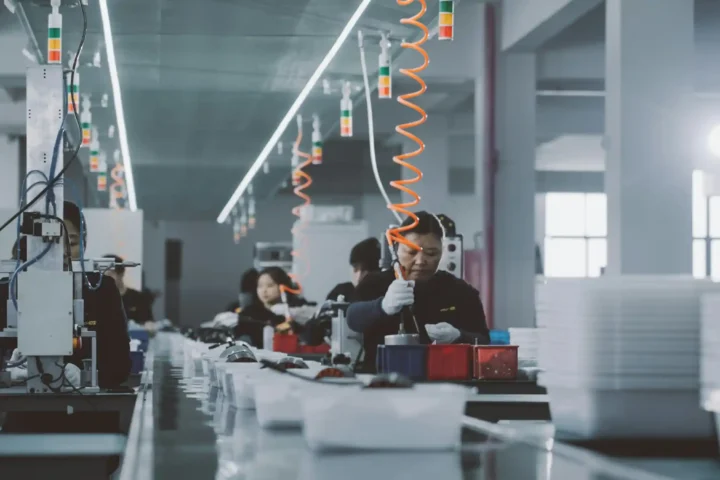
For the better part of fifteen years, the electronics supply chain had a simple, almost boring logic. China made the world’s phones, laptops, and gadgets because China could make them better, faster, and cheaper than anywhere else, at a scale no other country came close to matching. At its height, well over two-thirds of the world’s smartphones rolled off Chinese assembly lines. This was not an accident of geography; it was the product of decades of investment in ports, power grids, supplier networks, and a workforce trained to hit impossible deadlines. It worked. It also meant that when the system wobbled, everyone felt it at once.
The pandemic showed how a single blocked port could stall factories on the other side of the planet. Escalating tariffs showed how a policy decision in Washington could reprice an entire product category overnight. And a widening set of export controls on chips and critical minerals showed both governments and corporate boards something they had mostly preferred not to think about: dependence on one country, however efficient, is not a strategy. It is a bet.
Companies responded with a phrase that has since hardened into doctrine: “China plus one.” Keep the scale in China, but build a real second line somewhere else, so that a tariff, a natural disaster, or a diplomatic crisis doesn’t stop production cold. What’s striking now, looking at where the money and the factories have actually gone, is that the “plus one” was never going to be just one place. It has become a constellation — and the country rising fastest within it is one that, for most of the last generation, the world associated with call centers and code, not circuit boards.
That country is India.
The Quiet Arithmetic of a Shift
The numbers, when you line them up, tell a story that has outpaced most people’s mental map of where things are made. By 2025, China, India, and Vietnam together accounted for more than nine out of every ten smartphones produced on Earth. China still led by a wide margin, with something like 63 percent of global output. But India had climbed to roughly 18 percent and was still climbing, with analysts projecting it could reach a fifth of global production within a year or two.
Apple is the clearest illustration of how fast this has moved. A few years ago, India assembled a rounding error’s worth of iPhones. Now it’s close to a quarter of them. Even more telling: India has overtaken China as the largest source of smartphones imported into the United States, with its share of those imports leaping from 13 percent to 44 percent in the span of a single year. Google has been shifting its Pixel production away from its old reliance on Vietnam and toward India, part of a stated plan to exit Chinese manufacturing for phones, watches, and earbuds entirely by 2027. Microsoft, Amazon, and other giants are quietly running the same audit on servers, laptops, and networking equipment, looking for lines that don’t run through a single country.
None of this means China’s role is over. It isn’t. China remains the majority producer of smartphones on the planet and an irreplaceable source of integrated circuits and display panels — the deep, unglamorous infrastructure of modern electronics that took decades to build and cannot be conjured elsewhere overnight. What’s changing is not that China is being abandoned, but that it is no longer being trusted alone. The strategy boardrooms have settled on isn’t “China out.” It’s “China, plus increasingly serious others.”
Why a Country Known for Software Is Now Building Hardware
If you had asked an economist in 2010 to bet on the next great electronics manufacturing hub, India would not have topped many lists. Its reputation was built on services — call centers, back-office processing, software outsourcing — not on the exacting choreography of a modern assembly line, where a single dust particle can ruin a display module. Its infrastructure was, and in many places still is, a genuine constraint: unreliable power in some states, congested ports, a regulatory culture that earned India a reputation for being difficult to build in.
And yet the transformation has been real. A decade ago, only about a quarter of the mobile phones sold in India were actually made there; the rest were imported. Today, nearly all of them are made domestically. The value of that domestic production has grown more than twentyfold in less than a decade, and mobile phone exports have multiplied more than a hundredfold over the same period. India went from being a net importer of handsets to a net exporter, and by 2025, smartphones had become the country’s single largest export category — ahead of refined petroleum, ahead of gems and jewelry, categories that have defined Indian trade for generations.
This didn’t happen because global capital simply discovered India’s virtues on its own. It happened because New Delhi built an unusually aggressive set of financial incentives to make it happen, chief among them the Production Linked Incentive scheme, which pays manufacturers a percentage of incremental sales — typically in the low single digits — in exchange for building real production capacity and hitting localization targets inside the country. It is industrial policy in the most literal sense: the government picked an outcome it wanted and paid companies to deliver it. By most measures, it worked better than its designers expected. Cumulative production and exports under the smartphone incentive program have already blown past the original five-year targets by 30 to 40 percent.
The private-sector math lines up with the public incentives almost too neatly. Manufacturing wages in China have roughly tripled since 2010. Tariffs on Chinese-made electronics have crept toward 35 percent under some proposals. Geopolitical risk has a way of showing up as a line item on a spreadsheet now, not just a headline. Against that backdrop, a subsidized factory line in India starts to look less like a hedge and more like simple arithmetic.
From Screwdriver Work to the Whole Machine
Here is where the story stops being a tale about cheap labor absorbing overflow orders and starts being something more consequential. India’s stated ambition, laid out with unusual candor in government policy documents, is not to remain a place where imported parts get screwed together into a finished phone. It is to move up the value chain — into the circuit boards, camera modules, batteries, displays, and chips that make up the actual guts of a device, the components that, right now, overwhelmingly still come from China, Taiwan, and South Korea.
Progress here is real but partial. Domestic value addition in Indian-made mobile phones — essentially, the share of a phone’s value that is actually created inside the country, as opposed to imported and assembled — has risen to roughly 23 percent, up sharply from earlier in the decade. That is meaningful progress. It is also a reminder that most of the value in a phone assembled in India is still, for now, imported from somewhere else. The country has climbed the first flight of stairs in a very tall building.
The most audacious part of this climb is the semiconductor push. New Delhi has committed roughly $10 billion through its Semicon India program, covering as much as half the cost of new silicon fabs, display fabs, and advanced packaging facilities. A follow-on expansion, sometimes called Semicon 2.0, has added another $13 billion aimed at chip design, fabrication equipment, specialty materials, and — perhaps the scarcest resource of all — trained engineers. India’s official planning body has sketched out an ambition to build a $120 to $150 billion domestic semiconductor value chain by 2035, with a particular focus on advanced packaging and the wide-bandgap semiconductors used in electric vehicles and power electronics.
Set against the CHIPS Acts passed in Washington and Brussels, India’s incentives are, in percentage terms, often just as generous, if not more so. The message to global chipmakers is unsubtle: this is not a country that wants to keep making other people’s designs. It wants a seat at the table where those designs get made.
Where the Optimism Should Come With Footnotes
It would be a mistake to read all of this as inevitable. India’s manufacturing boom rests on a scaffolding of subsidies, and scaffolding built by policy can be dismantled by policy, or simply by a change in political priorities and fiscal appetite. The physical constraints that have long made India a harder place to build than Vietnam or Malaysia haven’t vanished — power reliability, logistics, environmental permitting, and a shortage of workers trained in the specialized business of wafer processing and precision equipment maintenance remain real obstacles, and they vary enormously from state to state.
It’s also worth being honest that India has not simply outrun the rest of the field. Several independent analyses, including work from Indian think tanks themselves, suggest that Vietnam, Thailand, Malaysia, and Mexico have in some respects absorbed the “China plus one” shift more quickly and more broadly than India has. India’s relatively thin network of free trade agreements with major markets, particularly the European Union, blunts some of the export advantage that Vietnam and Mexico enjoy. And that 23 percent domestic value-addition figure cuts both ways: it means that a serious disruption to the flow of components from East Asia would still ripple through Indian factories almost as hard as it would ripple through anywhere else, because India doesn’t yet have the deep ecosystem of chemical, glass, and specialty-materials suppliers that true self-sufficiency would require.
What Washington and Brussels Should Actually Do About This
The temptation, in a moment of high anxiety about supply chains, is to talk about “reshoring” as though the answer to over-reliance on China is simply to bring everything home. That fantasy ignores three decades of economic logic, and neither the American nor the European chip acts are actually built on it — both focus narrowly on the most strategically sensitive nodes, like leading-edge logic chips, not on the sprawling, labor-intensive business of making phones and laptops. That business is not coming back to Ohio or Bavaria, and pretending otherwise wastes political capital that could be spent more usefully.
What governments in Washington and Brussels can do is treat India’s rise as a resource rather than a rival — deepening technology partnerships with India’s semiconductor and chip-design initiatives, folding Indian manufacturing explicitly into supply-chain security planning, and calibrating export controls to distinguish between trusted and untrusted production ecosystems rather than applying blunt, uniform restrictions. If India follows through on its ambitions in advanced packaging and wide-bandgap semiconductors, it is not hard to imagine defense contractors and automakers coming to rely on Indian suppliers the way they already rely on Korean and Taiwanese ones — not as a replacement for those relationships, but as a third leg on a stool that has, for too long, stood on two.
A New Node, Not a New China
It is tempting, and lazy, to describe India as “the next China.” It isn’t, and it probably won’t try to be. China’s dominance was built on a particular alignment of hyper-centralized industrial policy, export-led growth, and total commitment to global manufacturing integration. India’s federal structure, its noisier democracy, and its uneven state-level governance make its path slower and messier. They also make it, for many Western governments and companies, an easier long-term partner to trust.
The better way to think about what’s happening is that the world’s electronics supply chain is evolving from a single hub with spokes radiating outward into something more like a network, with several genuine centers of gravity instead of one. India is emerging as one of the largest of those centers — not the next assembly line to exploit for cheap labor, and not a wholesale replacement for China, but a country making a serious, well-funded bid to become a co-architect of how the next generation of devices gets designed, built, and secured.
The real question isn’t whether India can pull off this transformation. In smartphones, it already has. The question is whether the rest of the world is prepared to treat it as a genuine partner in redesigning how technology gets made — or whether it will keep treating India the way it treated China for so long: as a convenient place to put the factory, without ever handing over the blueprint. That choice will shape far more than the price of your next phone.