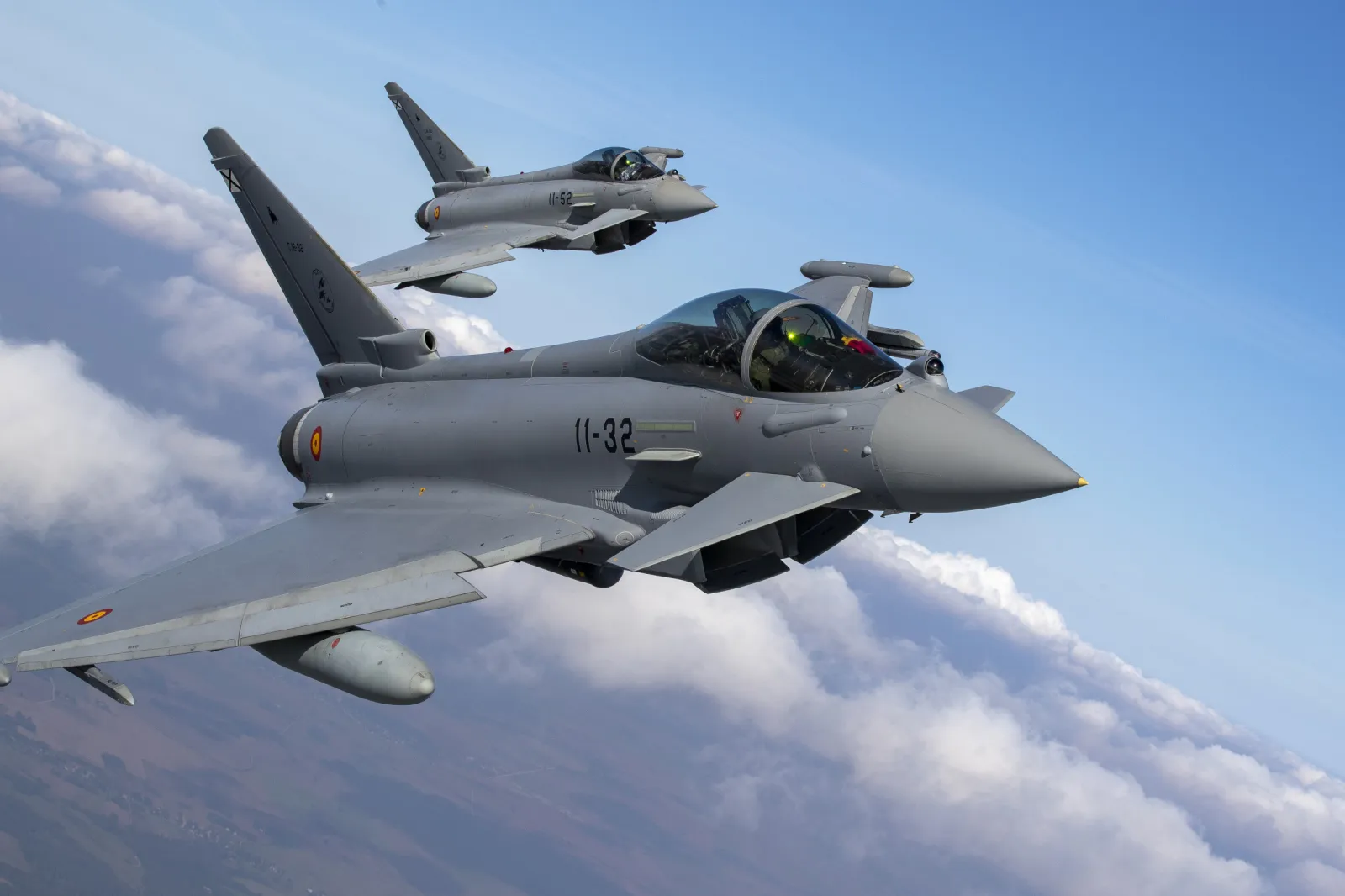
It arrived in the early hours: a low-altitude drone crossing into Romanian airspace, moving through the sky near Galați. Radar locked on, authorization was given, and a NATO fighter jet — a Spanish F-18 on an air-policing mission — brought it down. Moments later, NATO’s spokesperson offered a brief, deliberately cautious confirmation: the aircraft “appears to be Russian.”
On paper, this plays out as a procedural victory for modern air defense. Radar detected the threat, allied forces scrambled, rules of engagement were followed, and the drone was destroyed over an uninhabited stretch of countryside between two villages. But strip away the military jargon, and a starker reality emerges. A NATO fighter jet, piloted by an officer from a member nation, opened fire on a suspected Russian military asset over sovereign alliance territory. It was the fourth such shootdown over Romania this year alone.
This incident marks a critical shift in how NATO manages the war raging along its borders. The quiet strategy of containment and passive tracking is giving way to direct kinetic engagement. What was once dismissed as stray navigation errors or electronic warfare spillover has escalated into routine military action. The intercept over Romania is not an isolated event. It signals a fundamental change in the geometry of European security.
Passive Monitoring to Active Engagement
For years, the alliance’s response to border breaches remained intentionally cautious. When Russian drones or stray ordnance drifted across the Ukrainian border into Romania or Poland, official statements leaned toward understated management: the situation is being monitored, debris is being analyzed, there is no indication of a deliberate attack. That restraint was driven by a core fear — that a single miscalculation could trigger Article 5 and draw the 32-nation alliance into direct confrontation with a nuclear-armed state.
That posture has visibly evolved. Romania’s shift became formal in July, when its air force shot down three Russian drones for the first time in more than four years of war, after the country’s defense chief had spent the preceding year publicly pushing for the legal authority to do exactly that. Sunday’s intercept near Galați — the fourth of the year — shows that this is no longer an exceptional response reserved for extraordinary circumstances. It is becoming standard operating procedure. NATO is no longer waiting for foreign hardware to crash into fields, farmland, or residential buildings before responding. Earlier this year, a Russian drone struck an apartment block in Galați itself, injuring two people. The threshold for kinetic force has shifted from after impact to at entry.
This active-defense posture brings clear tactical benefits. It protects civilians on the ground and reinforces the sovereign boundaries of Eastern European states that have spent four years absorbing the debris, literal and political, of a war fought next door. But it also narrows the room for error. When live weapons are authorized against targets over allied soil, in the dark, at low altitude, the line between defensive enforcement and direct confrontation grows thinner with every intercept.
Reality of “Gray Zone” Friction
The strategic challenge lies in the nature of modern drone warfare. Unmanned aerial vehicles are cheap, expendable, and easily disavowed. They let an adversary continuously test enemy defenses, gather intelligence, and probe response times at minimal cost and even less political exposure. For NATO, this dynamic creates a genuinely asymmetric dilemma.
There is, first, an economic friction: launching missiles from advanced fighter jets to destroy mass-produced drones is not a sustainable trade over the long run, however necessary it is in the moment. There is a geographic friction: Romanian villages sit directly across the Danube from Ukrainian port infrastructure that Russia routinely targets with Shahed-type drones, and at low altitudes and high speeds, the operational window to distinguish a lost drone from a deliberate probe is measured in seconds, not minutes. And there is an attribution friction, visible in the language NATO itself chooses. A spokesperson’s statement that the drone “appears to be Russian” — rather than a flat assertion of fact — is not evasiveness. It is a deliberate diplomatic posture, one that allows the alliance to act decisively at the tactical level while preserving flexibility to manage escalation at the strategic one. Romania’s own defense ministry, notably, still has not confirmed the drone’s origin even as its military destroyed it.
Whether by design or by the simple physics of drift and jamming, this friction serves Moscow’s interests. Every incursion — attributable or not — forces NATO to reveal something: radar coverage, command-and-control timing, engagement protocols, and how quickly member states will authorize force. Each intercept is also, inescapably, a small experiment in alliance resolve, repeated often enough that it stops being newsworthy and starts being background noise — which may be exactly the point.
This pattern of engagement marks something close to a point of no return for NATO’s border strategy. The debate over whether to intercept airborne threats over allied territory has, in practice, already been settled — not in a communiqué, but in the accumulating record of drones destroyed over Romanian soil. What remains open are the harder, second-order questions.
Will NATO extend its defense perimeter to neutralize incoming threats before they breach sovereign borders at all, rather than reacting once radar picks them up 24 kilometers inside the country? How will command centers standardize rules of engagement across very different border sectors — the dense air traffic near the Baltics, the maritime approaches of the Black Sea, the river border Romania shares with both Ukraine and Moldova? And perhaps most urgently: how does the alliance ensure that a string of tactical successes, each one individually justified and even routine, does not eventually compound into a strategic miscalculation nobody intended?
The shootdown over Galați demonstrates that NATO’s air-policing apparatus can detect and eliminate low-altitude threats safely and repeatedly. Romania’s defense minister was quick to frame it that way, thanking the Spanish pilots and Romanian ground crews and describing the episode as proof of allied solidarity and rapid response. That framing is not wrong. But it is incomplete. The same episode also confirms that the spillover from the war in Ukraine is no longer a hypothetical risk to be war-gamed in briefing rooms — it is an active, recurring feature of life along Europe’s eastern border, one that has now happened four times this year in Romania alone, and continues to happen in Poland and the Baltics as well.
Deterrence along the Eastern Flank is no longer maintained solely through sanctions packages or forward troop deployments announced at summits. Increasingly, it is measured in real time, in radar locks and weapons releases over sleeping villages, in the seconds a pilot has to decide whether an object crossing a border at dawn is a stray fragment of someone else’s war or something aimed more deliberately. The sky over Eastern Europe is no longer a passive buffer zone. It has become an active line of defense — and every crossing of it, however routine it now appears, is a test the alliance cannot afford to treat as simply procedural.