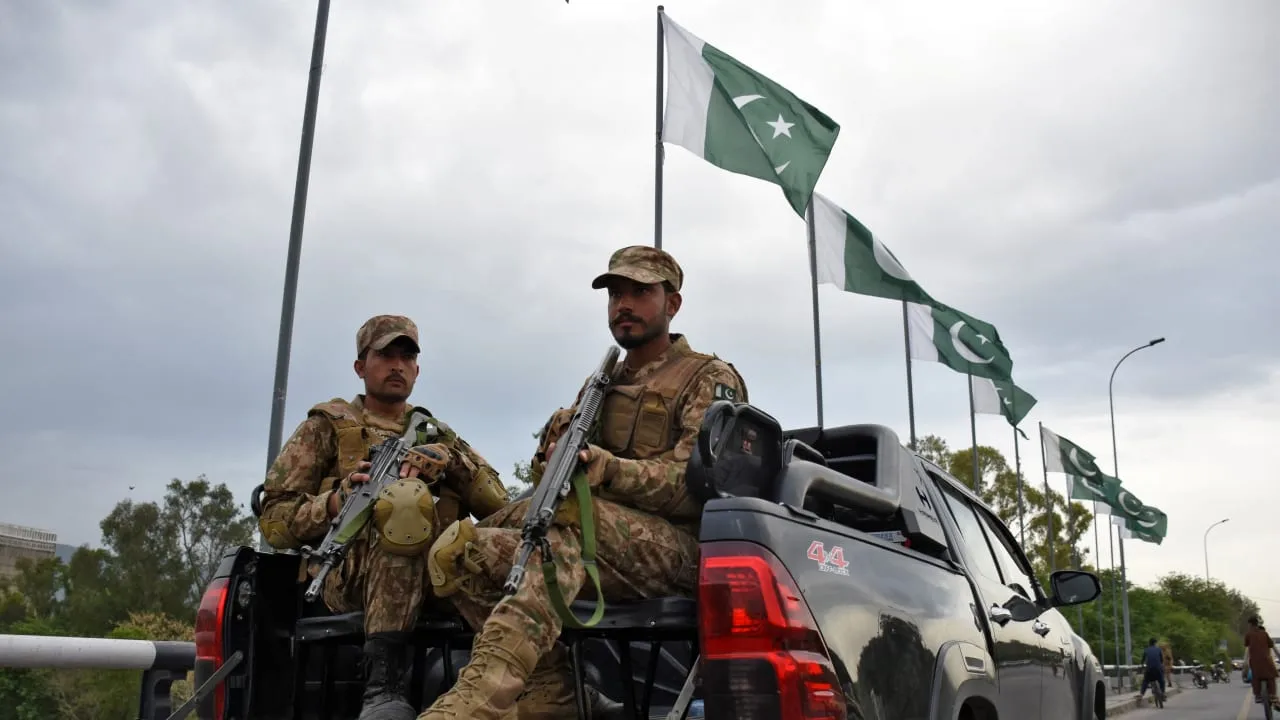
Pakistan has moved from a paper commitment to a visible military presence in Saudi Arabia, and the timing could not be more awkward. On October 5th, the defence and foreign ministers of Saudi Arabia, Pakistan and Türkiye, met in Riyadh as the Strategic Political and Defence Committee of the Makkah Alliance, and agreed to activate collective-deterrence measures and to “provide the agreed military forces and capabilities and ensure their rapid deployment” inside the Kingdom. Two days later, Pakistan’s military spokesman, Lieutenant General Ahmed Sharif Chaudhry, told CNN that Pakistani forces were already there, “discharging duties in multiple capabilities and domains.” Defence Minister Khawaja Asif, speaking from Riyadh, drew a narrower line: Turkish and Pakistani personnel were involved in reconnaissance and support; “the army fighting is that of Saudi Arabia.”
The caveat does not make the commitment sustainable. Pakistan’s external accounts are held together by an IMF programme, rolled-over Gulf deposits and remittances from the same Gulf that is now a war zone. The deployment deepens both problems at once. It consumes equipment and formations the eastern front and two domestic insurgencies already claim, and it pulls a mediator into the shooting war it has been trying to keep at arm’s length.
A treaty written on someone else’s balance sheet
The bilateral text came first. On 17 September 2025 Sharif and Mohammed bin Salman signed the Strategic Mutual Defence Agreement in Riyadh: any aggression against either state “shall be considered an aggression against both.” The full text was not published. A Saudi official told Reuters it “encompasses all military means.” On 7 August 2026 Türkiye joined, and the three leaders signed the Makkah Joint Defence Agreement in the holy city, with the same attack-on-one logic. The 5 October meeting was the first time that clause was switched on. Retired Pakistani Lieutenant General Nauman Mahmood was named the alliance’s first secretary-general.
What sits underneath the signatures is an older, transactional arrangement. Pakistani units have rotated through the Kingdom since the late 1970s; a 1985 CIA assessment counted 13,000 to 14,000, including an armoured brigade at Tabuk. In April 2015, when Riyadh asked for jets, ships and troops against the Houthis, parliament refused. The joint resolution demanded neutrality in Yemen so Pakistan could mediate, and limited the pledge to Saudi territory and the holy sites. The 2026 formula is that resolution with a treaty attached and equipment already on the ground.
The scale of the new layer is still partly opaque. Reuters reported on 18 May 2026, citing Pakistani security and government sources, that Islamabad had sent about 8,000 troops, a squadron of roughly 16 aircraft, mostly JF-17s, two drone squadrons and a Chinese HQ-9 air-defence battery, with Riyadh financing the package and Pakistani crews operating it. Those sources said the confidential text contemplated up to 80,000 troops. Islamabad has not confirmed the figures. It has confirmed the presence, including jets at King Abdulaziz Air Base from April. Saudi money can pay stipends and operating costs. It cannot replace a squadron or an air-defence battery on the Indian border, or manufacture the political room to use them in Yemen.
The domestic ledger does not support a second theatre
The budget that would have to carry any widening of this role is already spoken for.
For FY2026–27 the federal government allocated Rs 3 trillion to defence services, about $10.8 billion, an 18 percent rise on the original Rs 2.55 trillion and roughly 2.1 percent of projected GDP. That is about 16 percent of a federal outlay of Rs 18.8 trillion. Military pensions sit outside that line, budgeted separately at Rs 822 billion. Markup on debt, at about Rs 8 trillion, is more than two and a half times the defence allocation.
FY2026-27 federal budget
Interest already outspends the army
Debt service is Rs 8.05 trillion. Defence services are Rs 3 trillion — and that line excludes Rs 822 billion in military pensions.
Source: budget speech and Dawn, June 2026. Defence is about 16% of the Rs 18.77 trillion federal outlay; interest is about 43%. Bars scale to interest.
Finance Minister Muhammad Aurangzeb presented the increase as a response to the 2025 fighting with India, the Afghan border and militant violence at home, not as spare capacity for the Gulf.
Debt is the binding constraint. Public debt reached Rs 86.7 trillion at end-June 2026, up 76 percent from Rs 49.3 trillion in June 2022.
Public debt stock
Public debt, June 2022 to June 2026
From Rs 49.3 trillion to Rs 86.7 trillion, a 76 percent rise in four years.
Sources: Ministry of Finance Annual Borrowing Plan (Rs 49.3 trillion at June 2022; Rs 86.7 trillion at June 2026) and the State Bank debt summary (gross public debt Rs 80.5 trillion at June 2025, Rs 86.7 trillion at June 2026).
Gross financing needs for the current year are Rs 28.65 trillion, about a fifth of GDP, against tax collection that covers only a fraction of that rollover. External debt is about $98 billion. The IMF’s own projections, as domestic analysts have noted, still imply an external financing gap above $20 billion a year through 2030.
The programme that keeps this structure from seizing is the twenty-fifth-odd IMF arrangement in Pakistan’s history. On 7–8 October staff and the authorities reached agreement on the fourth review of the Extended Fund Facility and the third of the Resilience and Sustainability Facility, unlocking about $1.21 billion if the Board agrees and taking disbursements under the two facilities to roughly $5.7 billion. Growth in FY26 is estimated around 3.6 to 3.7 percent. Inflation, after the energy shock, was still about 10.3 percent in September. Reserves of roughly $21.5 billion at end-September are an improvement on the 2023 trough and still only a few months of imports. The Fund’s price for this is a primary surplus of 2 percent of GDP and continued restraint on development spending. A state on that leash does not have an unallocated war budget.
Gulf cash is what makes the restraint look manageable, and it is the same Gulf now under fire. Pakistan holds about $8 billion in Saudi deposits at the central bank. In July the State Bank said Riyadh had rolled $5 billion of that to December 2028, which cut the year’s external financing need to $21.5 billion — still $21.5 billion, of which cash deposits and commercial loans are a large share. A further $3 billion deposit was extended in the spring. This is relief, not independence. A deployment financed in Riyadh and a balance of payments financed in Riyadh are the same relationship counted twice. If the Kingdom decides the treaty requires more than reconnaissance, Islamabad’s leverage to refuse is the leverage of a borrower.
Energy turns the same dependency into a feedback loop. Pakistan imports more than 80 percent of its oil, principally from Saudi Arabia, the UAE and Kuwait, and more than 90 percent of its contracted LNG from Qatar. The Strait of Hormuz, choked after the Gulf conflict began on 28 February 2026, carries about 27 percent of global oil and 20 percent of LNG. The World Bank recorded gasoline and diesel price rises of 40 percent or more in Pakistan after the conflict started. A senior finance official told Arab News that the weekly oil import bill jumped from about $300 million to nearly $800 million by the last week of April, a 167 percent surge, and warned that a prolonged crisis would simultaneously weaken Gulf remittances and swell the import bill. Remittances, above $33 billion in the first ten months of FY26 and running near $40 billion a year, are the single largest external inflow, and the Gulf is where most of them originate. LNG arrivals in March fell 68 percent month on month when Ras Laffan was disrupted. Rolling blackouts and a fertiliser squeeze followed.
Workers’ remittances, FY2025-26
The Gulf pays the external account
A longer war in the Kingdom is a direct hit on Pakistan’s largest source of foreign currency.
USD billion. Total USD 41.6 billion. Source: State Bank of Pakistan via Gulf News country tables. EU is the reported aggregate; Other is the residual. Red bars are Gulf corridors. Scale is Saudi Arabia = 100.
A country in that position is unusually exposed to the war it is now reinforcing. Every additional month of Houthi strikes on Saudi energy sites, and every additional month of tension around Hormuz, raises the import bill and threatens the remittance stream that services the debt. Using scarce air-defence assets to help defend the Kingdom does not insure Pakistan against that shock. It identifies Pakistan with one side of the conflict producing it.
Escalation is the point at which the line fails
The military case against sustainability is the same fact as the diplomatic one. Pakistan does not have a quiet home front from which to spare a corps.
ACLED recorded more than 540 armed clashes between Baloch separatists and the security forces in the first eight months of 2026, against 299 in the same period of 2025, with explosive attacks up as well.
Already on the books
Two loads already on the books
The oil bill moved before any wider combat role. So did the fighting in Balochistan.
Oil import bill
USD 300m
Before conflict, weekly
+167%
USD 800m
Late April 2026, weekly
Balochistan: militants vs security forces
299
Jan–Aug 2025
+81%
540
Jan–Aug 2026
Sources: finance ministry briefing reported by Arab News, July 2026 (weekly oil bill from about USD 300 million to nearly USD 800 million). ACLED, October 2026 (540 armed clashes in the first eight months of 2026, against 299 a year earlier). Panel scales are separate.
The Balochistan Liberation Army’s late-January “Herof” offensive hit camps and administrative sites; the roads from Quetta to Karachi and to the Iranian border have been repeatedly cut. In Khyber Pakhtunkhwa and the Pashtun north of Balochistan the Tehreek-e-Taliban Pakistan has returned as a primary threat. A September attack on a mosque in Kohat killed at least 31 people and was followed by Pakistani strikes into Afghanistan and Afghan drone fire back across the border. Khyber Pakhtunkhwa and Balochistan account for the large majority of terrorism casualties. The 2025 confrontation with India is why the defence budget rose 18 percent. Formations and air-defence batteries are sized for that border. A tailored, rotational package can be hidden inside the order of battle. An open-ended Gulf commitment cannot.
The diplomatic cost is already visible. Pakistan has claimed to be a principal channel between Washington and Tehran since the US–Israeli campaign began in late February, and the Islamabad memorandum was meant to be a route out of that war. Field Marshal Asim Munir has been in contact with the Iranian foreign minister even as the Makkah committee was activating. The Houthis are Iran-aligned; Tehran says they decide for themselves. Riyadh reports strikes on Jazan, Najran, energy sites and, by its account, a drone intercepted near Mecca, which the Houthis deny and which Sharif called a red line at the UN. Saudi-backed Yemeni forces are pushing on the Red Sea coast toward Bab al-Mandeb.
Asif’s “support, not combat” line is an attempt to stay on the 2015 ledge. The ledge is narrower than it was. In 2015 there was no Article 5 clause, no secretary-general, and no Pakistani-operated HQ-9 battery on Saudi soil. A single engagement — a battery firing on a Houthi missile, a JF-17 drawn into an incident on a defensive patrol — collapses the distinction between territorial defence and participation in the Yemen war. Iranian analysts have already described that reading: Islamabad joining a campaign against Tehran’s regional partner. Pakistan shares a long border with Iran. It also has a sectarian balance that the 2015 parliament explicitly cited when it refused to enter Yemen, warning that a non-sectarian war could become one “with critical fallout” inside Pakistan.
The escalation does not have to be deliberate to be real. Collective-defence clauses exist to remove ambiguity. Ambiguity is what Pakistan’s mediation, its Iranian border and its domestic politics require. By standing up the machinery — a secretariat, a rapid-deployment promise, forces already in theatre — Islamabad has made it harder to repeat the 2015 refusal if Riyadh decides the next barrage is the attack the treaty was written for. That is how a support role becomes a combat role without a fresh political decision. It is also how a mediator becomes a party, and how a war Pakistan needs to end, because its oil, its LNG and its remittances run through it, becomes a war Pakistan is structurally less able to settle.
The unsustainable bargain
Makkah pact, October 2026
Saudi money does not insure the war
A paid contingent still ties Pakistan to the conflict that raises its oil bill and threatens its remittances.
October activation: agreed capabilities, including reported JF-17s and an HQ-9 battery, on Saudi soil.
Support and reconnaissance sit on a treaty that treats an attack on one as an attack on all.
Energy sites, Hormuz risk, and the Gulf jobs that send home 53% of remittances.
Weekly oil imports jumped from about USD 300m to nearly USD 800m after the conflict began. Reserves stay IMF-thin.
Riyadh also holds about USD 8bn in State Bank deposits. The paymaster and the financier are the same capital.
The contingent can be invoiced to Saudi Arabia. The oil bill and the remittance stream cannot.
Schematic, not a forecast. Deployment size remains a May 2026 Reuters source count; Islamabad has confirmed presence, not the headcount. Oil-bill swing: finance ministry briefing, Arab News, July 2026.
Saudi financing of a limited deployment is not evidence that Pakistan can afford the pact. It is evidence that Pakistan cannot afford it alone. The Kingdom underwrites both the troops and a decisive share of the external financing; the IMF underwrites the fiscal rules that leave no room for an unplanned war; the eastern border, the Afghan frontier and two insurgencies underwrite the claim on every squadron and air-defence battery not already spoken for. Widening the Middle East conflict raises the oil bill, threatens the remittance inflow and complicates the Iranian mediation on which any regional de-escalation partly rests. Those are the same channels that keep the external account open.
Pakistan can rotate a paid contingent and call it territorial defence, as it has in various forms for forty years. It cannot, on this balance sheet and this security map, sustain a treaty obligation that treats the next Houthi strike as an attack on Pakistan itself. The October activation asks it to pretend otherwise. The domestic numbers, and the structure of the war, say the pretence will not hold.