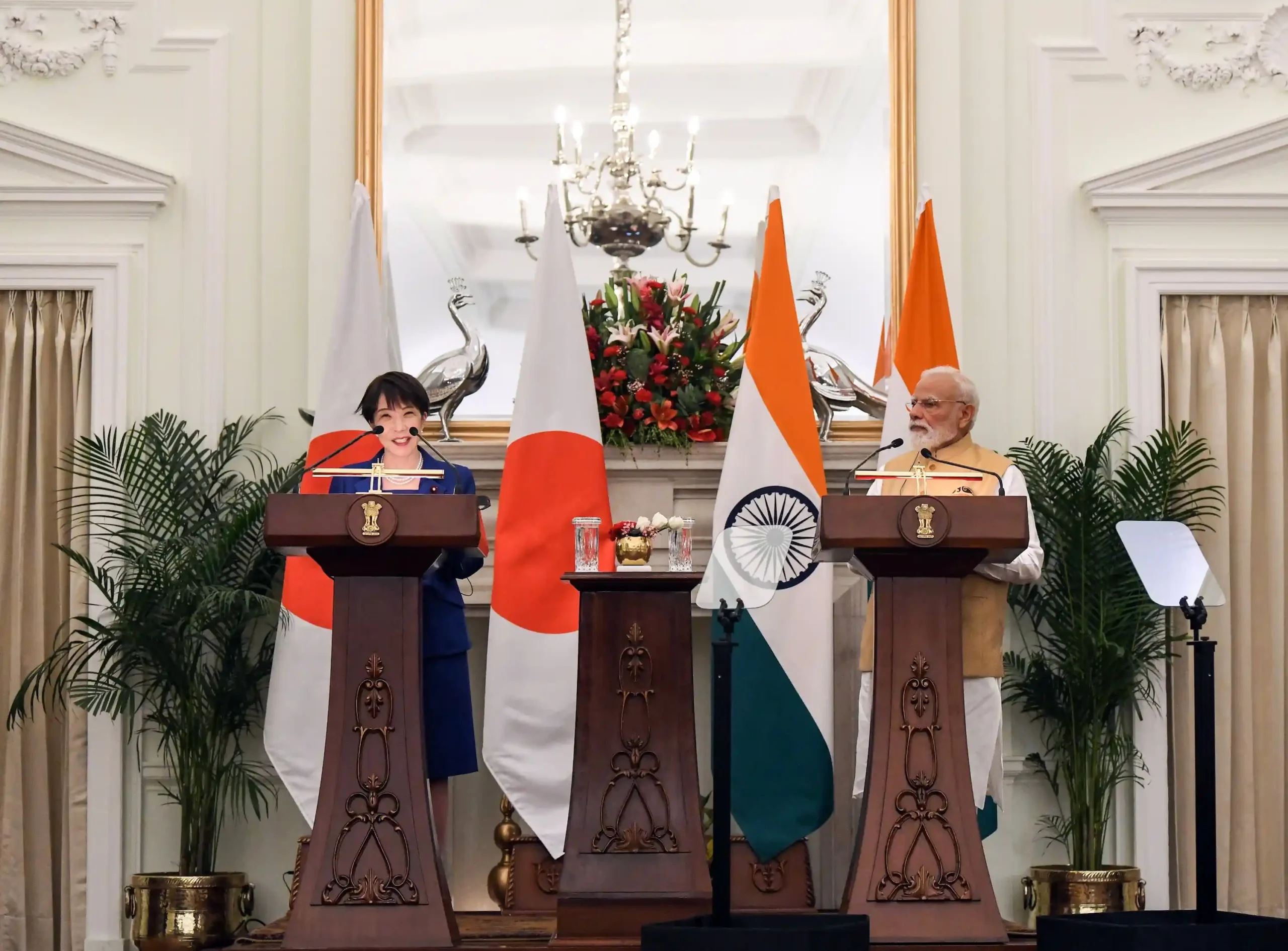
There is a particular kind of diplomatic language that gets deployed when two countries want to signal that a relationship has moved from courtesy to consequence. This week in New Delhi, Japanese Prime Minister Sanae Takaichi and her Indian counterpart Narendra Modi supplied it in abundance — right down to Mr Modi calling Ms Takaichi his “younger sister” and declaring that mutual trust is now the region’s greatest strategic asset. Beneath the warmth of the language lies a genuinely substantive shift, and the wider Asia-Pacific would do well to take note of it.
Strip away the ceremony and what emerges from the 16th India-Japan annual summit is a dense package of commitments: a first-ever co-developed defence system for naval communications, a joint roadmap on semiconductors and critical minerals, an artificial intelligence partnership pairing Japanese precision engineering with Indian software talent, and a biogas initiative that would seed a thousand plants across rural India. Layered on top is roughly $10 billion in fresh Japanese investment commitments and a reaffirmed, if still-delayed, high-speed rail project linking Mumbai and Ahmedabad. This is not a photo opportunity. It is the scaffolding of a long-term partnership between two of Asia’s most capable democracies.
That partnership deserves to be read plainly for what it is: two nations sitting on either side of a rising and increasingly assertive China have decided that the way to build a stable, prosperous order is to knit their economies and militaries more closely together, without ever framing it as confrontation aimed at anyone. The joint statement’s language on the East and South China Seas, on North Korea, and on a “free, prosperous and rules-based Indo-Pacific” reflects two capitals that have each felt the sharp edges of great-power friction and decided the answer is deeper mutual investment, not retreat into narrower nationalism.
This is precisely the kind of development the region needs more of, not less. For years, the Indo-Pacific narrative has been dominated by talk of rivalry, decoupling and hardening blocs. The India-Japan summit offers a different template: two large, democratic economies choosing integration over insulation, and doing so across an unusually wide front — defence, technology, energy, health and infrastructure all at once, rather than any single domain carrying the weight of the relationship.
Consider what is actually on the table. The joint roadmap on semiconductors, quantum technology and advanced materials, backed by concrete deals such as Sumitomo Chemical’s collaboration with Tata Electronics on semiconductor materials, signals that India is consolidating its position as a serious node in the global effort to diversify manufacturing and supply chains away from overconcentration in any one country. That diversification benefits every economy in Asia that depends on resilient, redundant supply lines — which by now is nearly all of them.
Energy security tells a similar story. India’s push into biogas and organic fertiliser production, explicitly framed by regional analysts as a response to the shock of the Strait of Hormuz closure, is a reminder that energy vulnerability is not an abstract risk confined to a handful of importing nations. It is a shared exposure across the region, and any credible experiment in reducing it — even one built on unglamorous inputs like cattle manure and rice straw — is worth watching closely.
Perhaps the most consequential dimension, though, is maritime security. Japan’s commitment to expand naval exercises with India in the Indian Ocean, alongside deeper equipment cooperation under the Make-in-India banner, extends a serious security partnership into waters through which an enormous share of the world’s trade must pass. A more capable, more engaged Japan-India security axis in the Indian Ocean is unambiguously good news for every trading economy in Asia, all of which depend on open sea lanes and a predictable rules-based order rather than contested, ambiguous ones.
What makes this summit worth the world’s attention is not any single deal but the model it represents. At a moment when great-power friction feels like a permanent condition rather than a passing phase, Tokyo and New Delhi have chosen to answer uncertainty with deeper interdependence — investing in each other’s industries, defence capabilities and energy futures rather than retreating into self-sufficiency or waiting for others to guarantee their security. Mr Modi’s insistence that mutual trust is Asia’s greatest strategic asset is not merely a diplomatic flourish. It is, if this partnership continues to deliver at the pace suggested this week, an accurate description of how stability in the Indo-Pacific will actually be built: not through any single power’s dominance, but through precisely this kind of patient, wide-ranging cooperation between capable, like-minded states. The rest of the region — and the wider world — should be watching closely.