
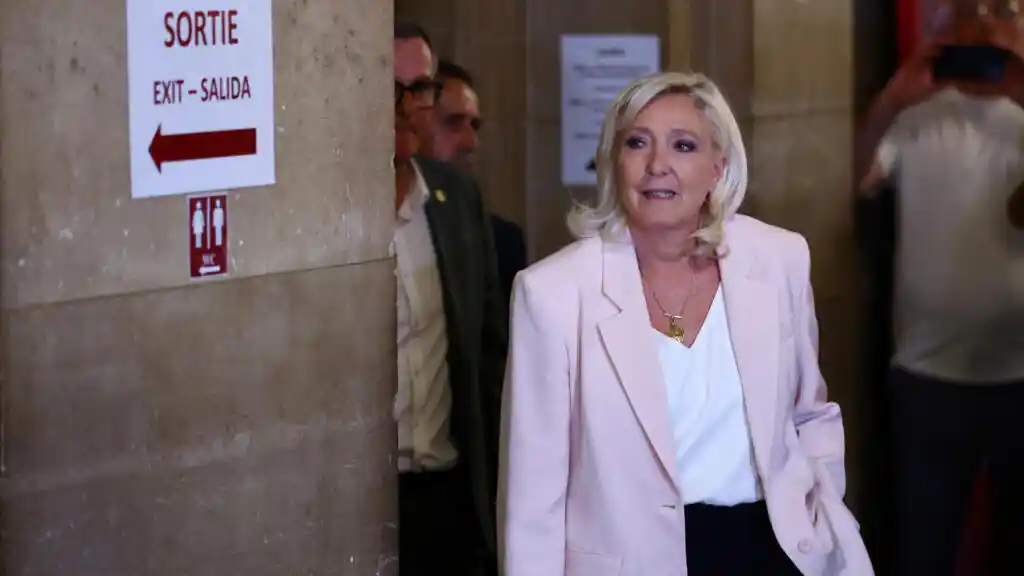
When the Paris Court of Appeal handed down its ruling against Marine Le Pen on July 7, 2026, it was easy to read the sentence as the end of a political story: three years in prison, one of them to be served outside a cell but under electronic surveillance, a fine of 100,000 euros, and a ban on standing for office—45 months, with 30 suspended. On paper, it looks like a decisive blow against the leader of France’s Rassemblement National. In practice, it may turn out to be one of the more consequential gifts French justice has ever handed a politician it convicted.
That is the paradox sitting at the center of the Le Pen verdict, and it is worth taking seriously, because the 2027 presidential race—already shaping up as one of the most fractured and high-stakes in France’s Fifth Republic—will be defined by how this paradox plays out.
A Court Trying Not to Decide the Election
Start with what the judges actually did. They convicted Le Pen and her party of misusing European Parliament funds meant for parliamentary assistants—a real offense, but a specific and somewhat bloodless one. Nobody accused her of stuffing money into her own pocket, the way Nicolas Sarkozy’s former ally François Fillon was accused of doing with his wife’s fictitious parliamentary job. This was institutional fraud, not personal enrichment, and voters have historically drawn a sharp line between the two kinds of corruption.
More telling than the sentence itself is the language the court used to justify the reduced disqualification: it invoked the voter’s freedom of choice as a foundational condition of democratic elections. That is not a court declaring that elections outrank the law. It is a court trying, carefully, to keep two separate systems separate—the legal system, which has become increasingly rigorous about policing the financial conduct of politicians through bodies like the High Authority for Transparency in Public Life, and the political system, which judges character, trust, and fitness to lead through an entirely different, more ancient logic. The Romans called that second quality auctoritas: the moral authority to set an example. It cannot be conferred by a judge. It can only be granted, or withheld, by the public.
By writing the ruling this way, the appeals court effectively said: we will punish the offense, but we will not make the ultimate judgment for the country. That judgment belongs to voters. It is a strikingly modest position for an institution to take, especially one currently under fire for its own credibility problems—including its handling of the unrelated but politically damaging Lyhanna case, which has left the judiciary exposed to accusations of selective rigor. A court that already looks vulnerable has every incentive to avoid the appearance of engineering an election outcome.
The Clock Is the Real Verdict
Le Pen wasted no hours announcing that she will appeal to France’s highest court, the Court of Cassation, and that this appeal will suspend the sentence—meaning no ankle monitor, no disqualification, at least for now. The substance of that appeal matters far less than its timing.
If the Court of Cassation rules early, it could still reshape the race. If it rules late—and there is every reason to think it will, given the complexity of the case and the institutional caution already on display—the practical effect is that Le Pen simply runs. A ruling that arrives after campaigning is well underway does little more than arrive too late to matter procedurally, even if it matters symbolically. And if a final ruling doesn’t land before the second round on May 2, 2027, the calculation shifts entirely: win, and presidential immunity settles the question outright; lose, and the ruling becomes largely academic.
In other words, the legal process is not really running in parallel with the political campaign. It is running behind it, and it may never catch up.
Conviction as Campaign Asset
Here is the part that should unsettle anyone who assumes convictions are simply liabilities: Le Pen has genuine room to turn this into a strength. Because the fraud was institutional rather than personal, and because the current moment is saturated with corruption cases against French officials at every level of government—especially in local government—this conviction lands with less shock value than it might have a generation ago. Scandal has been normalized by sheer repetition.
That leaves an opening for narrative. An ankle monitor, worn on the campaign trail, could easily have become a liability. It could just as easily have become an image: the persecuted outsider, restrained by the state yet still moving, still speaking, still fighting on behalf of ordinary people who feel similarly hemmed in by institutions they no longer trust. Whether or not Le Pen ultimately serves any part of her sentence during the campaign, she has already signaled she understands the emotional register available to her—casting herself not as a woman avoiding accountability but as someone enduring a trial in order to fulfill an obligation to her voters. That is not spin invented after the fact. It is a deliberate positioning, and it reflects a level of political instinct that her rivals, privately, respect and fear in equal measure.
The Bardella Problem
For more than a year, RN insiders and outside observers alike wondered whether Jordan Bardella, the party’s telegenic 30-something president, would end up as its 2027 standard-bearer instead of Le Pen. That question now looks largely settled, and not just because Le Pen remains eligible to run. It’s settled because Bardella’s path to the presidency was always more plausible as an heir apparent than as a frontrunner. He has never been prime minister, never run a major city, never had to prove himself against the daily friction of governing. Those are not disqualifying weaknesses in a deputy. They are real ones in a would-be head of state, especially in a field that increasingly includes candidates with exactly that kind of institutional weight.
The Real Fight Isn’t Where Everyone Is Looking
That brings us to the shape of the race itself, which the Le Pen verdict has, if anything, clarified rather than muddied. Three broad political visions are competing for the same disoriented electorate. There is the RN’s nationalist, identity-focused vision, built around sovereignty and memory. There is La France Insoumise’s alternative on the left, organized around diversity, participatory democracy, and expanded social protections. And now there is a third force taking shape: a post-Macronist current championed by Édouard Philippe, oriented toward managing France’s place in a globalized economy from a distinctly right-of-center, technocratic position.
It is this third figure, not Bardella, who may pose the sharpest challenge to Le Pen. Philippe and Bardella occupy oddly similar terrain—both offering a kind of authoritarian-liberal governance, both skeptical of unchecked institutional drift—but Philippe brings the experience of having actually run a government and a major city, an asset Bardella simply doesn’t have yet. Le Pen, meanwhile, has spent years insisting she is neither of the left nor the right, but of “the grassroots”—a populist inversion of the very centrism Macron built his career on. That positioning gives her something neither Philippe nor Bardella can easily claim: a plausible pull on left-leaning voters and habitual abstainers who feel unrepresented by all three establishment currents.
What the Verdict Actually Decided
The Paris court did not decide who will be France’s next president. It could not, and on some level, it did not try to. What it did was hand down a punishment calibrated to avoid overriding the electorate, set in motion an appeals timeline that may run out the clock on its own relevance, and inadvertently supply Marine Le Pen with a narrative of persecution that she is fully equipped to use.
The 2027 election was already shaping up as a contest between fundamentally incompatible visions of France. The verdict hasn’t changed that. If anything, it has sharpened the terms—and reminded everyone watching that in French politics, a courtroom loss and a campaign advantage are not always mutually exclusive.