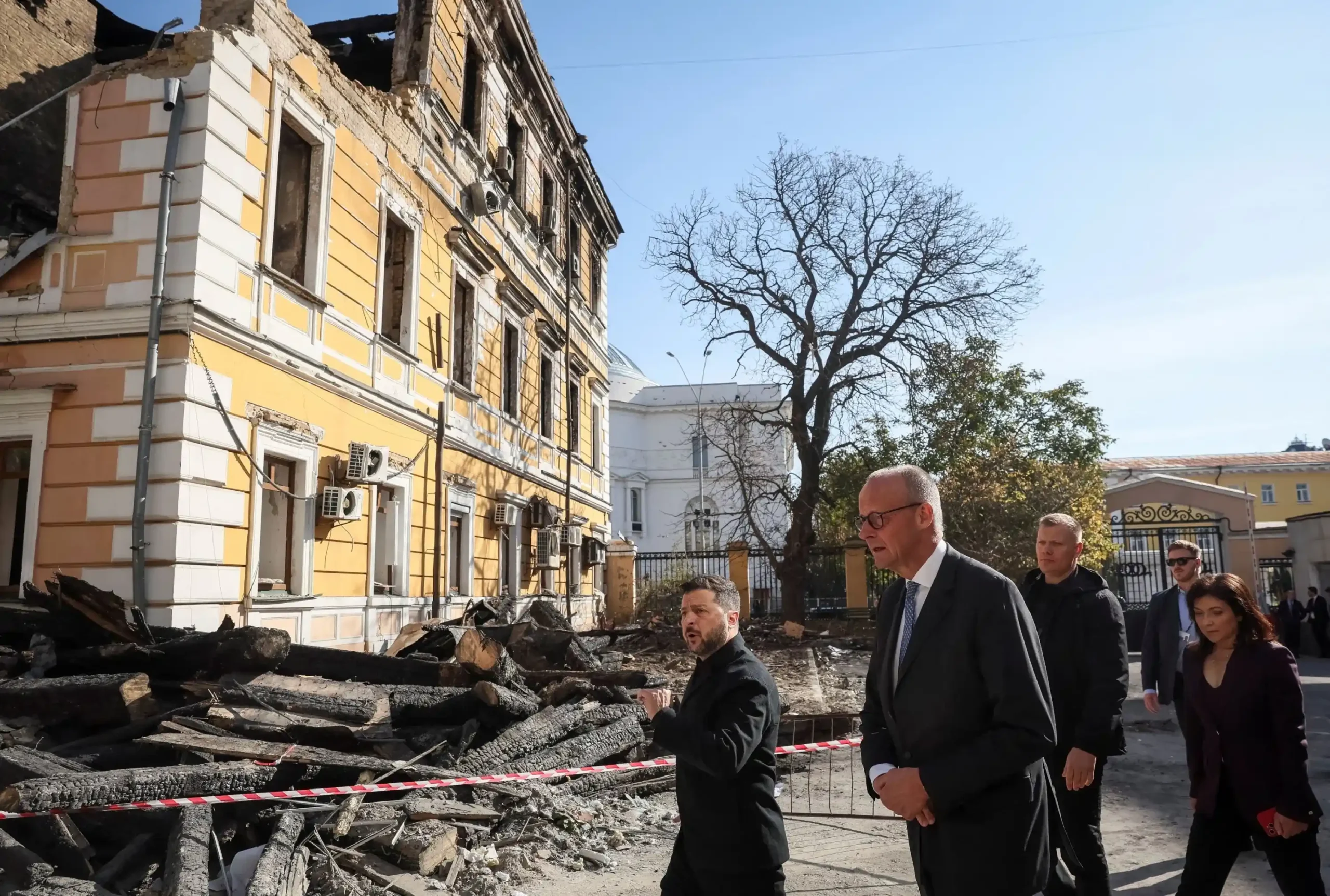
Friedrich Merz arrived in Kyiv by train on Sunday as Russian drones were hitting the bridges over the Dnipro. That sequence is the argument. Germany’s chancellor came to prove that Europe’s lead power will not be frightened off the war. Moscow answered, in real time, that the war’s next phase is not the front line. It is the heating season.
The visit was Merz’s first bilateral trip to the capital and his second as chancellor, after the May 2025 joint appearance with the French, British and Polish leaders. He brought Economy Minister Katherina Reiche and executives from the energy and defence firms that now underwrite Berlin’s Ukraine policy: Siemens Energy, Diehl Defence, Hensoldt, Quantum Systems. He left behind roughly €1 billion in military support — interceptor drones against Russia’s jet-powered Shaheds, long-range strike weapons, satellite data to hit launch sites — and €350 million for generators, substations and repair kits. German firms signed about fourteen agreements worth some €6.6 billion. Air-raid sirens ran through the day. A drone struck the Northern Bridge while he was in the city; the Southern Bridge had already been hit on Friday and Saturday. Three of Kyiv’s six road bridges were fully or partly closed. Merz stood in the wreckage of the National Academy of Sciences, hit on 28 September, and called the strikes daily war crimes.
The pledges are real. They are also the smaller half of what the visit exposed.
Winter as a campaign, not a season
Merz warned, before he left Germany, that the fifth winter of the war would likely be the hardest yet. Ukrainian officials have been saying the same thing for months, and they now claim to have the Russian staff work to prove it. Energy Minister Denys Shmyhal has shown European partners two planning documents, dated around August, that the New York Times also reviewed and could not independently authenticate. Taken at face value, they describe a three-stage strike package of up to a thousand missiles, drones and bombs: first the western substations that import European power, then hydroelectric plants, then the switchyards that tie Ukraine’s three operating nuclear stations to the grid — close enough to the reactors to force a shutdown without a direct hit on the cores. Kyiv, Kharkiv and Odesa are listed for cuts of up to 90 percent in electricity and heat, with sewage systems wrecked alongside. The stated aim is to erase about 15 gigawatts of capacity, roughly what Ukraine still had at the end of summer.
This is not a reprise of 2022. Russia has stockpiled ballistic missiles and fielded jet-powered drones that outrun much of the old air-defence layer. Ukraine has adapted too: 14.6 billion cubic metres of gas in storage by late August, a month ahead of the planning target, plus distributed generation and a thicker stock of spare equipment. Resilience is not the same as margin. A grid that can be repaired after each raid can still be driven below the threshold at which cities function, and a winter campaign aimed at nuclear switchyards carries a risk that no interceptor package can fully price.
The political target sits beside the technical one. Ukrainian officials read the plan as an attempt to break civilian endurance before early 2027 and to push another wave of people toward an EU already souring on refugees. Merz’s €350 million buys transformers and time. It does not buy a winter.
Germany is now the residual guarantor
That is why the visit matters beyond the cheque. Since Merz took office in May 2025, Germany has become Ukraine’s largest military donor, filling a hole the United States opened. Kiel Institute tracking shows American allocations collapsing in 2025 — by the institute’s count, from about €46 billion to under €0.5 billion — while EU states raised military support to roughly €28.5 billion, up 67 percent. Germany alone accounted for about €9 billion of that, ahead of Britain, Sweden and Norway. Overall monthly military aid to Ukraine has still fallen, to a little over €2 billion in 2026 from more than €2.5 billion in prior years, because Europe’s increase did not replace the American flow. Kyiv says it is short about €24 billion for weapons; Brussels has answered by accelerating a €45 billion loan, not by closing the gap.
Merz has been explicit about the interest at stake. “If Russia is not stopped, its war machine will sooner or later turn against us.” He is not speaking only about a future tank army on the Polish border. Germany already treats the Leipzig drone incident of August as a Russian operation, and intelligence sharing for Ukrainian long-range strikes was expanded in its wake. The same week Merz was in Kyiv, Washington was cutting the brigade combat teams allocated to Europe from five to three. The security Merz invoked is no longer underwritten by the arsenal that underwrote it in 2022.
The industrial deals are the serious part of the German answer. Joint production of interceptors, IRIS-T missiles, radars and energy equipment is how a coalition survives an American drawdown: not by writing larger cheques from a budget the Bundestag will eventually refuse, but by making Ukrainian survival a line in German order books. Merz called the partnership “not a one-way street.” That is also its limit. A contract can be slower than a missile salvo, and a firm can be lobbied by an opposition that wants the contracts cancelled.
The membership that was not on offer
The visit’s other shadow was the one Politico put in the headline: Ukraine’s European future. In a letter to EU leaders in May, Merz proposed an “associate membership” that does not exist in the treaties — a seat at European Council and Council meetings, a non-voting commissioner, non-voting MEPs, single-market access, and a political promise to extend Article 42(7) mutual assistance to Ukraine. Full accession, he argued, faces ratification hurdles that make it unrealistic on any timetable that could anchor a peace. He repeated the offer in Kyiv. He also said Germany wants the formal process accelerated, and he tied further EU money to rule-of-law and anti-corruption laws. Zelenskyy has rejected anything short of full and equal membership. Kyiv still talks about 2027.
Both positions are coherent, and they do not meet. For Merz, associate status is a way to give Zelenskyy something he can sell if a settlement leaves territory occupied and NATO closed: market, money, a security phrase, no veto over the EU budget. For Zelenskyy, anything short of membership converts a war aim into a waiting room, and a waiting room is what Moscow has wanted since the association agreement itself became the trigger for the conflict in 2014. The mutual-assistance promise is the most consequential line in the letter and the least bankable. A political commitment to treat Ukraine as if Article 42(7) applied, adopted while several member states are already hedging, is a communiqué, not a guarantee. It will be read in Moscow as proof that NATO membership is off the table and that the EU substitute is optional.
The consequence is a split screen Europe has not resolved. On the military screen, Germany is all in for the winter. On the constitutional screen, Germany is offering a status designed to make a negotiated outcome easier to swallow. Kyiv needs the first immediately. It cannot accept the second without advertising that the political prize of the war has been deferred. Merz left without agreement on the point. That is not a diplomatic miss. It is the policy.
The clock in Berlin
None of this is stable inside Germany. The AfD, which wants military aid ended and energy ties with Moscow restored, is the strongest party in national polls and has just won eastern state elections that humiliated the CDU. An ARD survey in early September found 52 percent of Germans still willing to arm Ukraine, but 42 percent saying aid has already gone too far — 54 percent in the east — the highest opposition in years. Merz’s own conservatives are debating whether he is the man to lead them into the next test. He answered the AfD in the Bundestag on 9 September by calling Ukraine the defence of German freedom, and he answered it again in Kyiv. A chancellor under pressure at home does not make that trip for the cameras alone. He makes it because the policy’s domestic half-life is shortening, and a winter of blackouts in Kharkiv will be argued in Saxony as a reason to stop, not a reason to continue.
Russia does not have to win the air war to use that clock. It has to keep the costs visible, the refugee numbers politically usable, and the European argument about membership loud enough that aid looks like an open-ended subscription. The strikes during the visit were the message: solidarity visits no longer buy a pause.
What follows
Three consequences follow from the day, and none of them is settled by the package Merz announced.
First, the winter of 2026–27 is now the decisive campaign of the war’s middle phase. If the intercepted plan is even partly real, Russia will try to cut the cities and isolate the nuclear backbone before any early-2027 negotiation. Germany’s interceptors and spare parts raise the price of that campaign. They do not end it. Air defence at scale, and the long-range strikes Merz green-lighted against launch infrastructure, are the only measures that change the arithmetic. A €24 billion hole against a €1 billion visit tells you the arithmetic has not changed yet.
Second, Europe has slid into a two-track Ukraine policy without admitting it. Track one is material support led by Berlin, industrialised, framed as self-defence, and increasingly detached from Washington. Track two is a political horizon capped at association, observer rights and a conditional promise. Track one can keep Ukraine in the war. Track two, if it hardens, tells Ukrainian society that the war’s political end-state is a permanent associate buffer. That is a recruitment argument for every actor, in Kyiv and elsewhere, who says only maximal aims are worth the winter.
Third, Germany’s capacity to fund track one now depends on a chancellor who is personally identified with it, facing an opposition that has made opposition to it the centre of its foreign policy, in a country where nearly half the public already thinks the line has been crossed. The business delegation is an attempt to outrun that politics. It will work only if the contracts produce interceptors faster than the AfD produces votes, and only if the lights in Kyiv, Kharkiv and Odesa stay on long enough that the policy still looks like strategy rather than subsidy.
Merz told Putin, in the ruins of the academy, to stop a senseless war and come to talks. Foreign Minister Johann Wadephul had just sat with Sergei Lavrov in New York; a US invitation for Putin to the G20 in Miami in December is being treated in Berlin as a possible opening. Talks are not the constraint. The constraint is that Russia has scheduled the winter, Germany has scheduled the cheques, and nobody in Kyiv on Sunday could schedule the political settlement both men claim to want. Until those three calendars meet, the hardest winter is not a forecast. It is the plan.