Donald Trump’s declaration that he would “love to see” a united Ireland may have lasted only a few moments, but the political question it touches is more than a century old.
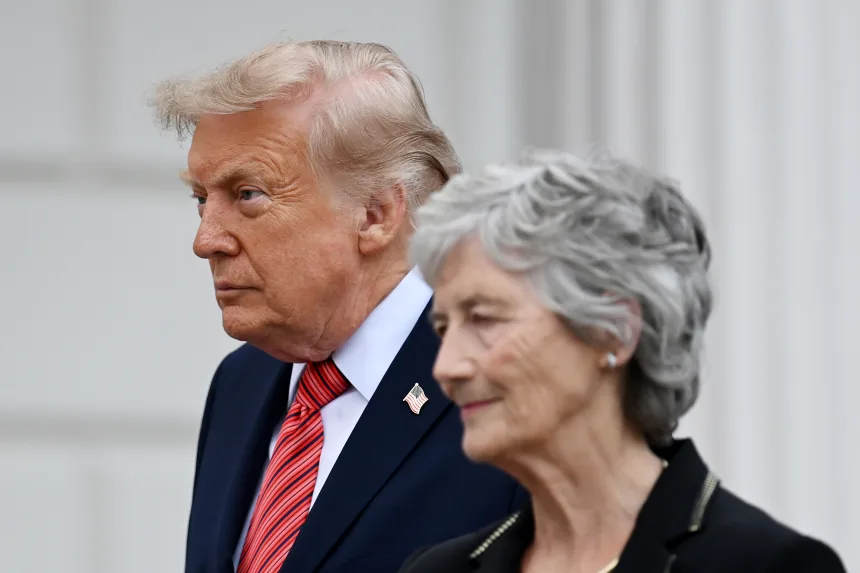
Standing alongside Irish Taoiseach Micheál Martin, the US president went considerably further than American presidents traditionally have on one of Europe’s most sensitive constitutional questions. Irish reunification, Trump said, would be “a fantastic thing”. More strikingly, he predicted that it would happen eventually — perhaps even sooner than expected.
It would be tempting to dismiss the remarks as another example of Trump speaking more freely than diplomatic convention normally permits. That would be a mistake.
American presidents cannot decide whether Ireland becomes united. Neither can Dublin, London or any political leader acting alone. Under the architecture established by the Good Friday Agreement, Northern Ireland’s constitutional future ultimately rests on democratic consent.
But presidents can change political conversations. And when the president in question leads the United States — a country that played an indispensable role in the Northern Irish peace process — words carry consequences far beyond their legal authority.
The most immediate significance of Trump’s intervention is therefore not that Irish unity has suddenly become more likely. It is that a question once treated with extraordinary diplomatic caution has been pushed further into mainstream international discussion.
For decades, Washington’s position has been carefully constructed. The United States supported peace, cross-border cooperation and the institutions created by the 1998 Good Friday Agreement while generally avoiding advocacy for either constitutional outcome.
There was good reason for that restraint.
Northern Ireland’s conflict was never simply an argument over geography. The Troubles left thousands dead and communities divided by competing identities, histories and understandings of sovereignty. The achievement of the Good Friday Agreement was not to resolve those differences but to create a political system within which they could coexist without violence.
Its genius was ambiguity disciplined by consent.
Northern Ireland could remain within the United Kingdom for as long as that reflected the democratic will of its people. At the same time, those who aspired to Irish unity were assured that reunification remained constitutionally possible if majorities supported it through democratic votes.
That distinction matters enormously.
Irish reunification is therefore not forbidden by the peace settlement. It is explicitly contemplated by it. But the agreement transforms reunification from a territorial claim into a question of democratic legitimacy.
Trump’s comments become consequential precisely because they blur the difference between supporting that democratic possibility and expressing a preference for its outcome.
Unionist reaction was consequently predictable. Democratic Unionist Party leader Gavin Robinson’s insistence that Northern Ireland’s future will be determined by its people rather than politicians in Washington, London or Dublin is more than political defensiveness. It goes to the heart of the post-1998 settlement.
If Irish unity is ever to succeed, it cannot credibly be presented as something imposed upon unionists by demographic change, diplomatic pressure or geopolitical fashion. It would have to command sufficient democratic legitimacy to make an entirely new constitutional arrangement workable.
Winning a referendum would be only the beginning.
A united Ireland would raise formidable questions about taxation, public spending, healthcare, pensions, policing, citizenship, education and political representation. Northern Ireland is deeply integrated into the UK state, and transferring sovereignty would require negotiations of a scale rarely captured by the emotional simplicity of the phrase “united Ireland”.
Then there is identity.
Hundreds of thousands of people in Northern Ireland regard themselves as British. Their identity would not disappear the morning after a successful border poll. Any serious reunification project would therefore have to answer a difficult question: what place would British identity occupy within a united Irish state?
Flags, constitutional guarantees, public institutions and cultural rights could become as important as economics.
That is why the most consequential discussion about reunification may ultimately concern not whether Ireland becomes united, but what kind of Ireland would emerge if it did.
Yet Trump’s remarks also reflect how profoundly the political landscape has changed since 1998.
Brexit altered the context of the constitutional debate. The Republic of Ireland remained inside the European Union while Northern Ireland left with the rest of the United Kingdom, despite a majority of Northern Irish voters having supported remaining in the EU in the 2016 referendum. The resulting arguments over the border, trade arrangements and Northern Ireland’s economic position forced constitutional questions back into everyday politics.
Meanwhile, political demographics and electoral patterns have evolved. The old assumption that Northern Ireland possessed a permanent unionist majority can no longer be treated as immutable.
None of this means reunification is inevitable. Constitutional identity cannot simply be calculated from religious affiliation, and voters deciding Northern Ireland’s future could weigh economics and public services as heavily as nationalism or unionism.
But it does mean that Irish unity is no longer merely an aspiration discussed at the edges of practical politics.
Trump’s intervention could accelerate that normalisation.
There is also an intriguing geopolitical dimension. Washington has historically possessed unusual influence in Ireland because it enjoys deep relationships with both Ireland and the United Kingdom. Irish-American political connections gave the United States an important role during the peace process, while the Anglo-American strategic relationship ensured Washington remained a trusted interlocutor with London.
An American president openly favouring reunification complicates that balance.
The irony is particularly striking because Trump has frequently presented himself as sympathetic to Britain and sceptical of European integration. Irish reunification would move territory currently under British sovereignty into an EU member state. In geopolitical terms, it would represent a contraction of the United Kingdom and an expansion of the territory governed within the European Union.
That does not necessarily explain Trump’s thinking. His remarks appeared more instinctive than doctrinal. But governments will nevertheless consider their implications.
London will be especially wary of any suggestion that outside powers are beginning to regard the breakup of the United Kingdom as inevitable. The Scottish independence question has not disappeared either, meaning debates over Northern Ireland inevitably resonate within the broader constitutional structure of Britain.
Dublin faces an equally delicate challenge.
For an Irish government, the possibility of peaceful reunification is constitutionally and historically significant. Yet responsible leadership requires resisting the temptation to interpret supportive comments from Washington as a shortcut to constitutional change.
If anything, greater international discussion increases Ireland’s responsibility to prepare seriously.
The question can no longer be approached solely through symbolism. If reunification is genuinely considered a plausible long-term possibility, policymakers need credible answers about its fiscal cost, institutional architecture and consequences for communities on both sides of the border.
That preparation must include unionists rather than merely planning around them.
The Good Friday Agreement succeeded because peace required recognising that Northern Ireland contains more than one legitimate identity. A future united Ireland that forgot that principle could win sovereignty while losing reconciliation.
There is another reason Trump’s intervention matters.
Political inevitability is a powerful idea. Once leaders begin describing a constitutional outcome as something that “will happen eventually”, politics can shift from debating whether it should happen towards debating when and how.
That can become self-reinforcing.
Businesses begin considering contingencies. Political parties refine their positions. Governments commission studies. Younger voters encounter the question as a practical choice rather than an inherited taboo. What once appeared remote gradually becomes imaginable.
But inevitability can also be dangerous.
Northern Ireland’s peace was built precisely by replacing historical certainties with democratic consent. Nationalists could no longer assume that history guaranteed reunification; unionists could no longer assume that the constitutional status quo was permanent.
That principle should survive the renewed debate.
Trump is entitled to believe that a united Ireland would be desirable. Irish nationalists are entitled to campaign for it, just as unionists are entitled to campaign for continued membership of the United Kingdom.
What neither Washington nor anyone else should decide is that the outcome has already been written.
The extraordinary achievement of the past three decades is that a question once fought over with bombs and bullets can now be argued through elections, institutions and potentially referendums.
If Ireland is ever reunited, that is how it must happen: not because an American president predicted it, not because London reluctantly accepted it and not because Dublin desired it, but because enough people on the island chose it under the democratic framework that replaced conflict.
Trump may therefore be right about one thing, even if his confidence about the outcome is premature.
The Irish constitutional question is moving again.
The challenge now is ensuring that, wherever it eventually moves, the peace that made the conversation possible moves with it.